What Does “Floor Loaded” Mean in Military Shipping?
11/23/2026
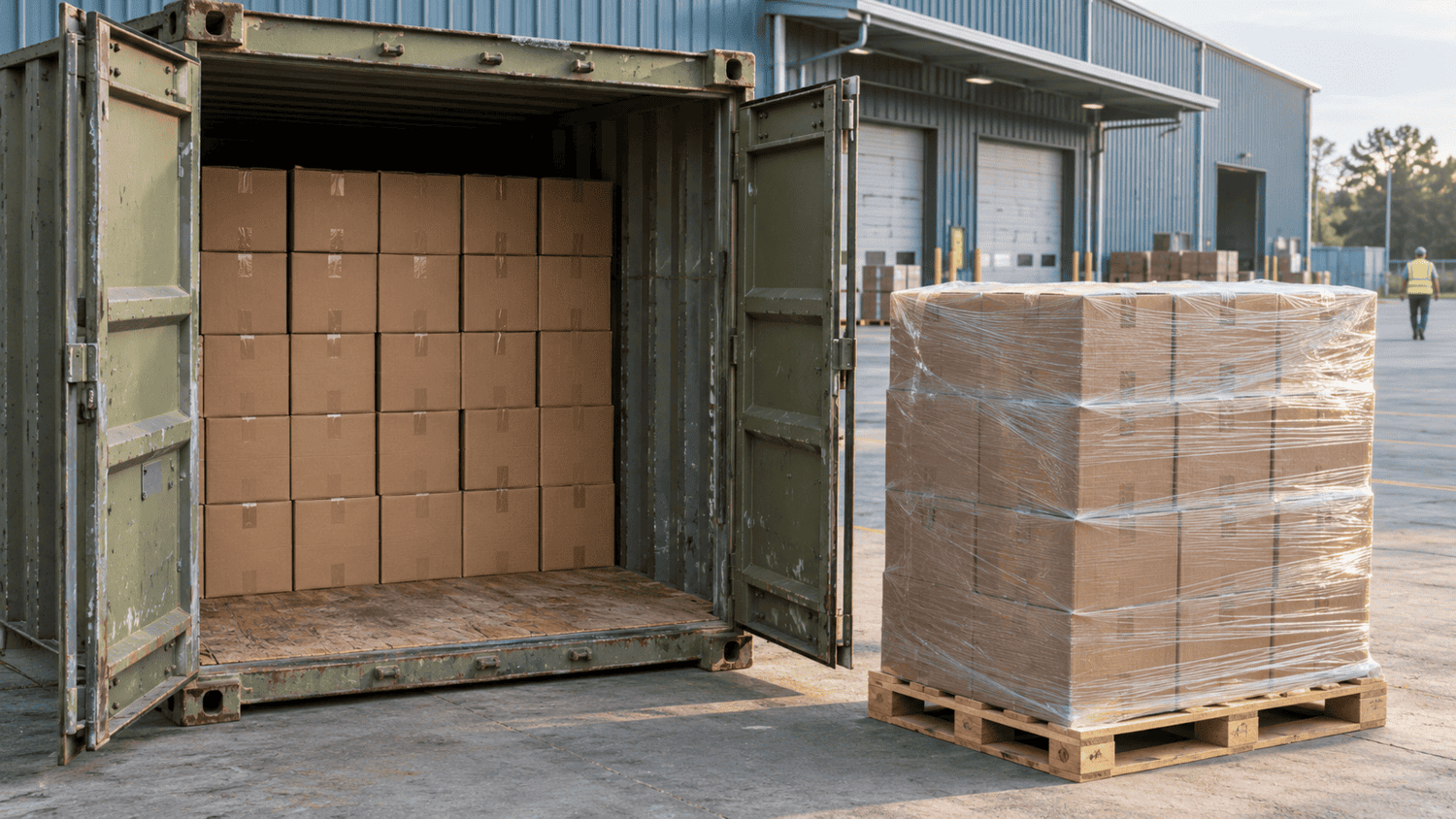
- Check the purchase order first. Military buyers can specify which goods may travel without pallets and how each carton must be labeled.
- Floor loading can fit more lightweight, stackable goods into a container. Pallets generally shorten unloading time because a forklift can move several cartons at once.
- Compare the cost through delivery. Savings on pallets at origin can disappear if the receiving warehouse must unload, sort and palletize hundreds of individual cases.
Floor-loaded freight travels directly on the floor of a trailer or shipping container, without pallets underneath. In U.S. military transportation, it can mean packaged meals carried on an aircraft’s cargo floor or merchandise a supplier is authorized to deliver without pallets.
When do military shipments travel without pallets?
In its account of a 2005 hurricane relief delivery, the U.S. Army describes a helicopter arriving in Livingston, Texas, with ready-to-eat meals on its cargo floor. Local residents passed the meals out by hand while a forklift unloaded pallets of water and meals from the same aircraft.
The Marine Corps Exchange vendor guide lists furniture, fixtures and appliances as eligible for floor loading on truckload and less-than-truckload deliveries. A boxed display cabinet may qualify. A vendor sending cartons of towels to the same buyer needs approval to ship them loose.
The Army & Air Force Exchange Service prefers pallets whenever possible. Under its supplier requirements, each floor-loaded carton needs its own shipping label. Cartons mixed on a pallet also need individual labels. A full pallet intended to reach the buyer intact can have one shipping label for the unit.
For a Defense Logistics Agency (DLA) order, start with the packing instructions in the awarded contract. If it cites RP001, check the palletization requirements that apply to that order. The DLA packaging and marking guide shows where to find that reference. If the award calls for pallets, get the buyer’s authorization before switching to loose cartons.
How do floor-loaded and palletized containers compare?
Picture an intermodal shipping container arriving with 600 cartons of bedding. A packing list that says “20 pallets, 30 cartons each” tells the dock to expect 20 units it can lift. If those same 600 cartons are floor loaded, the crew will handle individual cases.
| What matters | Floor-loaded cartons | Palletized freight |
| Space | Stackable cartons can use the height a pallet base would occupy. | Pallet dimensions affect how many cartons fit. |
| At the dock | Workers handle individual cases, often with a conveyor. | The dock can move a full pallet with a forklift or pallet jack. |
| Mixed items | Similar-looking cases may need to be sorted as they come out. | Pallets built by item or destination can go to separate receiving areas. |
| Costs to compare | Case unloading, sorting and any pallets built at destination. | Pallets and packing labor at origin, plus pallet handling at delivery. |
Extra space helps with bulky goods such as pillows. Dense goods such as boxed fasteners may reach the container’s weight limit with room to spare. Carton strength matters, too. If the bottom boxes crush under a third layer, that extra headroom has little value. The Cargo Transport Units Code covers packing and securing freight for road and sea transport.
When does floor loading save money?
Compare quotes for the same quantity delivered in the condition the buyer requires. If all the cartons fit in one container either way, a flat per-container freight rate stays the same. The calculation then turns on what you save at origin and what the receiver charges for the extra work.
Suppose the bedding supplier saves $300 on pallets and packing by floor loading those 600 cartons. That leaves $0.50 per carton for extra work at destination before the saving disappears. If the warehouse quotes an additional $0.60 per carton for unloading, that adds $360. On those figures, shipping on pallets costs $60 less, even before buying any pallets at destination.
What if the final receiver only accepts pallets?
If the order permits an intermediate stop, a transloading warehouse can unload loose cartons from an ocean container and build pallets for the final truck delivery. Tell the warehouse what is inside the cases. If the bedding order contains both twin and queen sheets, a count by size lets the crew check for shortages and build separate pallets if the buyer wants one item per pallet.
Send the receiver’s pallet dimensions, labeling instructions and appointment time with the quote request. A retail delivery checklist can help the shipping team match the labels and packing list to the finished pallets. Under an Army & Air Force Exchange Service policy for scan-based trading suppliers effective August 14, 2026, unreadable carton labels or contents that differ from the advance ship notice can trigger a charge.
Where can you palletize freight in North America?
At OLIMP Warehousing, we connect shippers, brokers and carriers with warehouse partners across the United States, Canada and Mexico. If your container arrives floor loaded and the buyer needs pallets, share the carton count, delivery postal code and receiver’s specifications. We can help you find a facility for unloading, palletizing or short-term storage before the final delivery.
Frequently Asked Questions (FAQ) – OLIMP Warehousing
Q: Is floor loading the same as a full container load?
A full container load (FCL) reserves a container for one shipper. Floor loading describes how the goods are packed inside. An FCL shipment can carry loose cartons or palletized freight.
Q: Does every floor-loaded carton have to be unloaded by hand?
Many facilities handle loose cases individually. Others use conveyors or powered unloading equipment. Give the warehouse the weight and dimensions of the heaviest carton so it can confirm how it will handle the shipment.
Q: Is a slip-sheet load the same as loose cartons?
A slip sheet is a thin platform under a group of cartons. A warehouse with slip-sheet handling equipment can move the group together. Specify slip sheets when booking so the dock knows what equipment the job needs.
Q: How many cartons fit in a 40-foot floor-loaded container?
The count depends on the carton dimensions, usable interior space, payload and stacking limits. Two orders with the same total weight can need different amounts of space. Check the specifications for the actual container before promising a carton count.
Q: Who pays to unload a floor-loaded delivery?
Check the purchase order and delivery terms. For example, on Army & Air Force Exchange Service orders with FOB destination terms, the supplier is responsible for unloading charges. Settle who will pay when you book the dock appointment.
Q: Do the same loading rules apply to air freight?
The air carrier confirms how freight can travel on the booked aircraft. For a commercial air leg, the FAA’s air cargo guidance distinguishes bulk-loaded cargo from freight carried in approved aircraft containers or on aircraft pallets.
You may be interested in
Pallet Rework Services: Restacking Freight & Preventing Shifted Loads
Pallet rework – sometimes called load rework or freight rework – is the corrective handling of a shifted or rejected shipment. When a load leans, collapses or arrives poorly stacked, a specialist will unload the freight, inspect the damage, rebuild the pallets and redistribute weight so it can be safely delivered. This guide explains why […]
Best On-Demand Warehousing Platform for Short-Term Overflow Storage
When warehouses reach capacity during peak seasons, promotions, or unexpected supply chain disruptions, businesses need fast access to additional storage. On-demand warehousing platforms solve this challenge by connecting companies with available warehouse space exactly when it’s needed. Among these solutions, OLIMP’s on-demand warehousing platform helps businesses quickly secure short-term overflow storage across thousands of warehouse […]
How Can Flexible Warehousing Improve Peak Season Logistics in 2026?
Flexible warehousing lets businesses add storage and handling capacity for changing inventory volumes without committing to a permanent expansion. During peak season, it can protect receiving, replenishment, and shipping operations, provided the extra facility has the people, equipment, and processes to handle the work. What Should Businesses Know About Peak Season in 2026? In its […]
Ready to streamline your warehousing needs?
Request a quote today and discover how OLIMP's tailored solutions can optimize your operations