Retail Delivery Readiness Checklist: Are Your Pallets and Labels Ready?
10/01/2026
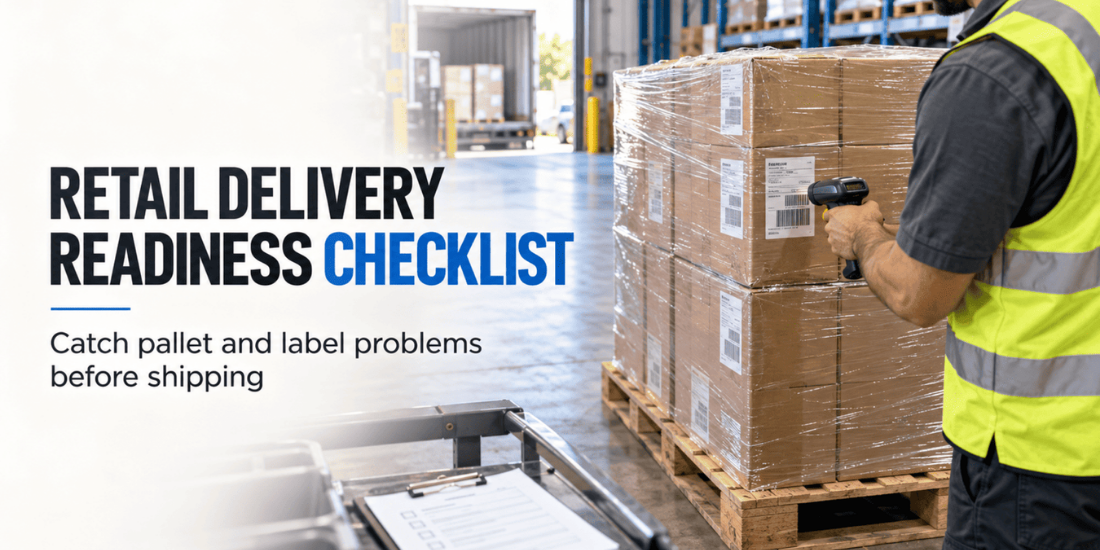
- Use the buyer’s current routing guide and instructions for the specific shipment.
- Check pallet condition, loaded dimensions, overhang, and load stability.
- Confirm carton and pallet labels are accurate, readable, and correctly positioned.
- Match shipment information to the freight actually leaving the warehouse.
- Hold affected freight until errors are corrected and checked again.
A retail delivery readiness checklist is a final inspection of the freight, labels, documents, and shipping arrangements against the receiving retailer’s requirements. Completing it before dispatch helps identify problems that could cause receiving delays, rework, or rejected freight.
What should you check before shipping to a retailer?
Our B2B fulfillment guide explains the broader order fulfillment process. The following checklist focuses on the final checks before a retail shipment leaves the warehouse.
1. Are you using the correct buyer routing instructions?
A retailer routing guide explains how suppliers must prepare and ship orders. Requirements can differ by destination, product category, shipping mode, and retail program, even within the same business.
Before preparing the load, confirm:
- The current purchase order (PO), including approved changes.
- The correct distribution center or store address and location code.
- Shipping dates, delivery windows, and appointment requirements.
- Carrier selection, routing authorization, and freight payment instructions.
- Whether freight must be palletized or floor-loaded.
- Rules for mixed products, multiple POs, and destination separation.
Save the applicable guide version and written exceptions with the shipment record. If instructions conflict, resolve the conflict with the buyer’s designated contact before release.
2. Are the pallets and cartons in acceptable condition?
Inspect every pallet base and the accessible cartons before final wrapping.
- Check the required pallet material, dimensions, grade, and entry configuration.
- Look for broken boards, loose components, exposed nails, or an unstable base.
- Inspect cartons for crushing, punctures, moisture, open seams, or leakage.
- Confirm packaging can support the planned stack without damaging the product.
- Separate questionable freight for inspection and a documented decision.
These are practical inspection checks; use the receiver’s specifications to determine acceptance. Replacing a damaged pallet should include checking the cartons it supported. Extra wrap does not repair a broken base.
3. Do pallet height, weight, and overhang meet the requirements?
There is no single pallet height limit that applies to every retail shipment. Follow the applicable buyer and carrier instructions, and clarify whether the stated height includes the pallet base. Retailer requirements can also restrict double-stacking and prohibit carton overhang.
Measure the finished load and check:
- Height: The highest point is within the confirmed limit.
- Footprint: Cartons remain inside the pallet edges.
- Weight: The load meets the specified limits and pallet capacity.
- Stability: Cartons are supported, with no leaning or loose layers.
- Protection: Wrap, straps, or corner protection secure the load without crushing cartons.
Overhang means cartons extend beyond the pallet’s edge. Correct it during pallet building, then measure and inspect the finished load again.
4. Do carton and pallet labels identify the correct freight?
Use the retailer’s approved label template for each required packaging level. A pallet label does not automatically replace labels required on individual cartons.
Depending on the buyer, check:
- Supplier identification and ship-to information.
- PO number and destination code.
- Product identifier, size, color, or quantity where required.
- Carton sequence and shipment references.
- The required barcode and its encoded data.
Retailer label specifications can define both mandatory fields and placement. Confirm them before printing a batch.
Where an SSCC is required, it identifies a particular logistics unit, such as a carton or pallet. GS1-128 is a barcode format that can encode that identifier. The identifier and the printed barcode serve different roles.
Avoid assigning the same SSCC to different logistics units. Identical labels placed on different sides of the same unit should identify that same unit.
5. Are the labels readable and scannable after packing?
Check labels in their final shipping position, including after wrapping where applicable.
- Inspect for smudges, missing print, wrinkles, or torn edges.
- Preserve the blank space around the barcode, known as its quiet zone.
- Check that tape, straps, or wrapping do not interfere with scanning.
- Follow the specified label position, orientation, and size.
- Scan labels and compare the decoded values with the shipment records.
GS1 identifies contrast, barcode dimensions, quiet zones, placement, and packaging interference as common barcode quality issues.
A successful scan alone does not establish full barcode quality compliance. Use barcode verification when required by the buyer or your quality process.
6. Does the shipment information match the physical load?
An advance ship notice (ASN) tells the buyer what is being shipped. In an X12 EDI workflow, the 856 Ship Notice/Manifest can communicate order details, shipment contents, packaging, and carrier information.
Cross-check the physical shipment against the ASN, bill of lading (BOL), required packing list, and routing record:
- PO numbers and destinations.
- Product quantities and carton counts.
- Pallet counts and shipment weight.
- Carton or pallet identifiers and their associated contents.
- Carrier details and required shipment references.
Use the final packed quantities. If cartons are removed, moved between pallets, or repacked, update the affected records.
Send the ASN through the required channel and within the buyer’s deadline. Check for errors or required acknowledgments. GS1 recommends that the receiving system process the ASN before the goods arrive.
7. Are delivery arrangements and release approval complete?
Before the truck leaves, confirm that the required routing authorization is in place and appointment arrangements meet the receiver’s process. Share the correct delivery address, references, and instructions with the carrier.
For an internal release record, capture:
- Inspector’s name and inspection time.
- Final pallet and carton counts.
- Photos of the finished load and representative labels.
- Corrections completed and any written exceptions.
- The person authorizing dispatch.
Make responsibility clear. A warehouse inspection should lead to an explicit release decision.
What should you do when a shipment fails the checklist?
Use a simple correction workflow:
- Hold the affected freight. Mark the problem and keep it out of the dispatch staging area.
- Correct the physical or data issue. Replace damaged pallets, restack cartons, reprint incorrect labels, or correct shipment records as needed.
- Reconcile the changes. Recheck dimensions, counts, identifiers, documents, and electronic shipment information.
- Inspect again and release. Record the correction and obtain the required approval before dispatch.
For example, suppose a pallet exceeds the receiver’s height limit. Moving its top layer to another pallet may fix the height, but it also changes the pallet count and the distribution of cartons. Review the pallet identifiers, update affected shipment records, and confirm the revised load still fits the transport booking.
If corrections will affect the shipping window or appointment, contact the appropriate buyer and carrier representatives while the freight is still at origin.
How can OLIMP help with retail delivery preparation?
OLIMP connects businesses with on-demand warehousing services across North America, including the United States and Canada. Its network supports storage, cross-docking, and pallet rework, including restacking, pallet replacement, and load re-securing; label checks and basic visual inspections can be requested. When arranging support, share the retailer’s instructions, freight photos, shipment details, and deadline so the required work and facility capabilities can be confirmed.
Frequently Asked Questions (FAQ) – OLIMP Warehousing
Q: What is a retail delivery readiness checklist?
It is a pre-dispatch check of buyer instructions, packaging, pallets, labels, shipment data, and delivery arrangements. Its purpose is to catch discrepancies while the shipper can still correct them.
Q: What is the maximum pallet height for retail deliveries?
Use the limit specified for the receiving location and shipment type. Confirm whether it includes the pallet base, and check carrier restrictions before building the load. Do not apply another customer’s limit automatically.
Q: Do cartons need labels if the pallet is already labeled?
They may. Carton and pallet labels identify different packaging levels, and the buyer determines which are required. Check the retailer’s labeling instructions before assuming one pallet label is sufficient.
Q: Can a retailer reject freight with incorrect labels?
Depending on its receiving policy, a retailer may delay processing, request corrections, apply compliance charges, or reject affected freight. The outcome depends on the error and the buyer’s requirements.
Q: Is a readable barcode enough for retail compliance?
No. The barcode must also contain the correct data, identify the correct unit, and meet applicable format, placement, and quality requirements. A readable label attached to the wrong carton is still incorrect.
Q: What should you do if pallet contents change after creating the ASN?
Update the affected shipment data and review the carton-to-pallet relationships and identifiers. Follow the buyer’s ASN correction procedure, then check the revised records against the final load.
Before your next retail shipment, keep the buyer’s current instructions beside this checklist and resolve every open issue before dispatch.
You may be interested in

What Causes Conflicts Between Warehousing and Transport, and How Can You Resolve Them?
Conflicts between warehousing and transport occur when warehouse operations and transportation teams pursue different schedules, cost targets, capacity priorities, or service goals. Although both functions are responsible for moving goods through the supply chain, optimizing one function in isolation can create delays or added costs for the other. A warehouse may prioritize efficient labor utilization, […]

Food Logistics: Definition, Supply Chain Process & Best Practices
What Is Food Logistics? Food logistics is the process of planning, storing, handling, transporting, and delivering food products safely and efficiently from producers to consumers. It includes warehousing, inventory management, food transportation logistics, cross-docking, order fulfillment, traceability, and returns management. Unlike general freight, food products logistics requires stricter controls for temperature, sanitation, packaging condition, shelf […]

AI in Logistics & Supply Chain: A Practical Guide for Shippers, 3PLs and Warehouse Operators
Most conversations about artificial intelligence (AI) in logistics still focus on futuristic concepts. Yet AI is no longer confined to research labs; it’s a practical tool delivering real business results today. Market analysts forecast that the global AI in supply‑chain market will grow from US$7.3 billion in 2024 to US$63.8 billion by 2030. DataM Intelligence reports that the AI in […]
Ready to streamline your warehousing needs?
Request a quote today and discover how OLIMP's tailored solutions can optimize your operations