Box Truck Sizes and Dimensions by Cargo Capacity
06/10/2025

Common box truck sizes include 10, 12, 15, 16, 17, 20, 22, 24 and 26 feet. Smaller trucks suit compact deliveries, while larger bodies provide more room for furniture, business inventory and palletized freight. Some fleets also offer longer options, including U-Haul’s 29-foot moving truck.
A box truck has an enclosed cargo body mounted on the same chassis as its cab. It is a type of straight truck. The advertised length usually describes the cargo body, while the vehicle’s overall length also includes the cab.
To select a truck, check its usable cargo dimensions, door opening, payload and loading equipment. This guide compares published U.S. rental examples. Specifications and licensing requirements differ by vehicle and country.
What are the common box truck sizes for commercial use?
For planning, compare three broad groups: 10–12 feet for compact loads, 15–20 feet for furniture and smaller delivery routes, and 22–26 feet for larger shipments. These are size groups, not official weight classes. A truck’s weight rating and configuration determine its class.
Common box truck sizes and dimensions chart
The figures below belong to specific provider examples. They are not universal specifications for every truck of that length. Capacity figures are the providers’ published volumes and maximum loads, not calculations from the listed dimensions.
Scroll horizontally to view all columns.
| Truck size and example | Interior: L × W × H | Cargo volume | Maximum load |
|---|---|---|---|
| 10 ft — U-Haul | 9 ft 11 in × 6 ft 3 in × 6 ft 1 in | 402 cu. ft. | 2,850 lb |
| 12 ft — Penske moving | 12 ft × 6 ft 6 in × 6 ft 1 in | 450 cu. ft. | 3,100 lb |
| 15 ft — U-Haul | 15 ft × 7 ft 8 in × 7 ft 2 in | 764 cu. ft. | 6,385 lb |
| 16 ft — Penske moving | 16 ft × 7 ft 7 in × 6 ft 6 in | 800 cu. ft. | 4,300 lb |
| 17 ft — U-Haul | 16 ft 9 in × 7 ft 8 in × 7 ft 2 in | 865 cu. ft. | 6,160 lb |
| 20 ft — U-Haul | 19 ft 6 in × 7 ft 8 in × 7 ft 2 in | 1,016 cu. ft. | 5,700 lb |
| 22 ft — Penske moving | 21 ft 11 in × 8 ft 1 in × 8 ft 1 in | 1,200 cu. ft. | 10,000 lb |
| 26 ft — Penske commercial | Up to 25 ft 11 in × 8 ft 1 in × 8 ft 7 in | Up to 1,700 cu. ft. | Up to 10,000 lb |
| 26 ft — U-Haul | 26 ft 2 in × 8 ft 2 in × 8 ft 3 in | 1,682 cu. ft. | 12,859 lb |
| 29 ft — U-Haul | 29 ft 2 in × 8 ft 1 in × 8 ft 9 in | 2,057 cu. ft. | 11,939 lb |
Published provider examples, not universal specifications. Confirm the assigned truck’s clear floor space, door opening and payload before booking.
Published dimensions can include space above the cab or other areas that do not form a full-height rectangular floor. For pallets and long items, confirm the uninterrupted floor length. Do not assume that multiplying the advertised length, width and height reproduces the supplier’s usable-volume figure.
How do box truck dimensions affect cargo capacity and payload?
Cargo volume measures available space in cubic feet. Payload measures the weight the vehicle can carry. A longer body can increase volume without increasing the cargo weight allowance.
For example, Penske lists 1,200 cubic feet for its 22-foot moving truck and 1,700 cubic feet for its 26-foot moving truck, with a 10,000-pound maximum load for both. The larger truck offers more room for bulky freight, but no additional published weight allowance in that comparison.
Check four separate limits:
Interior dimensions determine whether the shipment fits inside.
The rear-door opening determines whether each item can enter.
Payload and axle limits determine whether the weight is acceptable.
The liftgate, ramp and floor ratings determine how the freight can be loaded.
For a dispatch calculation, subtract the truck’s actual ready-to-load weight from its GVWR. That weight should include fuel, occupants, installed equipment and tools. The remaining difference is only a gross-weight allowance: axle, tire, body, equipment and other applicable limits may allow less cargo.
As a hypothetical example, a truck rated at 26,000 pounds and weighing 16,500 pounds before freight is loaded has 9,500 pounds of remaining gross-weight allowance. It cannot carry a 10,000-pound shipment simply because the body has enough space.
Which companies offer box truck sizes for delivery businesses?
Penske, Enterprise Truck Rental, Ryder and U-Haul offer different combinations of truck sizes and loading features. The best fit depends on the cargo, loading location, rental terms and vehicles available locally. Use the comparison below as a shortlist, then confirm the exact unit.
Box truck providers for delivery businesses
Scroll horizontally to view all columns.
| Provider | Published options | What to compare for your operation |
|---|---|---|
| Penske | 12- and 16-foot options; commercial 22-, 24- and 26-foot trucks | Smaller delivery loads versus larger freight; liftgate configuration and the selected CDL or non-CDL model |
| Enterprise | 15-foot parcel vans, 16-foot cabovers, 24- and 26-foot box trucks | Dock access, tuck-under liftgate, payload and local availability |
| Ryder | 16-foot box trucks and larger commercial straight-truck configurations | Business rental terms, ramp or liftgate equipment and vehicle-specific capacity |
| U-Haul | 10-, 15-, 17-, 20-, 26- and 29-foot moving trucks | Low-deck moving configuration, usable floor length and permission for the intended commercial use |
For deliveries to a warehouse, confirm deck height and dock compatibility. For a customer without a dock, confirm the liftgate’s platform size and rated capacity. A truck with enough cubic space can still be unsuitable if the loading equipment does not match the freight.
What box truck sizes suit small moving businesses?
A small moving business can begin by comparing 12–16-foot trucks for compact jobs and 20–26-foot trucks for larger inventories. Select the vehicle from a measured inventory, expected weight, access conditions and number of trips.
| Job profile | Sizes to assess first | Main selection check |
|---|---|---|
| A few furniture items or a compact move | 10–12 ft | Largest item’s dimensions and loading access |
| Small apartment or office inventory | 15–17 ft | Total volume, weight and loading time |
| Larger home or office inventory | 20–26 ft | Whether the complete load fits safely in one trip |
| Dense equipment or palletized goods | Select by verified payload | Weight distribution, floor strength and unloading equipment |
These are planning starting points, not fit guarantees. Rental companies use different room and bedroom estimates, and a home office or garage can add substantial cargo. Confirm each item’s dimensions and include protective packaging, moving equipment and crew in the load plan.
Where can you find detailed box truck specifications?
Start with the rental company’s official vehicle page and comparison chart, then request the specifications for the actual truck assigned to the job. For a purchased or custom-built vehicle, obtain both the chassis specification and the body builder’s drawing.
Ask for clear interior length, width and height; rear-door clearance; continuous floor length; exterior height and total vehicle length; GVWR and axle ratings; ready-to-load weight; and liftgate or ramp limits. Record whether any quoted dimensions describe the body exterior rather than its usable interior.
For a larger shipment, see our 26-foot box truck dimensions and capacity guide for more detail on loading and freight preparation.
How should you choose a box truck for palletized freight?
Measure the complete loaded pallets, including overhang and wrapping. Confirm their weights, whether they can be stacked, and the space needed to secure them. Then check the floor layout and door clearance against the assigned truck.
A simple floor-plan example shows why dimensions matter. Twelve 48-by-40-inch pallets arranged two across and six rows deep occupy 80 inches of width and 288 inches of length before loading clearance or restraints are allowed for. This is a geometric example, not a guaranteed capacity for every 26-foot truck.
Weight may be the tighter limit. Twelve loaded pallets weighing 900 pounds each total 10,800 pounds. That exceeds a truck’s 10,000-pound cargo allowance even if the floor plan fits. Splitting the load or choosing a suitably rated vehicle would be necessary.
Confirm the receiver’s dock or ground-level unloading arrangement before dispatch. If a shipment needs to be divided between smaller delivery vehicles, cross-docking can support the transfer. If unstable or oversized pallet loads need adjustment, ask about pallet rework.
Need to transfer or store freight before delivery?
OLIMP Warehousing Solutions connects businesses with warehousing and logistics providers for cross-docking, short- and long-term storage, pallet rework and freight redelivery. If your load needs to be transferred, held between appointments or prepared for another delivery attempt, share the location, pallet dimensions, total weight and required timing with our team.
Frequently Asked Questions (FAQ) – OLIMP Warehousing
Q: What size box truck requires a CDL?
Under U.S. federal standards, a Class B CDL generally applies to a single commercial vehicle with a GVWR or actual gross vehicle weight of 26,001 pounds or more. Cargo-box length does not set the threshold. Towing, certain hazardous-material loads and passenger transport can trigger other CDL requirements. Verify the vehicle and applicable state rules.
Q: Do you need a CDL for a 16-foot or 26-foot Penske truck?
Not necessarily. A 16-foot or 26-foot label is not enough to decide. Penske advertises non-CDL commercial trucks in its 22–26-foot range, and also has a separate CDL-required range. Check the selected vehicle’s rating and intended use, rather than assuming every truck of the same length has identical licensing requirements.
Q: How much can a box truck carry without a CDL?
There is no single cargo-weight allowance for all non-CDL trucks. Remaining capacity depends on the truck’s weight rating, actual operating weight, equipment and axle limits. The commonly discussed 26,000-pound figure concerns the complete vehicle, not the amount of freight it can carry.
Q: What is the largest box truck you can drive without a CDL?
There is no universal cargo-box length limit for non-CDL operation. For example, U-Haul’s 29-foot truck has a published maximum gross vehicle weight of 25,999 pounds. That shows why 26 feet should not be presented as the absolute maximum. Check the particular vehicle, use and jurisdiction.
Q: How much can a 26-foot box truck haul?
Published examples differ: Enterprise’s commercial 26-foot truck allows up to 10,000 pounds, while U-Haul’s 26-foot moving truck lists 12,859 pounds. Neither figure applies to every 26-foot truck. Use the assigned vehicle’s cargo allowance and loading limits.
Q: What is a 16-foot box truck, and how many cubic feet does it hold?
It is a truck with a nominal 16-foot cargo body. Penske’s published example offers up to 800 cubic feet and a 4,300-pound maximum load. Other 16-foot configurations differ, so obtain the provider’s actual specifications.
Q: How big is a 17-foot box truck?
U-Haul’s published 17-foot example measures 16 feet 9 inches long, 7 feet 8 inches wide and 7 feet 2 inches high inside. It lists 865 cubic feet of cargo space and a 6,160-pound maximum load. Confirm local availability.
Q: How wide and tall is a box truck?
The examples in this chart span interior widths of 6 feet 3 inches to 8 feet 2 inches, and interior heights of 6 feet 1 inch to 8 feet 9 inches. These are example ranges, not universal limits. Check exterior height for road clearance and rear-door dimensions for loading access.
Q: How many pallets fit in a 16-foot or 26-foot box truck?
Pallet capacity depends on clear floor dimensions, pallet orientation, overhang and weight. Six standard 48-by-40-inch pallets in a two-across layout occupy 80 by 144 inches. Eight occupy 80 by 192 inches, leaving no length allowance on a precisely 16-foot floor. Twelve occupy 80 by 288 inches. Add clearance and verify payload before choosing a layout.
Q: How much does an empty box truck weigh?
U-Haul lists an empty weight of 5,790 pounds for its 10-foot truck and 13,140 pounds for its 26-foot example. These figures are model-specific. For dispatch, verify the actual truck’s weight with its operating fuel, occupants and equipment before calculating how much freight it can carry.
Q: Is a 26-foot box truck a straight truck?
Yes. A box truck is a straight truck with an enclosed cargo body on the same chassis as the cab. Straight trucks can also have other body styles, so the terms are not interchangeable in every situation. Read our straight truck guide for the distinction.
Q: Are 30-foot or 40-foot box trucks standard rental sizes?
They are not standard cargo-body sizes in the rental lineups compared here. A listing may describe the vehicle’s total length, a separate trailer or a container. Ask the supplier exactly what the measurement refers to and request a body specification for any custom vehicle.
Q: How do box truck sizes affect rental costs?
Compare quotes for the same dates, route, mileage and equipment. Include fuel, coverage and any extra trips. The lowest daily rate may not produce the lowest total job cost if the truck requires additional journeys or lacks suitable loading equipment.
You may be interested in

Full Truckload (FTL) Shipping: Costs, Capacity & When to Use It
Full truckload shipping (FTL) is a freight transport mode where one shipper’s cargo occupies an entire truck trailer. In FTL service – also known as FTL trucking or full truckload freight transport – a carrier dedicates a 48′ or 53′ trailer exclusively to one shipment. Unlike less-than-truckload (LTL) shipping (where freight from multiple shippers shares […]
Straight Truck Guide: Dimensions, Weight Limits & Choosing the Right Truck
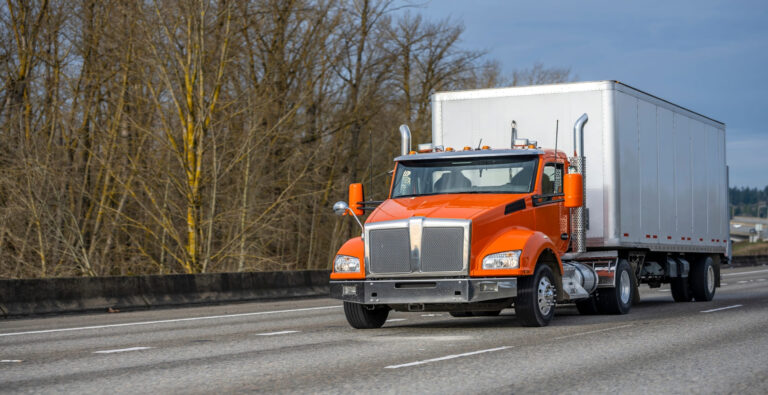
A straight truck is a vehicle with the cab and cargo body mounted on one rigid chassis. Common examples include box trucks, refrigerated trucks, and single-unit dump trucks. Unlike a tractor-trailer, its main cargo body stays attached to the truck rather than traveling on a separate semitrailer. Straight trucks are widely used for local deliveries, […]
What Is a 26-Foot Box Truck, and How Much Can It Carry?
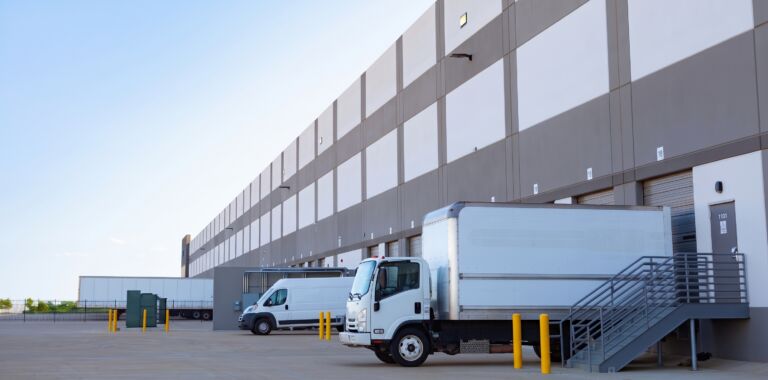
A 26 foot box truck is a straight truck with an enclosed cargo body approximately 26 feet long mounted on the same chassis as the cab. It is one of the largest common box-truck sizes used for palletized freight, commercial deliveries, warehouse transfers, furniture, appliances, and large moves. What Are the Dimensions of a 26 […]
Ready to streamline your warehousing needs?
Request a quote today and discover how OLIMP's tailored solutions can optimize your operations