Logistics Services: Meaning, Types & Benefits
Logistics services are the backbone of any supply chain, encompassing all the activities needed to move goods efficiently from their source (like a factory or supplier) to the end customer. In simple terms, a logistics service ensures that products get to the right place, at the right time, in the right condition, and at the right cost, which supply chain experts often call the “seven R’s” of logistics. This includes managing inbound shipments of raw materials, warehousing and inventory control, fulfilling orders, and outbound transportation for final delivery. In fact, the scale of modern logistics is enormous, over 160 billion parcels were delivered worldwide in 2022 alone, highlighting how crucial efficient logistics services are for today’s economy.
Businesses across nearly every industry – from e-commerce and retail to manufacturing and pharmaceuticals – rely on logistics services to handle these supply chain operations. For example, a logistics partner might arrange ocean freight shipping from an overseas factory to a U.S. port, handle customs clearance, transport the goods to a warehouse, then manage order fulfillment (picking & packing) and book local carriers for last-mile delivery to customers. By outsourcing such complex tasks to expert logistics service providers (often called 3PLs or 4PLs), companies can streamline operations, reduce costs, and focus on their core business.
What logistics services include
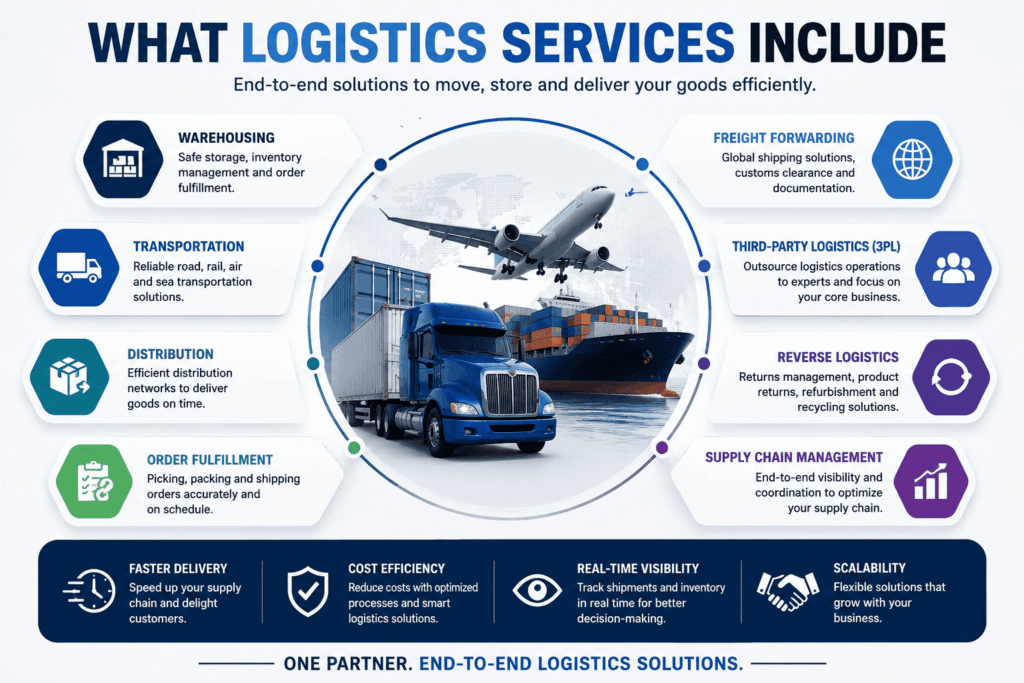
Multiple types of logistics services come into play to move products through the supply chain. The major categories of services include:
- Transportation & Freight: Coordinating the movement of goods by truck, rail, ship, or air. Logistics providers handle carrier bookings and paperwork (often via freight forwarders or 3PL partners) so that products move smoothly from factories into the distribution network. This covers everything from local trucking to international shipping, essentially the transport and logistics services that physically relocate goods.
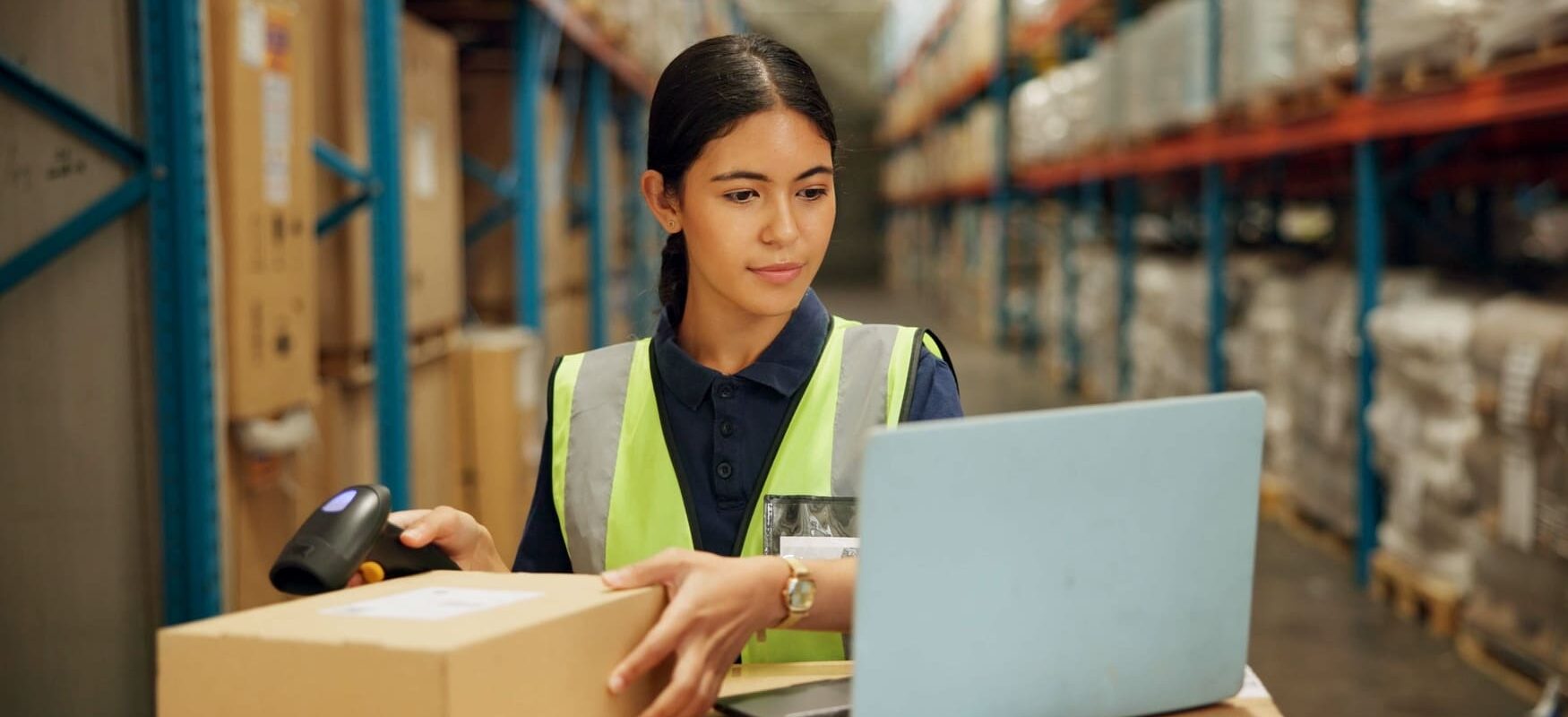
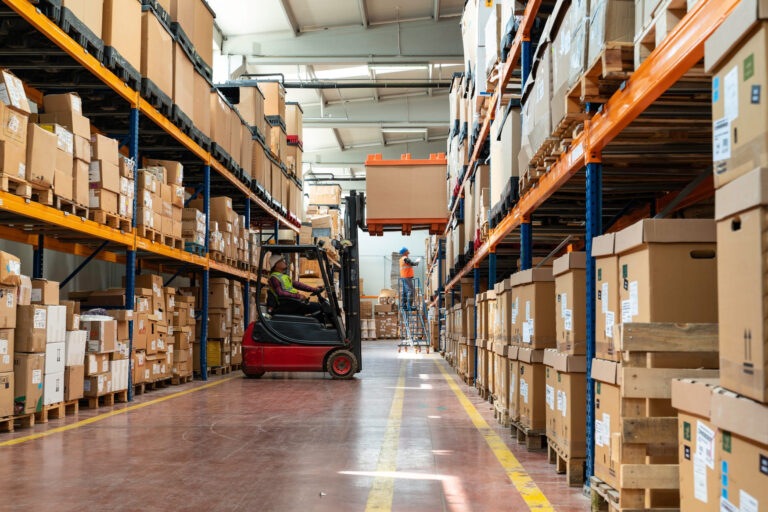
- Warehousing & Storage: Receiving and storing inventory until it’s needed. Warehousing services include loading/unloading inbound freight, organizing products in storage, and performing cross-docking when needed. A logistics warehouse might also pick and pack orders, then load goods back onto trucks for shipment to retailers or customers.
- Order Fulfillment: Picking, packing, and shipping customer orders accurately and quickly. Fulfillment centers (which can be run by third-party logistics providers) handle order processing and integrate with carriers like UPS, FedEx or DHL for last-mile delivery. This logistics delivery service ensures each order gets to the right customer on time, whether it’s B2C e-commerce shipping or B2B retail restocking.
- Inventory Management: Tracking stock levels and planning restocking. Modern logistics providers offer software that gives real-time inventory visibility, forecasts demand, and helps prevent stockouts. These tools ensure the right amount of inventory is in each warehouse.
- Value-Added Services: This includes activities like custom packaging, kitting/assembly, quality inspections, labelling, and returns handling (reverse logistics). For international logistics, it often involves customs brokerage and clearance paperwork as well. Providers may bundle these warehousing and logistics services to offer a one-stop solution.
These components work together so products flow smoothly through the supply chain. Whether you sell online or in stores, a comprehensive logistics service handles every step, from inbound freight to final delivery, so your team can focus on growing the business.
Benefits of Logistics Services
- Cost Savings: Logistics service providers cut costs by consolidating shipments, optimizing routes, and negotiating better freight contracts. They also reduce storage expenses through smarter inventory management, helping companies ship more cost-effectively.
- Improved Efficiency: Professional logistics services use advanced route planning, warehouse automation, and coordinated freight management to reduce delays and errors. This results in a faster, leaner supply chain.
- Enhanced Customer Service: Fast and accurate logistics delivery services improve customer satisfaction. By placing inventory closer to customers and using reliable carriers, companies can meet same-day or 1–2 day shipping expectations.
- Scalability and Flexibility: Logistics providers scale operations up or down as demand changes. They offer on-demand warehousing, seasonal support, and nationwide transport and logistics services without heavy upfront investments.
- Focus on Core Business: Outsourcing logistics allows companies to focus on growth, marketing, and customers while experts manage warehousing, shipping, and compliance. This creates efficiency and frees resources.
Strong logistics services mean lower costs, better efficiency, and happier customers, a competitive edge for any business. Local distribution centers also shorten delivery times from a week to just 1–2 days.

Real‑world examples and use cases
- E‑commerce and online retailers – Many online brands outsource fulfilment, warehousing and shipping to 3PLs. Third‑party logistics providers offer order fulfilment, inventory management, returns processing and customs assistance, enabling e‑commerce businesses to scale globally without large capital investments.
- Healthcare and pharmaceuticals – Hospitals and pharmaceutical companies require temperature‑controlled logistics and specialized courier services to transport sensitive items such as blood samples or medications quickly and safely. Providers with refrigerated warehousing and cold‑chain monitoring ensure compliance with health regulations.
- Large manufacturers – Big companies may lease dedicated fleets or outsource to freight forwarders to handle international shipments. Freight forwarders coordinate multimodal transport, handle customs paperwork and consolidate cargo to achieve cost efficiencies.
- Returns and recycling programmes – Reverse logistics services manage the return, recycling or disposal of products. For example, electronics manufacturers offer take‑back schemes where logistics providers collect used devices for refurbishment or recycling.
How to choose the right logistics service provider
When searching for logistics services (especially locally), consider factors like service coverage, technology, and flexibility:
- Network and Coverage: Strong logistics service providers offer broad warehouse and transportation networks. A wide reach ensures nationwide distribution and faster fulfillment.
- Speed and Responsiveness: Look for providers that can launch operations quickly, scale up during peak seasons, and handle urgent requests. On-demand services with flexible contracts give businesses agility.
- Technology Integration: A good logistics partner offers visibility (online dashboards, tracking, inventory apps). This transparency helps you monitor shipments and stock in real time. Ask about their warehouse management system (WMS) and transportation management system (TMS) tools.
- Value-Added Services: Beyond basic shipping and storage, consider what additional services the logistics provider can bundle for you. Do you need climate-controlled storage, product assembly/kitting, custom packaging, freight consolidation, or handling of hazardous materials? Ensure the company offers all the warehousing and logistics services required for your products. The right provider will bundle these into one solution so you don’t have to juggle multiple vendors. For example, if you need returns processing or specialized labeling, it’s ideal if the logistics partner can do that in-house as part of their service package.
- Pricing and Scalability: Transparent pricing is key. Providers should clearly outline storage, handling, and shipping costs. Ensure they can scale with business growth and adapt to new markets.
- Customer Support and Experience: Choose a logistics partner with proven industry experience, good testimonials, and dedicated account management. Trust and reliability are essential for long-term success.
Logistics Services Near Me and Local Warehousing
Many businesses today search for “logistics services near me” – and for good reason. Using local or regional warehouses as distribution hubs can dramatically speed up delivery times. Having inventory stored closer to your end customers essentially gives you a shortcut for fast shipping and more reliable service. Instead of sending every order across the country from one central warehouse (which takes longer and costs more), a company can fulfill orders from a nearby facility and cut out days of transit. Proximity = speed: strategically placed warehouses have been shown to reduce delivery times from 5–7 days down to 1–2 days in some cases. In other words, local warehousing translates directly into faster deliveries, lower shipping costs, and fewer transit risks for damage or delay.
Storing products in regional hubs helps companies cut delivery times from several days to just 1–2. For example, an e-commerce retailer with fulfillment centers on both coasts can reach most customers within two days via ground shipping. The same applies to retail stores – shelves are restocked faster when inventory is closer.
Working with a logistics partner that has a wide warehouse network makes this strategy simple. OLIMP’s on-demand warehousing connects businesses to 5,000+ warehouses across North America, allowing even small companies to place inventory in key regions without heavy investment.
By decentralizing stock through on-demand logistics services, businesses can achieve faster, more reliable deliveries and compete with large-scale providers.
Logistics services are the foundation of every successful supply chain – from warehousing and inventory management to freight and last-mile delivery. Choosing the right logistics service provider makes the difference between slow, costly operations and a streamlined supply chain that drives growth.
At OLIMP Warehousing Solutions, we connect businesses with 5,000+ warehouses across North America, offering flexible and cost-effective logistics solutions tailored to your needs. Whether you need short-term storage, retail logistics services, or end-to-end supply chain support, our platform gives you the coverage and scalability to compete at every level.
With transparent pricing, responsive support, and advanced technology, OLIMP makes logistics simple, reliable, and efficient. If you’re looking for a trusted partner to handle your warehousing and logistics services, request a free quote today and discover how OLIMP can optimize your supply chain.
Frequently Asked Questions (FAQ) – OLIMP Warehousing
Q: What is the meaning of logistics services?
Logistics services cover every step of a supply chain, from inbound transport of materials, through warehousing and order processing, to outbound shipping and delivery to customers. In essence, logistics services ensure products are moved and stored so they arrive at the right place, at the right time, as efficiently as possible.
Q: What do logistics providers do?
A logistics provider (or LSP) handles parts or all of the supply chain. This can include managing warehouses in multiple regions, coordinating freight (truck, rail, ship, air), running fulfillment centers, and even offering additional services like customs clearance and returns processing. For example, a 4PL (fourth-party logistics) firm may orchestrate multiple 3PLs to give a turnkey solution across global channels.
Q: Why are logistics services important?
Effective logistics services maximize efficiency and cost-effectiveness. They allow businesses to scale and meet customer expectations for fast, reliable delivery. Companies that optimize logistics often see lower shipping costs, fewer stockouts or overstocks, and higher customer satisfaction. In today’s market, strong logistics are a competitive edge, a late delivery can cost customer loyalty, while a smooth supply chain drives growth.
Q: What types of logistics services are available, and what does each include?
Logistics services typically include transportation, warehousing, distribution, inventory management, fulfillment, and value-added services. Transportation covers freight movement by truck, rail, ocean, or air. Warehousing involves storage and handling, while distribution and fulfillment focus on order processing, packing, and last-mile delivery. Some providers also offer services like cross-docking, transloading, and returns management.
Q: How do I choose a logistics provider for my eCommerce business?
When choosing a logistics provider for eCommerce, look for scalability, warehouse location coverage, technology integration, and fulfillment speed. The right provider should support fast order processing, real-time inventory visibility, easy integrations with eCommerce platforms, and flexible storage options to handle seasonal demand.
Q: What are the main cost components of logistics services, and how can they be reduced?
Key logistics cost components include transportation, warehousing, labor, inventory holding, and handling fees. Costs can be reduced by consolidating shipments, using strategically located warehouses, optimizing inventory levels, and selecting flexible logistics services such as on-demand warehousing or transloading instead of long-term fixed contracts.
Q: What are the benefits of outsourcing logistics versus handling it in-house?
Outsourcing logistics allows companies to reduce overhead costs, gain access to specialized expertise, and scale operations faster. Compared to in-house logistics, third-party logistics providers offer established networks, advanced technology, and flexible capacity without the need for capital investment in warehouses, labor, or equipment.
Q: What key performance indicators (KPIs) should logistics providers track?
Common logistics KPIs include on-time delivery rate, order accuracy, inventory turnover, order fulfillment time, and cost per shipment. Tracking these metrics helps logistics providers measure efficiency, identify bottlenecks, and improve overall delivery performance and customer satisfaction.
Q: How are logistics services different from supply chain management?
Supply chain management (SCM) is an overarching discipline that coordinates all the activities involved in sourcing, production and delivery across multiple organisations. Logistics is a subset of SCM that focuses specifically on the movement, storage and flow of goods and information. While SCM aims to create strategic competitive advantage through integration, logistics primarily ensures that goods reach the right place at the right time, meeting customer needs in the most efficient manner.
Q: What are the main types of logistics?
The three main categories are inbound logistics (bringing materials and inputs into a business), outbound logistics (shipping products to customers) and reverse logistics (handling returns, recycling and disposal). Within these categories, specialised services include warehousing, inventory management, transportation, freight forwarding, 3PL/4PL services, temperature‑controlled logistics and just‑in‑time delivery.
Q: What is integrated logistics and why is it important?
Integrated logistics is a unified approach to managing the flow of goods, services and information from suppliers to customers. Instead of handling transportation, warehousing and inventory management separately, integrated logistics coordinates these activities to optimise the entire supply chain. This holistic approach leverages technologies like intelligent ERP systems and Internet of Things (IoT) sensors to deliver real‑time visibility and cross‑functional collaboration, reducing costs and enhancing customer satisfaction.
You may be interested in
4PL Logistics: The Ultimate Guide to Fourth-Party Logistics
Fourth-party logistics (4PL) refers to hiring a single partner to integrate and manage an entire supply chain. In practice, a 4PL provider acts as a strategic supply chain integrator, overseeing transportation, warehousing, inventory, and fulfillment on behalf of a company. In other words, businesses outsource their full logistics management to one expert who coordinates multiple […]
3PL vs In-House Logistics: When to Use a Warehouse or 3PL? (Essential Guide)
Running order fulfillment from your garage or back room can save money at first, but growth brings new challenges. In-house logistics means you handle everything yourself – storing inventory, packing boxes, managing shipping, and processing returns. This gives you full control and customization, but it becomes complex as orders grow. A 3PL (third-party logistics) provider […]
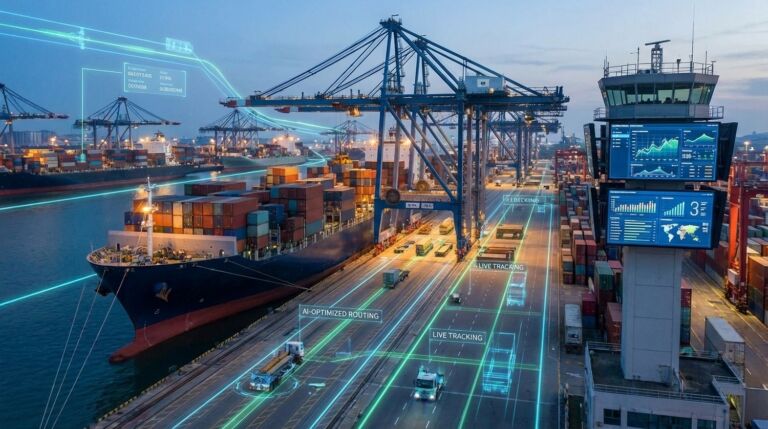
AI in Logistics & Supply Chain: A Practical Guide for Shippers, 3PLs and Warehouse Operators
Most conversations about artificial intelligence (AI) in logistics still focus on futuristic concepts. Yet AI is no longer confined to research labs; it’s a practical tool delivering real business results today. Market analysts forecast that the global AI in supply‑chain market will grow from US$7.3 billion in 2024 to US$63.8 billion by 2030. DataM Intelligence reports that the AI in […]
Ready to streamline your warehousing needs?
Request a quote today and discover how OLIMP's tailored solutions can optimize your operations