The Role of Temporary Warehousing Solutions During Peak Periods

Seasonal surges can overwhelm even well‑run supply chains. During the holidays, back‑to‑school rush, harvest season or big promotions, companies suddenly need more pallet positions than their primary facilities can offer. Temporary warehousing – also called short‑term or on‑demand storage – provides flexible overflow space that helps retailers, shippers and manufacturers meet peak‑period demand without committing to long‑term leases. These short‑term facilities allow businesses to scale up quickly, maintain inventory control and keep goods moving during high‑volume periods.
Key Takeaways
- Temporary warehousing refers to renting extra space for days or weeks to handle seasonal peaks or supply‑chain disruptions. It differs from long‑term storage because there is no long lease and you only pay for what you use.
- Why peak periods matter: predictable spikes in demand (holidays, harvests, promotions) and unpredictable disruptions (import congestion, weather delays) create overflow inventory that permanent facilities cannot handle.
- Benefits: temporary warehousing is cost‑efficient, scalable and speeds up order fulfillment. It reduces inventory bottlenecks and provides emergency storage for unexpected volume.
- Industries served: retailers/e‑commerce, food & beverage, manufacturing, automotive, electronics, consumer packaged goods and apparel all leverage short‑term warehousing during peak seasons.
- Choosing a provider: look for strategic location, flexible terms, affordable pricing and value‑added services like cross‑docking and handling equipment.
- Example provider: OLIMP offers access to more than 5,000 warehouses across North America with pay‑as‑you‑go pricing, no minimum commitments and fast matching for overflow or seasonal needs.
What Is Temporary Warehousing?
Temporary warehousing is the practice of renting storage space for short periods, typically a few days to a few months, to handle overflow inventory, seasonal demand or project‑based needs. Short‑term warehouse storage as a flexible solution that rents warehouse space for brief periods, typically less than 90 days, without long‑term contracts. Customers can lease space daily, weekly or month‑to‑month and pay only for the pallets or square footage used.
Difference from Traditional Long‑Term Storage
Long‑term warehousing involves multi‑year leases, fixed monthly rent and limited ability to scale capacity quickly. Short‑term or temporary warehousing offers week‑to‑week or month‑to‑month contracts with pay‑per‑use pricing. The table below summarizes the key differences:
| Feature | Temporary Warehousing | Traditional Long‑Term Storage |
| Contract length | Days, weeks or months (often < 3 months) | Months to years |
| Flexibility | High — easily scale up or down | Low — fixed space, difficult to adjust |
| Cost structure | Pay for what you use (per pallet or square foot) | Fixed rent with higher overhead |
| Typical uses | Seasonal peaks, overflow, short projects | Stable inventory, permanent distribution |
| Overhead | Low — shared resources, no capital investment | High — includes facility maintenance and staffing |
Examples of Temporary Warehousing
Temporary solutions range from shared warehouse space and pallet‑level storage to pop‑up warehouses and modular structures. Shared facilities allow multiple businesses to occupy a larger building and pay only for the space they use. Dedicated areas within larger warehouses provide more privacy while still maintaining flexible terms. Modular structures or portable storage containers can be installed on‑ sites for projects requiring extra space. These options make temporary warehousing a versatile tool for handling overflow stock, special projects or buffer storage during supply‑chain disruptions.
Why Peak Periods Create Demand for Temporary Warehousing Solutions
1. Seasonal Inventory Surges
Seasonal demand patterns drive the need for extra storage. Retailers experience major spikes around Black Friday, Cyber Monday and the year‑end holidays; agricultural producers see peaks during harvest; and consumer‑packaged‑goods brands may ramp up for summer promotions. Seasonal storage allows companies to adjust their warehousing capacity based on immediate needs, ensuring they aren’t paying for unused space. By adding temporary warehouses, businesses can maintain inventory control and avoid stockouts when consumer demand surges.
2. Imported Goods Arriving All at Once
Ports and rail terminals often experience congestion when multiple vessels or trains arrive simultaneously. Delays at ports or customs can force importers to unload containers quickly and store goods nearby until they can be delivered. Pop‑up warehousing as a solution for supply‑chain uncertainties that helps companies manage excess inventory and seasonal demand without permanent facilities. By renting temporary warehouse space near ports or distribution hubs, importers can de‑containerize shipments promptly and avoid demurrage fees.
3. Production Increases for Manufacturers
Manufacturers ramp up production ahead of seasonal peaks or product launches. Finished goods need safe storage before distribution, and production often temporarily outpaces outbound shipments. Rather than expanding permanent facilities, manufacturers can use short‑term warehouses to hold buffer stock, preserving production flow and smoothing out inventory fluctuations.
4. Supply‑Chain Disruptions
Unexpected events such as extreme weather, labor strikes, transportation breakdowns or global supply‑chain shocks can interrupt normal operations. Pop‑up warehousing offers agility by providing “temporary warehouse space that adjusts to real‑time needs” and helps companies expand or downsize quickly during uncertain periods. Temporary facilities serve as an emergency buffer to store goods until routes reopen or demand stabilizes, mitigating the risk of bottlenecks and lost sales.
Key Benefits of Using Temporary Warehousing During Peak Season
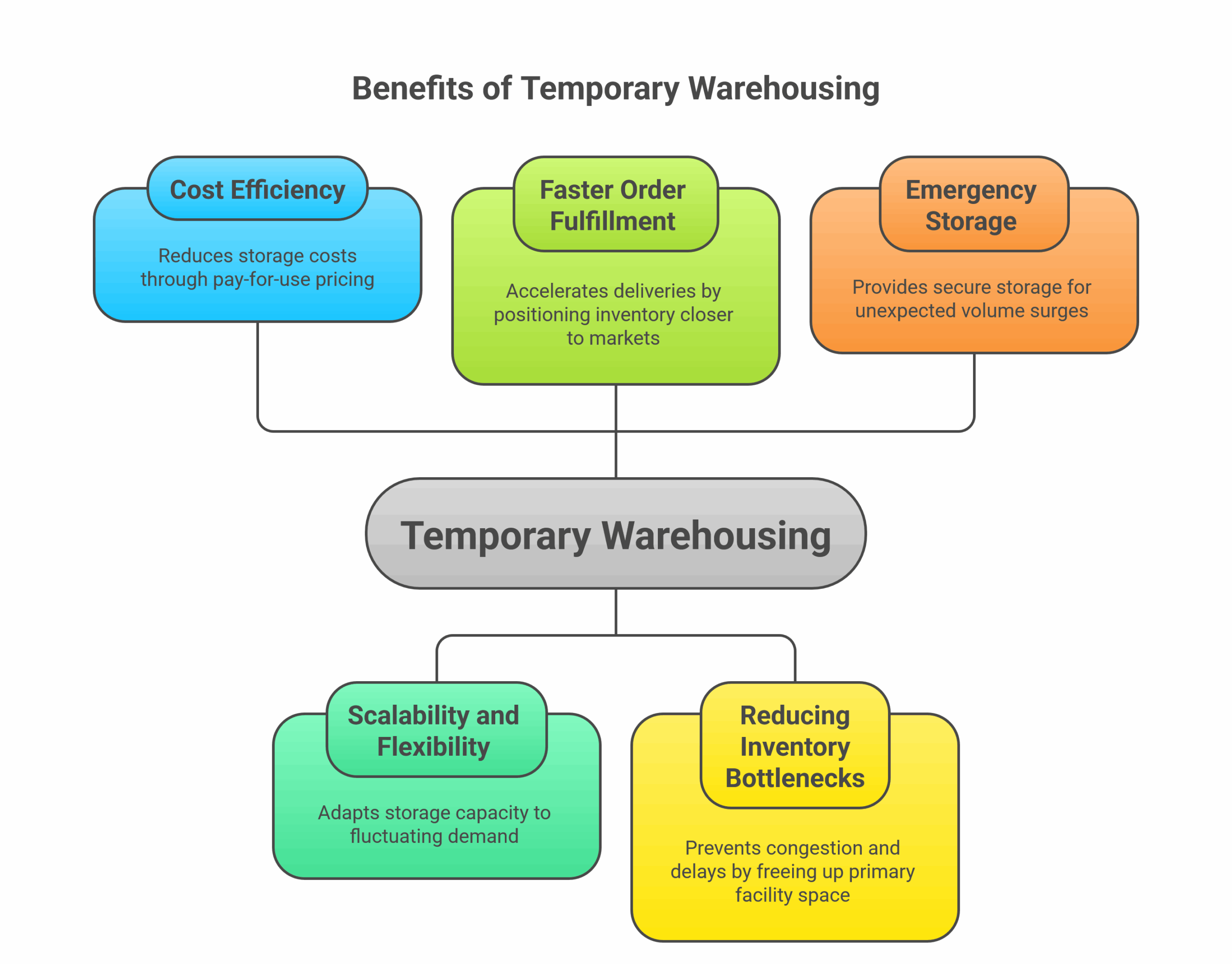
1. Cost Efficiency (Including Cheap Temporary Warehousing Options)
Short‑term storage is often cheaper than committing to long‑term leases or building additional warehouses. Pay‑for‑what‑you‑use pricing allows businesses to pay only for the space they occupy, eliminating the cost of unused square footage during slow periods. Short‑term storage can be more cost‑effective than long‑term leases because it avoids underutilized space and frees up capital for other investments. Temporary warehouses require lower upfront investment than brick‑and‑mortar facilities and can be decommissioned when no longer needed.
Cheap temporary warehousing doesn’t mean sacrificing quality. Shared warehousing allows multiple companies to split facility costs, making overflow storage affordable. Some providers even allow storing a single pallet for a single day, which is ideal for businesses with minimal overflow.
2. Scalability and Flexibility
Peak seasons require rapid scaling. Flexible warehousing provides a dynamic, on‑demand solution that enables businesses to adjust storage capacity as demand fluctuates. Temporary warehouses can be set up quickly and expanded with extra bays during busy periods, then removed or relocated when demand subsides. This agility avoids paying for unused space during slow seasons and ensures companies can respond promptly to market changes.
3. Faster Order Fulfillment
Forward positioning inventory in temporary warehouses near key markets reduces transit time and accelerates deliveries. Flexible warehousing enables businesses to forward deploy inventory closer to demand hotspots, significantly reducing transit times and transportation costs. Strategically locating short‑term storage near customer bases improves delivery speed and allows companies to experiment with different locations to meet customer expectations. Faster fulfillment enhances customer satisfaction and helps companies meet service‑level agreements during peak periods.
4. Reducing Inventory Bottlenecks
Temporary warehousing helps free space in the primary facility, preventing congestion. Seasonal storage improves inventory control and prevents shipping delays. Short‑term storage provides a buffer to maintain the right inventory levels and mitigate the risks of overstocking or understocking. By transferring excess goods to temporary locations, businesses can ensure that core operations remain efficient and that receiving, picking and shipping processes are not hindered by overflow stock.
5. Emergency Storage for Unexpected Volume
Supply chains are increasingly prone to disruptions. Short‑term storage provides a secure environment to hold goods when inbound shipments arrive faster than expected or when outbound transport is delayed. Pop‑up warehousing enables companies to adapt quickly to fluctuating demand and supply‑chain disruptions, allowing them to scale operations up or down without long‑term commitments. This emergency capacity prevents costly stockouts, demurrage fees and customer dissatisfaction during unforeseen surges.
Industries That Rely on Temporary Warehousing During Peak Periods
Temporary warehousing is not limited to a single sector. Many industries rely on short‑term storage to manage seasonal peaks:
- Retail & e‑commerce: Holiday shopping, flash sales and product launches create sudden increases in inventory and order volumes.
- Food & beverage: Harvest seasons and promotional campaigns require additional space, often with temperature‑controlled conditions.
- Manufacturing: Production ramps up ahead of product launches and seasonal demand, requiring buffer storage for finished goods.
- Automotive: Parts suppliers and aftermarket companies need storage for spikes in demand or when shipments arrive in batches.
- Electronics: Product release cycles and high‑demand periods (e.g., back‑to‑school or holiday tech sales) benefit from short‑term space to stage inventory.
- Consumer packaged goods (CPG) & apparel: Seasonal trends and marketing campaigns drive sudden surges that overflow standard facilities.
What to Look for in a Temporary Warehousing Provider
Selecting the right partner ensures your peak‑season strategy succeeds. When evaluating providers, consider the following:
- Location near customers or ports: Quality Warehouse advises choosing warehouses close to your target market to minimize transportation expenses and improve delivery times.
- Short‑term availability: Confirm that the provider offers daily, weekly or month‑to‑month contracts with no long‑term commitments.
- Affordable pricing: Pay‑as‑you‑go models help control costs. Ask about pallet‑level pricing and whether there are minimum storage requirements.
- Handling services: Look for warehouses that provide dock access, forklifts, pallet rework, pick/pack and cross‑docking services. These additional services streamline your supply chain and reduce handling time.
- Equipment and special requirements: Ensure facilities can accommodate temperature‑controlled storage, hazardous materials, food‑grade requirements or other specialized needs.
How OLIMP Connects Companies With Temporary Warehousing Solutions
OLIMP is a technology‑driven platform that matches shippers, freight brokers, carriers and retailers with vetted warehouses across North America. Unlike traditional 3PLs, OLIMP acts as a marketplace for on‑demand storage. Key features include:
- Massive network: OLIMP provides access to more than 5,000 warehouses across North America. This coverage ensures space is available wherever you need it.
- No long‑term contracts or minimums: Businesses can store just one pallet for as little as one day. The pay‑as‑you‑go model means you pay only for the space you use.
- Fast matching: OLIMP’s platform allows users to submit a request for quotation and receive quotes within 30 minutes. Once approved, the warehouse address and delivery details are shared for immediate booking.
- Peak‑season planning: OLIMP enables companies to pre‑book temporary warehouse space near key distribution points to handle holiday rushes or seasonal stock spikes. This ensures extra capacity is ready when needed, preventing last‑minute scrambling and lost sales.
- Overflow and buffer warehousing: When primary facilities reach capacity, OLIMP can secure overflow storage within hours. This helps prevent bottlenecks and keeps freight moving.
- Industry support: OLIMP serves freight brokers, carriers, shippers, retailers and manufacturers, providing specialized warehousing options such as temperature‑controlled, food‑grade, hazardous materials and foreign‑trade‑zone facilities.
By leveraging OLIMP’s network, businesses can access temporary warehousing solutions quickly and affordably, maintaining agility during peak seasons without investing in permanent infrastructure.
Final Thoughts
Temporary warehousing has evolved from a short‑term fix to a strategic necessity. Predictable seasonal peaks and unpredictable supply‑chain disruptions make it risky to rely solely on permanent facilities. By adopting on‑demand storage, companies gain cost control, operational flexibility and the ability to deliver orders quickly. When selecting a provider, prioritize location, flexible terms, transparent pricing and value‑added services. Platforms like OLIMP connect you with a nationwide network of vetted warehouses, making it easier than ever to secure overflow space, forward‑position inventory and stay agile.
Frequently Asked Questions (FAQ) – OLIMP Warehousing
Q: What is temporary warehousing?
Temporary warehousing refers to renting additional storage space for a short period — typically days or months — to handle overflow inventory, seasonal peaks or special projects. It differs from traditional warehousing because it involves pay‑as‑you‑use pricing and no long‑term lease commitments.
Q: How does temporary warehousing help during holidays?
During the holidays, retailers and e‑commerce companies experience sharp increases in order volume. Temporary warehouses provide extra pallet positions near demand hotspots, ensuring products are available for fast delivery and preventing stockouts. They also free up space in the main facility so picking and packing operations run smoothly.
Q: Is temporary warehousing expensive?
Short‑term storage is often more cost‑effective than long‑term leases because you pay only for the space and time you need. Shared warehouses and marketplace platforms like OLIMP allow businesses to store as little as one pallet for a single day.
Q: Which industries benefit from temporary warehousing?
Many sectors use short‑term storage, including retail and e‑commerce, food & beverage, manufacturing, automotive, electronics, consumer packaged goods and apparel. Any industry experiencing seasonal demand spikes or supply‑chain uncertainty can benefit from on‑demand space.
Q: What should I look for in a temporary warehousing provider?
Choose a provider with locations near your customers or ports, flexible week‑to‑week terms, transparent pricing and necessary equipment like forklifts or climate control. Providers should offer additional services such as cross‑docking, pick/pack and pallet rework to streamline your operations.
Q: How does OLIMP’s on‑demand warehousing work?
OLIMP connects businesses with a network of over 5,000 warehouses. Users submit a request for quotation and receive a fast, transparent quote with no minimum commitments. Once rates are approved, the platform matches you with available space and coordinates delivery details. You can pre‑book space for seasonal peaks or secure overflow storage within hours.
You may be interested in

Need a Warehouse Now? Your Guide to Securing Flexible Storage with OLIMP
In today’s fast‑moving economy, businesses can’t afford to wait weeks or months for warehouse space. E‑commerce retailers, manufacturers, freight brokers and 3PLs often face sudden spikes in inventory, seasonal peaks, returns and supply‑chain disruptions that require space now. This guide explains how OLIMP’s on‑demand warehousing platform connects you with a nationwide network of storage facilities—so […]

Warehouse for Small Businesses: Top Fulfillment Services for Startups & Growing Brands
For small businesses and startups, efficient order fulfillment is critical to scalable growth. Instead of leasing expensive warehouse space or handling shipping in-house, partnering with a small business fulfillment center or using order fulfillment services for small businesses can save money and simplify operations. In this guide, we’ll explain why warehousing and fulfillment services matter […]
Warehouse Solutions: Key Types and Benefits for Your Business
Warehouses provide critical space and services (storage, handling, fulfillment) that keep supply chains moving. By acting as strategic buffers between production and customers, they help prevent stockouts and meet demand spikes. Modern warehouse solutions range from basic storage racks to AI-driven smart systems. For example, the global warehouse automation market is projected to grow from […]
Ready to streamline your warehousing needs?
Request a quote today and discover how OLIMP's tailored solutions can optimize your operations
