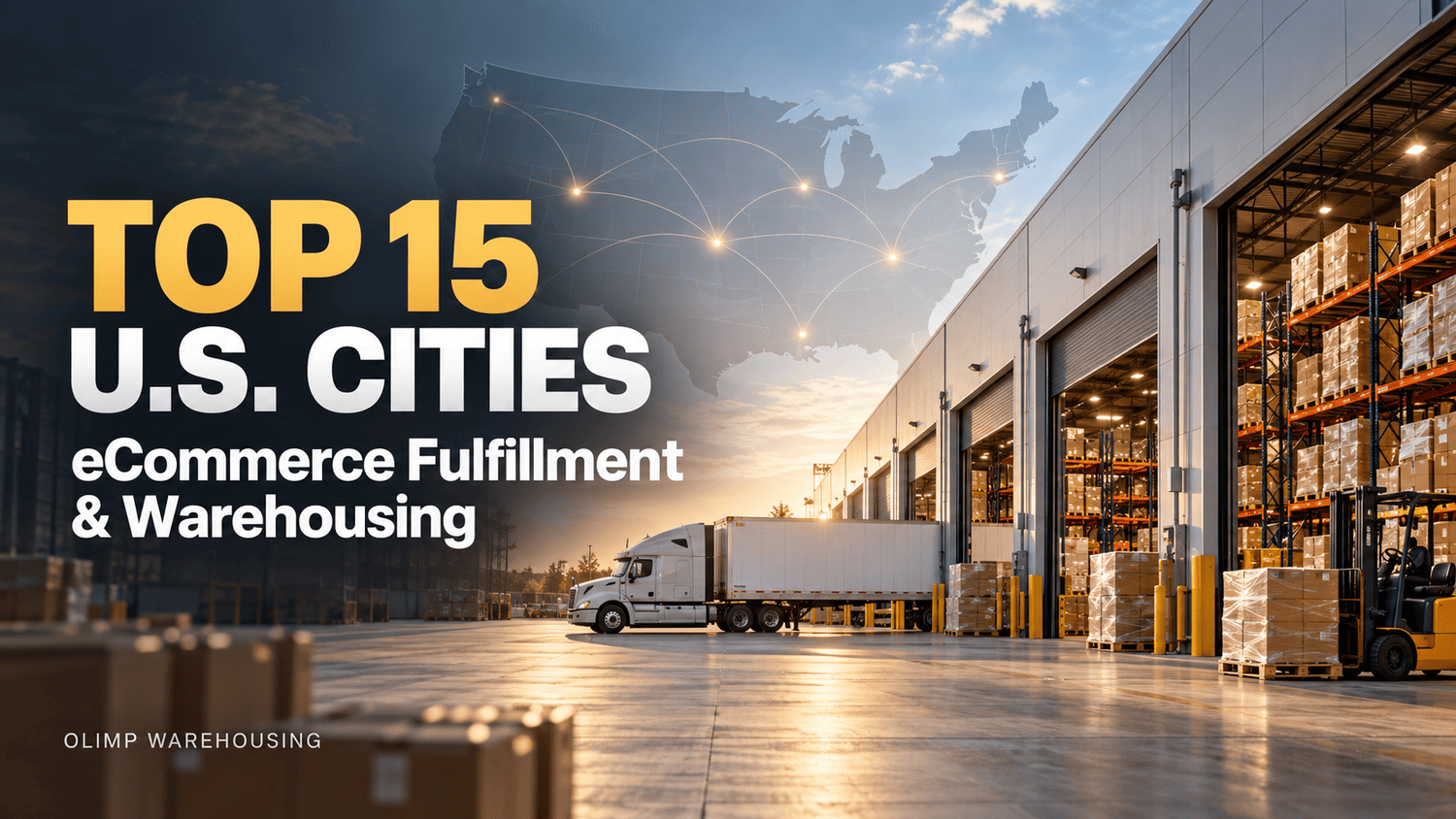
What Are the Top 15 U.S. Cities for eCommerce Fulfillment and Warehousing?
10/23/2026
Which cities should you shortlist?
| Distribution priority | Cities to consider |
| Western U.S. customers | Ontario, Seattle, Phoenix |
| Texas and central U.S. distribution | Dallas, Houston, Kansas City |
| Midwest and eastern U.S. demand | Chicago, Indianapolis, Columbus |
| Time-sensitive air-parcel operations | Louisville, Memphis |
| Southeast customers and import flows | Atlanta, Savannah, Miami |
| Northeast customers and Atlantic imports | Newark |
Choose from your order map first. A strong freight hub only helps if its warehouse location, carrier services, and operating capabilities fit your business.
eCommerce fulfillment covers receiving inventory, picking, packing, and shipping online orders, while warehousing provides the storage that supports these operations. Choosing the right location means balancing customer proximity, inbound freight, operating costs, and the services your products require.
What makes these 15 cities worth considering?
1. Why choose Ontario, California?
Consider it for Southern California fulfillment and imported inventory. Ontario sits in the Inland Empire, with access to I-10, I-15, and freight rail, as outlined by the City of Ontario.
When comparing warehousing in Ontario, price the complete port-to-warehouse move. Also confirm whether the facility provides individual order fulfillment or primarily pallet storage and replenishment.
2. Why choose Seattle, Washington?
Consider it for Pacific Northwest demand and Pacific imports. The Seattle–Tacoma cargo gateway connects ocean freight with regional distribution infrastructure.
Compare warehouse addresses across the surrounding market against your actual delivery ZIP codes. A Seattle-area facility deserves a separate service-cost comparison before using it to fulfill orders across the entire western United States.
3. Why choose Phoenix, Arizona?
Consider it for Arizona customers and Southwest expansion. Greater Phoenix has an established eCommerce and distribution network, including carrier operations around I-10 and Loop 303.
Check inbound transport costs if products arrive through California. For temperature-sensitive inventory, specify acceptable storage and loading conditions before selecting a facility.
4. Why choose Dallas, Texas?
Consider it for North Texas demand and a central-southern distribution base. The region connects I-20, I-30, I-35, and I-45 with rail and air-cargo infrastructure, according to the North Central Texas Council of Governments.
Test parcel rates from the exact warehouse ZIP code. A central map position alone does not establish nationwide two-day delivery coverage.
5. Why choose Houston, Texas?
Consider it for Gulf Coast imports and Southeast Texas customers. Port Houston’s container facilities include Bayport and Barbours Cut.
Compare the warehouse’s distance from your actual arrival terminal and customer base. Ask how container receiving, unloading, and storage connect with daily order processing, and review the facility’s storm-disruption plan.
6. Why choose Kansas City, Missouri?
Consider it for central U.S. inventory positioning and regional replenishment. The wider Missouri–Kansas metropolitan area combines truck, rail, air, and water freight infrastructure, documented in the city’s transportation planning materials.
Evaluate Kansas City when customers are spread across central states. Calculate actual parcel zones and inventory-transfer costs before treating it as a single national fulfillment solution.
7. Why choose Chicago, Illinois?
Consider it for Midwest customers and inventory arriving by rail. Chicago’s rail and intermodal network supports connections between inbound freight and regional distribution.
When comparing Chicago warehousing options, examine the specific suburb, truck routes, and carrier pickup schedule. Two warehouses in the same metropolitan area can have different receiving and dispatch arrangements.
8. Why choose Indianapolis, Indiana?
Consider it for Midwest distribution and an inland fulfillment base. The region combines airport cargo services with interstate freight corridors.
Compare its service coverage against Chicago and Columbus using the same order sample. Ask potential providers about peak staffing, order cutoffs, and daily dispatch capacity before assuming that a well-connected location guarantees fast fulfillment.
9. Why choose Columbus, Ohio?
Consider it for Midwest and eastern U.S. customers. The Columbus Region’s logistics infrastructure includes cargo-focused Rickenbacker International Airport and intermodal connections.
A useful comparison is Columbus versus a coastal warehouse for brands with substantial inland demand. Include the cost of moving imported inventory inland, then compare outbound shipping, storage, and returns handling.
10. Why choose Louisville, Kentucky?
Consider it when air-parcel dispatch is important to your service promise. Louisville Muhammad Ali International Airport is a major parcel air hub.
Confirm which shipping services the warehouse actually uses and its final pickup times. Being near an air hub does not automatically give your orders later cutoffs, priority handling, or lower shipping rates.
11. Why choose Memphis, Tennessee?
Consider it for time-sensitive shipments and Mid-South distribution. Memphis’s airport supports a major global air-cargo hub.
Shortlist Memphis when expedited shipping matters to your product mix, then compare ground and air services separately. Verify the warehouse’s ability to process orders before carrier collection; airport proximity cannot compensate for slow picking or missed dispatches.
12. Why choose Atlanta, Georgia?
Consider it for a Southeast fulfillment location. Atlanta’s transportation infrastructure combines highways, rail, and air links.
Select the side of the metropolitan area that suits your inbound routes and customer destinations. Ask providers to demonstrate order capacity during promotions, including how they manage receiving while outbound order volumes increase.
13. Why choose Savannah, Georgia?
Consider it for port-related inventory and Southeast replenishment. The Port of Savannah connects with I-16, I-95, and rail services.
Brands importing containers can evaluate Savannah transloading and drayage alongside storage. Confirm whether goods will ship directly to consumers locally or move onward to another fulfillment center; those models require different handling and pricing.
14. Why choose Miami, Florida?
Consider it for South Florida demand and trade connected with Latin America and the Caribbean. PortMiami’s container terminals support those shipping connections.
Compare local fulfillment benefits against the distance to customers elsewhere in the country. For imported or sensitive products, confirm the required customs status, storage conditions, and contingency arrangements at the proposed warehouse.
15. Why choose Newark, New Jersey?
Consider it for the New York metropolitan market and Northeast customers. Newark sits within the Port of New York and New Jersey’s container-terminal network.
Compare port access, tolls, receiving schedules, and parcel charges. OLIMP’s guide to New Jersey versus West Coast fulfillment explores how customer geography changes the location decision.
How do you choose the right fulfillment city for your business?
Use the same inventory and order profile when requesting quotes from different markets:
- Map demand. Group recent orders by destination ZIP code, package size, weight, and delivery promise. Include peak-season demand.
- Compare the complete cost. Include inbound freight, receiving, storage, picking, packaging, outbound delivery, returns, transfers, and minimum fees. Review common hidden eCommerce logistics costs.
- Verify facility capabilities. Confirm sales-channel integrations, inventory accuracy, product restrictions, daily capacity, and the returns process.
- Validate service before expanding. Test representative orders and compare promised versus actual dispatch and delivery performance.
For example, a brand importing through Southern California but selling mainly to Midwest customers should compare California-based fulfillment with bulk replenishment to a Midwest facility. Lower outbound parcel costs may justify the additional transfer, but the comparison must include extra handling and inventory carrying costs.
OLIMP’s fulfillment partner selection guide provides a broader checklist for evaluating the operator behind the location.
How can OLIMP support warehousing across North America?
OLIMP connects retailers, shippers, manufacturers, and freight brokers with partner warehouses across North America. Its warehousing services can support seasonal inventory, overflow storage, and regional stock positioning, with cross-docking, transloading, and fulfillment options matched to the request. Availability and capabilities depend on the selected facility. Share your preferred markets, product details, inventory volumes, and handling requirements so suitable options can be assessed.
Frequently Asked Questions (FAQ) – OLIMP Warehousing
Q: What is the best U.S. city for eCommerce fulfillment?
The best city depends on where your customers are and how inventory arrives. Chicago, Dallas, Columbus, and Atlanta are useful inland candidates; port-related markets deserve consideration when imports are central to the operation.
Q: Can one warehouse deliver nationwide in two days?
Do not assume nationwide two-day ground delivery from one location. Check carrier transit times from the warehouse ZIP code to actual destinations, then account for order processing, pickup cutoffs, and nonoperating days.
Q: Should my warehouse be near a port or near customers?
Port proximity can simplify inbound container handling; customer proximity can reduce outbound distance. Compare both legs of the journey. Some businesses use port-area storage to replenish a separate customer-facing fulfillment center.
Q: Are inland warehouses always cheaper than coastal warehouses?
No. Lower storage or occupancy charges can be offset by inbound transfers, handling, or longer customer deliveries. Compare total cost per shipped order using the same volumes, product mix, and service requirements.
Q: How many fulfillment centers does a small business need?
One may be sufficient if it meets delivery targets economically. Consider another location when shipping savings and service improvements justify additional inventory, minimum charges, replenishment work, and operating complexity.
Q: Can short-term warehousing support eCommerce fulfillment?
Yes, if the selected facility provides the required order-processing services. Confirm picking, packing, integrations, shipping, and returns explicitly. Pallet storage alone does not establish that a warehouse can fulfill individual online orders.
Start with two or three cities that match your customer map, then compare suitable facilities using one consistent brief.
You may be interested in
What Are the Best Warehousing Solutions for Small Businesses Outgrowing Their Garage?
Inventory overflow happens when stock exceeds the space available for effective storage and order handling. For a small business outgrowing its garage, flexible warehousing can solve a space shortage, while third-party fulfillment can also take over picking, packing, and shipping. What are the best solutions for managing inventory overflow? The strongest approach combines accurate inventory […]
Lean Warehousing: How to Reduce Waste and Improve Operations
Lean warehousing is an approach to warehouse management that reduces unnecessary movement, waiting, errors, and excess inventory while improving the flow of goods and information. It applies continuous improvement to receiving, storage, picking, packing, and shipping. For manufacturers, distributors, and third-party logistics providers, the practical goal is reliable fulfillment with fewer avoidable delays and costs. […]

Automated Warehouse Picking: Which System Is Right for Your Warehouse?
Automated warehouse picking uses software and equipment to automate parts of selecting and retrieving products for customer orders. Depending on the system, technology may guide a worker, transport inventory to a workstation, or physically pick individual items. The right solution depends on where your operation loses time, which products you handle, and how orders move […]
Ready to streamline your warehousing needs?
Request a quote today and discover how OLIMP's tailored solutions can optimize your operations