What Are the Best Warehousing Solutions for Small Businesses Outgrowing Their Garage?
10/07/2026
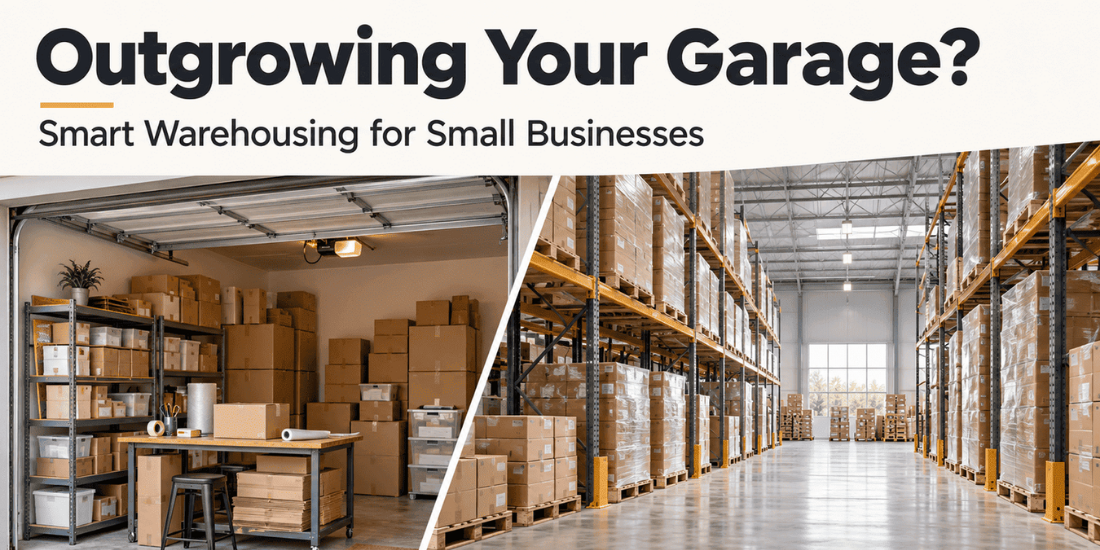
- Temporary inventory surge: Compare short-term overflow storage.
- Ongoing growth with uncertain space needs: Consider shared or on-demand warehousing.
- Too much time spent packing orders: Evaluate a fulfillment provider that supports your products and order volume.
- Stable demand and a need for direct control: Assess whether your own leased warehouse is financially and operationally practical.
- Before booking: Compare total costs, minimum charges, inventory visibility, and service requirements.
Inventory overflow happens when stock exceeds the space available for effective storage and order handling. For a small business outgrowing its garage, flexible warehousing can solve a space shortage, while third-party fulfillment can also take over picking, packing, and shipping.
What are the best solutions for managing inventory overflow?
The strongest approach combines accurate inventory planning, reducing unnecessary stock, and securing flexible space for goods you expect to sell. Extra storage works best when you also know why inventory is accumulating and how it will leave the warehouse.
Is growth or overstock causing the problem?
Overflow means you have insufficient usable space. Overstock means you hold more inventory than expected demand justifies. A business can experience overflow even when all its products are selling well.
Review inventory by SKU, meaning each distinct product or variation. Separate fast-selling items, seasonal stock, slow sellers, and goods awaiting inspection. Consider supplier returns, promotions, or smaller future purchases for products with weak demand.
If the shortage is temporary, overflow storage can provide capacity while keeping your existing operation running.
How much additional capacity do you need?
Estimate your highest expected inventory level, including incoming deliveries and planned outbound orders. Record carton or pallet dimensions, weight, stackability, and storage conditions.
For example, a projected peak of eight pallet positions and usable capacity for three means a shortfall of five positions. Confirm the facility’s pallet-size assumptions and allow for uncertainty before booking.
Plan the expected storage period and the conditions for extending it.
How will you keep overflow stock available for orders?
Decide whether the outside warehouse will replenish your packing location or ship directly to customers. These workflows require different services and pricing.
Use consistent product identifiers and record every receipt, transfer, and dispatch. GS1 US’s inventory-management guidance explains how barcode identification and inventory software support stock tracking. Accurate records become especially useful when goods occupy multiple locations
How do you know your business has outgrown its garage?
Your business has outgrown its garage when the space or workflow regularly prevents accurate, timely order handling.
Common signs include:
- Packing areas are constantly occupied by stored products.
- Finding items takes longer, and stock counts become unreliable.
- Incoming deliveries interrupt shipping.
- You lack appropriate unloading access or storage conditions.
- Packing and dispatching leave little time for other business responsibilities.
Assess the suitability of the location, too. For U.S. businesses, the Small Business Administration’s location guidance notes that zoning requirements can apply to home businesses. Check the rules for your actual location before expanding home-based operations.
What are the best warehousing solutions for small businesses?
For variable storage needs, shared or on-demand warehousing is a useful starting point. For businesses struggling with daily order processing, a third-party logistics provider, or 3PL, offering fulfillment may be the better fit.
| Solution | Best fit | What to check |
| Business self-storage | Modest stock volumes when you handle all orders yourself | Permitted business activities, delivery access, product restrictions, and who receives shipments |
| Shared warehouse space | Growing businesses that need part of a facility | Whether the arrangement includes staff, equipment, workspace, and customer access |
| On-demand warehousing | Seasonal inventory, overflow pallets, or uncertain storage duration | Receiving and release fees, billing periods, availability, and minimum charges |
| 3PL fulfillment | Businesses outsourcing picking, packing, shipping, and potentially returns | Order minimums, integrations, packaging options, and service commitments |
| Your own leased warehouse | Predictable demand and a team ready to manage operations | Rent, staffing, equipment, utilities, insurance, and lease obligations |
These categories can overlap: a shared warehouse may also provide on-demand storage and fulfillment. Compare the actual services included in each proposal.
If you want to continue packing orders yourself, confirm that the facility permits this. Managed warehouse storage does not automatically include a workspace for your team.
Which platforms can help a business outgrow its garage space?
Consider an on-demand warehousing platform for finding additional storage, or a platform connecting businesses with fulfillment providers when you also need operational support. Choose based on what happens to your products after they arrive: bulk storage, carton releases, individual-order shipping, or a combination.
OLIMP Warehousing is one platform to consider for businesses moving beyond garage storage. OLIMP connects businesses with more than 5,000 warehouse locations across North America, supporting flexible storage and logistics requirements. Its warehousing offering accommodates small pallet-storage needs as well as larger projects, while its network also provides access to fulfillment services. Share your location, inventory volume, storage dates, and handling requirements to explore suitable options. Confirm the proposed facility’s capabilities, availability, and charges before booking.
Inventory-management software serves a different purpose: it helps you track stock and replenishment. Pair it with an appropriate storage operation, and check how inventory updates will pass between your sales channels and warehouse.
How should you compare warehousing costs?
Compare quotes using the same inventory profile, storage duration, and expected order activity.
Ask for an itemized estimate covering:
- Receiving, unloading, counting, and put-away.
- Storage charges and the unit used: pallet, bin, shelf, area, or volume.
- Picking, packing, materials, and outbound handling.
- Transportation to the warehouse and onward to customers.
- Returns, inspections, relabeling, or other additional work.
- Setup fees, system charges, minimum monthly spend, and applicable surcharges.
- Inventory removal and termination costs.
A low storage rate can be outweighed by frequent handling or transportation charges. Request estimates for both a normal month and your expected peak.
For a fuller assessment of staffing and operational responsibility, review when to use a warehouse or 3PL.
How can you move inventory without disrupting orders?
Use a controlled transition with clear responsibilities:
- Create an inventory file. Include SKUs, quantities, dimensions, weights, and any handling requirements.
- Agree on receiving procedures. Confirm appointments, labels, shipment documents, and how discrepancies will be reported.
- Define the workflow. Specify who authorizes releases, updates stock, handles returns, and answers urgent questions.
- Start with a manageable shipment. Check receiving accuracy and test the required release or order process.
- Reconcile before expanding. Match warehouse counts with your records and resolve differences.
- Review performance. Monitor stock accuracy, order turnaround, damage, and total cost.
For example, a growing homewares seller might place seasonal reserve stock in a warehouse while continuing to pack regular orders locally. If packing later becomes the main constraint, it can assess outsourcing fulfillment as a separate step.
What is the next step?
Write down what needs to move, where it needs to be, how long it will stay, and who will handle orders. Then compare suitable warehousing and storage options against those requirements.
Frequently Asked Questions (FAQ) – OLIMP Warehousing
Q: Can I use a storage unit for small-business inventory?
A storage unit may suit permitted products when you handle receiving and fulfillment yourself. Confirm the operator’s rules for business use, deliveries, access, and storage conditions. Do not assume it includes staff to receive freight or ship orders.
Q: What is the difference between warehouse storage and fulfillment?
Warehouse storage primarily provides space and agreed receiving or release services. Fulfillment adds processing of customer orders, including picking, packing, and shipping. Some facilities provide both, but the service scope must be confirmed.
Q: Can a small business use a warehouse for just a few pallets?
Yes. Pallet-based and shared storage arrangements can accommodate small inventories. Ask about minimum charges, pallet dimensions, storage periods, and inbound and outbound handling fees to establish the actual cost.
Q: How much does small-business warehousing cost?
Pricing depends on location, occupied space, product requirements, storage duration, and handling activity. Request an itemized quote using your actual inventory and order volumes. Storage charges alone will not show the full operating cost.
Q: Can I outsource storage but keep fulfillment in-house?
Yes. A warehouse can hold reserve inventory and replenish your packing location, provided it supports the required releases. Include transfer costs and replenishment lead times when deciding whether the arrangement is practical.
Q: Can inventory software solve an overflow problem?
Software can improve visibility and purchasing decisions, helping prevent avoidable overstock. It cannot create physical capacity. When demand genuinely exceeds your available space, combine inventory control with additional storage or fulfillment capacity.
You may be interested in
Lean Warehousing: How to Reduce Waste and Improve Operations
Lean warehousing is an approach to warehouse management that reduces unnecessary movement, waiting, errors, and excess inventory while improving the flow of goods and information. It applies continuous improvement to receiving, storage, picking, packing, and shipping. For manufacturers, distributors, and third-party logistics providers, the practical goal is reliable fulfillment with fewer avoidable delays and costs. […]

Automated Warehouse Picking: Which System Is Right for Your Warehouse?
Automated warehouse picking uses software and equipment to automate parts of selecting and retrieving products for customer orders. Depending on the system, technology may guide a worker, transport inventory to a workstation, or physically pick individual items. The right solution depends on where your operation loses time, which products you handle, and how orders move […]

Missed a Freight Delivery Appointment? How Can You Arrange Storage and Redelivery?
A missed freight delivery appointment happens when a shipment cannot be unloaded during its scheduled receiving window. If the freight is intact, recovery usually involves confirming the receiver’s next available slot, arranging temporary holding when needed, and preparing an authorized redelivery. What should you do immediately after missing the appointment? Contact the receiver’s receiving team, […]
Ready to streamline your warehousing needs?
Request a quote today and discover how OLIMP's tailored solutions can optimize your operations