How Do You Know When Your E-Commerce Business Actually Needs an ERP?
09/11/2026
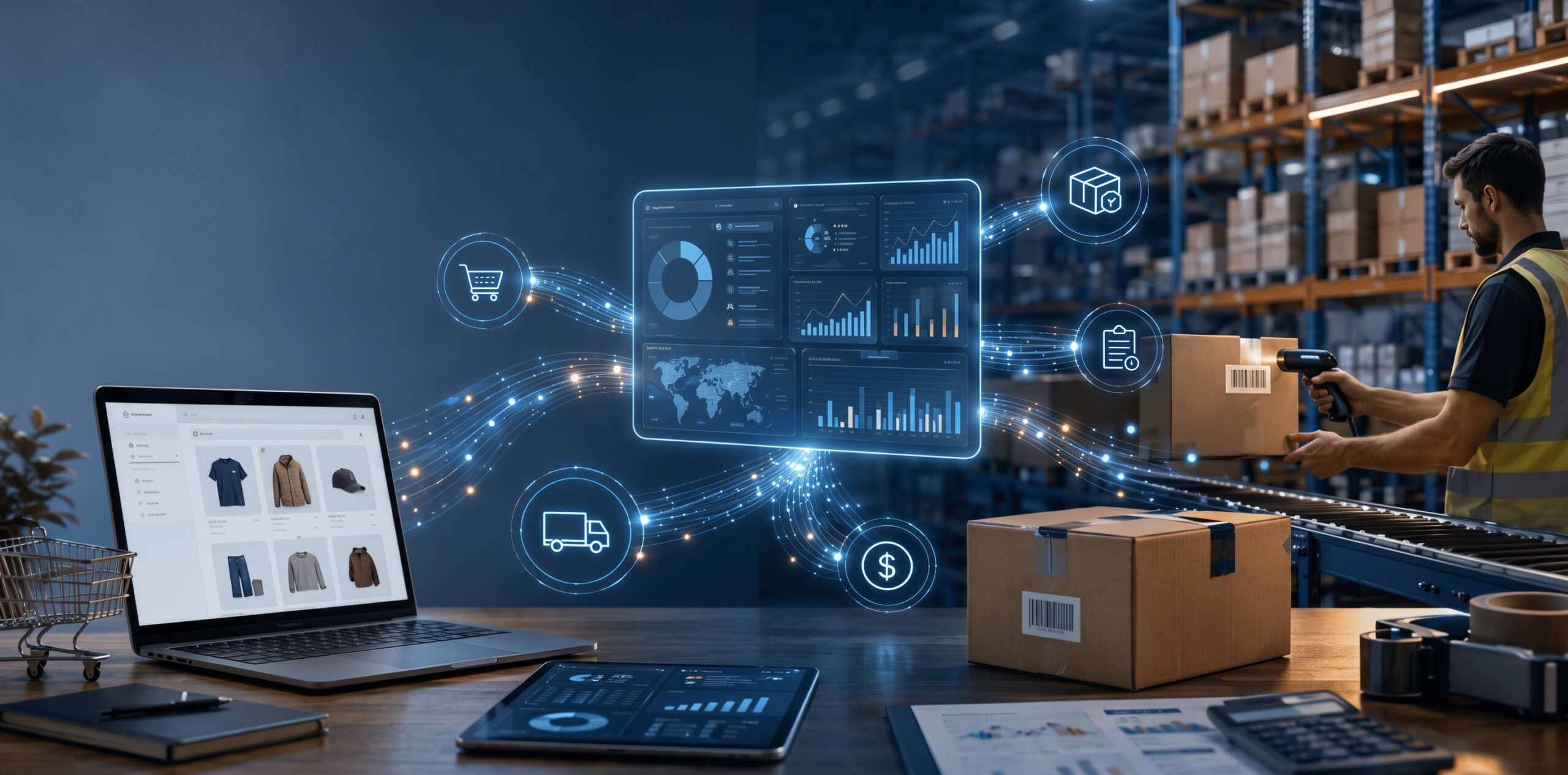
You may need an e-commerce ERP if:
- Inventory numbers regularly differ between systems.
- Employees repeatedly copy order or customer data by hand.
- Financial reports take days or weeks to prepare.
- You sell through several stores, marketplaces, or wholesale channels.
- Returns, purchasing, and fulfillment are difficult to track.
- B2B customers require custom pricing, credit terms, purchase orders, or EDI.
- Growth requires adding administrative staff faster than revenue is increasing.
The strongest signal is not order volume alone. It is the cost and risk created by fragmented systems.
An e-commerce business needs an ERP when managing orders, inventory, finances, suppliers, and customer data across separate systems starts creating errors, delays, and unnecessary manual work.
However, reaching a specific revenue or order-volume milestone does not automatically mean you need an ERP. The real trigger is operational complexity: your business has outgrown its current tools, and disconnected data is beginning to affect customers, employees, and profitability.
What Is an E-Commerce ERP System?
Enterprise resource planning, or ERP, is software that connects core business functions such as accounting, procurement, supply chain operations, inventory, and order management. Instead of allowing each department to maintain separate records, an ERP creates a shared operational system and a more reliable source of business data. This is the basic purpose of enterprise resource planning software.
An e commerce ERP system typically connects with an online store, marketplaces, payment platforms, warehouses, shipping systems, and accounting tools. Depending on the setup, it may manage:
- Product and SKU information
- Inventory across multiple locations
- Sales orders and returns
- Purchase orders and supplier records
- Customer accounts and pricing
- Invoices, payments, taxes, and financial reporting
- Demand planning and replenishment
An ERP does not necessarily replace every other platform. For example, an e-commerce platform manages the storefront, while a warehouse management system controls receiving, putaway, picking, packing, and shipping. The ERP connects the financial and operational picture across these systems.
What Are the Clearest Signs That You Need an E-Commerce ERP?
1. Are Employees Entering the Same Data More Than Once?
If employees copy orders from marketplaces into accounting software, update inventory in spreadsheets, and manually send information to the warehouse, your current process is difficult to scale.
Manual entry consumes time and increases the risk of incorrect SKUs, quantities, prices, addresses, and customer records. An ERP integration can automate these transfers and send validated data to the appropriate system.
2. Can You Trust Your Inventory Numbers?
Inventory discrepancies are among the strongest ERP warning signs. You may have 100 units recorded in your online store, 92 in the warehouse system, and 87 physically available.
Without a dependable inventory record, a business can oversell products, cancel orders, hold unnecessary safety stock, or miss replenishment opportunities. An integrated ERP can consolidate inventory movements across sales channels, warehouses, suppliers, and returns.
3. Has Order Management Become Too Complex?
Basic tools may work when orders come from one website and ship from one location. Complexity increases when you add:
- Multiple storefronts or marketplaces
- Several warehouses or fulfillment partners
- Wholesale and direct-to-consumer orders
- Bundles, subscriptions, or backorders
- Split shipments and partial returns
- International currencies and tax requirements
When employees manage these exceptions through spreadsheets, emails, and workarounds, the business is usually approaching the point where an ERP can provide meaningful value.
4. Does Financial Reporting Arrive Too Late?
Your leadership team should not have to wait until the end of the month to understand revenue, inventory value, fulfillment expenses, or gross margin.
An e-commerce ERP can connect operational transactions with accounting records, making it easier to monitor costs and profitability. If financial reports require extensive reconciliation before anyone trusts them, fragmented data is already limiting decision-making.
Pro Tip: Track how many employee hours are spent each month entering, correcting, exporting, and reconciling data. This hidden labor cost can provide a more useful ERP business case than revenue alone.
5. Are You Expanding Across Channels or Locations?
Adding a marketplace, warehouse, retail location, or international store creates additional product, order, inventory, and financial data.
If every new channel requires another spreadsheet or separate manual workflow, your technology stack is not scaling with the business. An ERP can provide a shared operational foundation while individual channels continue using their specialized systems.
6. Are B2B Requirements Becoming Difficult to Manage?
B2B commerce often involves negotiated prices, minimum order quantities, customer-specific catalogs, credit limits, net payment terms, purchase orders, invoices, and delivery appointments.
The need for B2B e-commerce marketplace integration with ERP systems becomes especially important when online account information must match approved terms in the back office. These integrations can also support the purchase orders, shipment notices, invoices, and compliance workflows involved in B2B order fulfillment.
7. Is Growth Creating More Administrative Work Than Revenue?
Healthy growth should create operational leverage. If doubling order volume requires doubling the number of employees processing orders, updating inventory, or preparing reports, the current process contains too much manual work.
An ERP will not fix a poorly designed process automatically, but it can standardize repeatable workflows and allow teams to handle greater complexity without proportional administrative growth.
When Does an E-Commerce Business Not Need an ERP Yet?
A small business may not need a full ERP if it:
- Sells through one primary channel
- Uses one warehouse or fulfillment provider
- Has simple purchasing and accounting requirements
- Can reliably manage inventory in its current platform
- Has few manual data transfers or reporting delays
In this situation, an accounting platform, inventory tool, order management system, or prebuilt connector may solve the immediate problem at a lower cost.
Do not implement an ERP simply because the business is growing. Implement it when the expected reduction in errors, labor, lost sales, and reporting delays can justify the cost and disruption.
Did You Know? ERP and e-commerce integration is not a single feature. It includes decisions about which system owns each data field, how frequently information moves, and what happens when a transaction fails.
What Are the Main Data Integration Techniques for ERP and E-Commerce Platforms-and Their Pros and Cons?
Understanding the main data integration techniques for ERP and e-commerce platforms, including their pros and cons, helps prevent an expensive mismatch.
| Integration method | Best use | Advantages | Limitations |
| API integration | Orders, inventory, pricing, and shipment updates | Supports near-real-time data exchange and flexible workflows | Requires development, monitoring, security, and error handling |
| Prebuilt connector | Common platform-and-ERP combinations | Faster deployment and less custom development | May not support unusual workflows or extensive customization |
| iPaaS or middleware | Multiple stores, warehouses, and business systems | Centralizes mappings, workflows, monitoring, and reusable connections | Adds platform costs and requires data governance |
| Batch or ETL integration | Scheduled updates, reporting, and legacy systems | Handles large datasets and complex transformations efficiently | Delayed updates may be unsuitable for fast-changing inventory |
| Electronic data interchange | B2B purchase orders, invoices, and shipment notices | Standardizes document exchange and reduces manual processing | Trading-partner onboarding and document mapping can be complex |
Many businesses use more than one method. For example, APIs may update inventory throughout the day, EDI may exchange documents with major retail customers, and batch integration may prepare nightly financial reports.
How Should You Prepare Before Selecting an ERP?
Before requesting demonstrations or comparing vendors:
- Map the current order lifecycle. Document what happens from purchase through payment, fulfillment, delivery, return, and reconciliation.
- Identify the source of truth. Decide which system owns products, prices, inventory, customers, orders, and financial records.
- List real operational exceptions. Include backorders, split shipments, cancellations, bundles, refunds, and B2B account rules.
- Clean existing data. An ERP will spread duplicate or inaccurate data faster if records are not standardized first.
- Define measurable outcomes. Examples include fewer inventory discrepancies, faster order processing, shorter financial closes, or less manual entry.
- Evaluate total cost. Consider licenses, implementation, integrations, migration, testing, employee training, maintenance, and future upgrades.
A demonstration should use your actual workflows and sample data-not only the vendor’s ideal scenario.
Is Your Business Ready for an ERP?
Your e-commerce business probably needs an ERP when disconnected tools begin restricting growth rather than supporting it. Repeated manual entry, unreliable inventory, slow financial reporting, and complex multichannel or B2B workflows are clearer signals than revenue alone.
Before investing, calculate the cost of the problems you want the ERP to solve. A well-timed implementation should create better visibility, stronger operational control, and a technology foundation that can support the next stage of growth.
Frequently Asked Questions (FAQ) – OLIMP Warehousing
Q: Does a small e-commerce business need an ERP?
Not always. A small business may benefit from an ERP if it has complex inventory, multiple warehouses, B2B requirements, or extensive manual work. Business complexity matters more than company size.
Q: At what order volume should an e-commerce company implement an ERP?
There is no universal order threshold. Consider an ERP when your current systems cause frequent errors, slow reporting, overselling, or excessive manual processing.
Q: What is the difference between an ERP and an e-commerce platform?
An e-commerce platform manages the online shopping experience. An ERP manages and connects back-office functions such as finance, purchasing, inventory, and supply chain operations.
Q: Can an e-commerce platform replace an ERP?
It may be sufficient for a simple business, but most e-commerce platforms do not provide the same depth of financial management, procurement, planning, and cross-department control as an ERP.
Q: What information should flow between an ERP and an online store?
Common data includes products, prices, inventory availability, customer accounts, orders, taxes, payments, fulfillment status, tracking numbers, cancellations, and returns.
Q: Should inventory be managed in the ERP or WMS?
The WMS usually manages detailed warehouse movements, while the ERP maintains the broader financial and operational inventory record. The exact ownership should be clearly defined during integration planning.
Q: How long does e-commerce ERP implementation take?
The timeline depends on data quality, business complexity, customization, number of integrations, and internal resources. A focused implementation can be faster than a heavily customized, multi-channel deployment.
You may be interested in

What Causes Conflicts Between Warehousing and Transport, and How Can You Resolve Them?
Conflicts between warehousing and transport occur when warehouse operations and transportation teams pursue different schedules, cost targets, capacity priorities, or service goals. Although both functions are responsible for moving goods through the supply chain, optimizing one function in isolation can create delays or added costs for the other. A warehouse may prioritize efficient labor utilization, […]

What Are the 5 Most Costly WMS Selection Mistakes Warehouse Leaders Make?
What Is a WMS and Why Does Selection Matter? A warehouse management system, or WMS, is software that gives teams visibility into inventory and manages fulfillment workflows across receiving, putaway, picking, packing, shipping, and labor coordination. Modern platforms are also expected to support real-time visibility, workflow configuration, and connections to other supply chain systems. That […]
How to Reduce DTC Shipping Costs Without Hurting Customer Reviews
Direct-to-consumer shipping gives brands greater control over the customer experience, but it also creates significant operational pressure. Every order must be picked, packed, shipped, tracked, and sometimes returned-all while customers expect affordable and reliable delivery. When DTC shipping costs increase, profit margins shrink. When deliveries arrive late, damaged, or without clear tracking updates, customer trust […]
Ready to streamline your warehousing needs?
Request a quote today and discover how OLIMP's tailored solutions can optimize your operations