What Are the 6 Types of Supply Chain Models?
08/21/2026
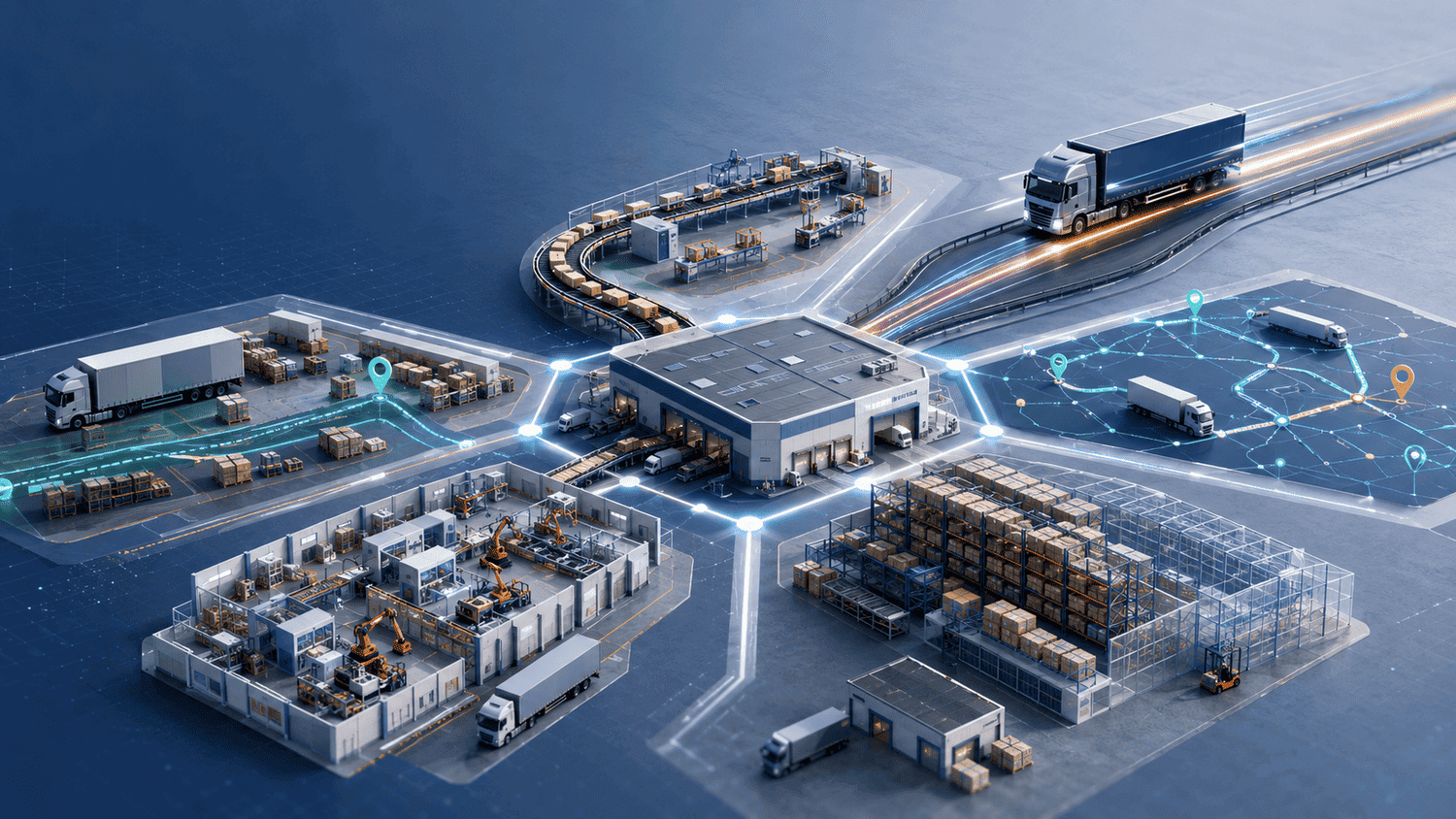
- Continuous flow supports standardized products with steady, predictable demand.
- Fast chain prioritizes speed for trend-driven products with short life cycles.
- Efficient chain minimizes cost and waste in highly competitive markets.
- Agile responds quickly to unpredictable demand, supply disruption, or customization needs.
- Custom-configured combines efficient upstream production with downstream personalization.
- Flexible scales capacity up or down for sharp seasonal or cyclical demand changes.
- No model is best for every business. Product characteristics, demand variability, customer expectations, margins, and risk determine the right fit.
A supply chain model is the operating framework a business uses to coordinate sourcing, production, inventory, warehousing, transportation, and fulfillment. The six commonly recognized models are continuous flow, fast chain, efficient chain, agile, custom-configured, and flexible.
What Is a Supply Chain Model?
A supply chain model is a strategic design for moving materials, information, and products from suppliers to customers. It determines how a company balances cost, speed, inventory, capacity, customization, and resilience.
IBM defines supply chain management as coordinating the entire production flow, from sourcing raw materials through delivery of the finished product. A supply chain model guides how that coordination should work under specific market conditions.
The six types discussed here are operating models, not supply chain stages. Processes such as planning, ordering, sourcing, transforming, fulfilling, and returning goods are part of the ASCM Supply Chain Operations Reference framework. Any of the six models may include those processes.
What Are the 6 Types of Supply Chain at a Glance?
| Supply chain model | Best suited to | Demand pattern | Main priority |
| Continuous flow | Standardized, high-volume products | Stable and predictable | Consistent throughput |
| Fast chain | Trend-driven, short-life-cycle products | Rapidly changing | Speed to market |
| Efficient chain | Price-sensitive, competitive products | Relatively predictable | Lowest total cost |
| Agile | Specialty or made-to-order products | Unpredictable | Rapid response |
| Custom-configured | Modular or personalized products | Stable base demand with variable configurations | Mass customization |
| Flexible | Seasonal or cyclical operations | Sharp peaks and lows | Scalable capacity |
1. What Is the Continuous Flow Supply Chain Model?
The continuous flow model keeps materials and finished goods moving at a steady rate. It works best when a company sells standardized products in high volume and demand changes little from month to month.
Key characteristics include:
- Long-term supplier relationships
- Stable production schedules
- Accurate replenishment planning
- Low product variation
- Consistent inventory movement
For example, a producer of basic paper goods may receive raw materials, manufacture standard products, and replenish distributors on a regular schedule. The model can reduce delays and unit costs, but an unexpected demand swing or supplier interruption can disrupt the carefully synchronized flow.
2. What Is the Fast Chain Supply Chain Model?
The fast chain model is designed to get products to market quickly before demand shifts or the product loses relevance. It is commonly used for fashion, consumer electronics, promotional merchandise, and other goods with short selling windows.
The model depends on:
- Short product-development and production cycles
- Near-real-time demand signals
- Rapid supplier and carrier coordination
- Quick inventory turnover
- Fast distribution and replenishment
Imagine an apparel company responding to a trend that may last only one season. Success depends less on achieving the lowest possible production cost and more on designing, producing, positioning, and selling the item while customers still want it. Unsold stock is a major risk because it can become obsolete quickly.
3. What Is the Efficient Chain Supply Chain Model?
The efficient chain model prioritizes cost control, resource utilization, and waste reduction. It is most suitable for businesses in highly competitive markets where customers compare similar products largely on price.
Companies using this model typically focus on:
- Accurate demand forecasting
- High equipment and labor utilization
- Supplier cost and performance management
- Optimized transportation and warehouse costs
- Lean inventory and standardized processes
The efficient chain and continuous flow models are related but not identical. Continuous flow emphasizes uninterrupted movement, while the efficient chain focuses on achieving the lowest practical total cost across sourcing, production, inventory, and logistics.
A commodity manufacturer, for example, may consolidate purchase volumes, optimize truckloads, reduce handling, and closely monitor cost per unit. This approach performs well under normal, predictable conditions but may need additional buffers or alternative suppliers to withstand major disruptions.
4. What Is the Agile Supply Chain Model?
The agile model is built to respond to unexpected changes in demand, supply, product mix, or customer requirements. It suits made-to-order goods, specialty products, volatile markets, and operations exposed to frequent disruption.
Oracle describes supply chain agility as the ability to adjust operations, production, and inventory quickly as demand, supply, or market conditions change. That capability usually requires:
- Real-time inventory and order visibility
- Collaborative supplier relationships
- Multiple sourcing or transportation options
- Short planning cycles
- Adaptable production and warehouse processes
- Selective safety stock or spare capacity
For example, an industrial equipment supplier may receive an urgent order with unusual specifications. An agile network can confirm components, reassign labor, secure specialized handling, and arrange expedited delivery without redesigning the entire operation.
An agile chain differs from a fast chain. Fast chains are optimized for known short market windows; agile chains are designed to react when the size, timing, or nature of demand is difficult to predict.
5. What Is the Custom-Configured Supply Chain Model?
The custom-configured model combines continuous flow with agile fulfillment. Standard components move efficiently through upstream processes, while final assembly or configuration is delayed until the customer’s exact requirements are known.
This model works well for:
- Configurable vehicles or machinery
- Made-to-order computers
- Personalized furniture
- Modular industrial products
- Products with standard bases and optional features
For instance, a manufacturer can produce common modules in volume, hold them at a facility, and complete final assembly after receiving the order. Delayed differentiation reduces the need to stock every finished-product variation, although it requires accurate component inventory and well-coordinated final assembly.
6. What Is the Flexible Supply Chain Model?
The flexible model is designed for businesses that face intense periods of demand followed by low-volume periods. It allows procurement, labor, production, warehousing, and transportation capacity to expand and contract as requirements change.
Common features include:
- A diversified supplier and logistics network
- Scalable labor and production capacity
- Short-term or on-demand warehousing
- Flexible transportation agreements
- Automation that supports quick changeovers
- Clear triggers for increasing or reducing inventory
A seasonal retailer, for example, may secure overflow storage and extra fulfillment capacity before the holiday peak, then reduce that footprint when volumes return to normal. The goal is to handle surges without paying year-round for resources that sit idle.
Flexible and agile supply chains overlap, but their central problems differ. Flexibility primarily addresses changes in volume and capacity; agility addresses broader uncertainty involving demand, supply, timing, product mix, or disruption.
How Do You Choose the Right Supply Chain Model?
Start with the behavior of the product and the market, not the model name. There is no universally right or wrong model; the appropriate choice depends on the company’s market, customers, products, and operational goals.
Ask these questions:
- How predictable is demand? Stable demand may favor continuous flow or an efficient chain, while volatility points toward agile or flexible operations.
- How long is the product life cycle? Short-lived or trend-based products often need a fast chain.
- How much customization is required? A custom-configured or agile model may be better for customer-specific orders.
- Is the competitive priority cost, speed, or service? The efficient model favors cost; fast chain favors speed; agile favors responsiveness.
- How severe are seasonal peaks? Large, repeatable volume swings often justify a flexible model.
- What disruptions must the network absorb? Review supplier concentration, transportation alternatives, warehouse capacity, lead times, and inventory buffers.
Many businesses use a hybrid strategy. A manufacturer might run continuous flow for core products, use custom configuration for premium variants, and add flexible warehouse capacity during peak periods.
How Does Warehousing Support Different Supply Chain Models?
Warehousing is not separate from supply chain strategy; it helps translate the chosen model into day-to-day operations. The required setup changes by model:
- Continuous flow: dependable inbound scheduling, replenishment, and rapid inventory movement
- Fast chain: quick receiving, cross-docking, order processing, and outbound dispatch
- Efficient chain: high space utilization, accurate inventory control, and reduced handling
- Agile: flexible storage, multi-client capacity, expedited handling, and multiple fulfillment options
- Custom-configured: component storage, kitting, postponement, and final-assembly staging
- Flexible: short-term space, overflow storage, scalable labor, and temporary distribution capacity
It is also important to distinguish logistics from the wider supply chain. Logistics is one component of SCM, which also covers planning, procurement, production, order management, data, and financial flows.
Frequently Asked Questions (FAQ) – OLIMP Warehousing
Q: Which supply chain model is best?
There is no single best model. The right choice depends on demand predictability, product life cycle, customization, competitive priorities, capacity requirements, and risk exposure.
Q: What is the difference between agile and flexible supply chains?
An agile supply chain reacts to unpredictable changes in demand, supply, or product requirements. A flexible supply chain is especially suited to scaling capacity up and down during major volume peaks and lows.
Q: Can a company use more than one supply chain model?
Yes. Companies often use different models by product line, region, sales channel, or season. A hybrid design can balance efficiency and responsiveness.
Q: Is a lean supply chain one of the six types?
Lean is a broader management approach focused on eliminating waste and improving flow. Its principles are especially visible in continuous-flow and efficient-chain models, but lean is not always listed as a separate model in the six-type framework.
Q: What is the difference between a supply chain and logistics?
The supply chain covers the end-to-end network of sourcing, production, inventory, data, fulfillment, and returns. Logistics focuses more specifically on storing, handling, and transporting goods within that network.
Q: What are the main stages of a supply chain?
Common stages include planning, sourcing, production or transformation, fulfillment or delivery, and returns. These are processes within a supply chain, not alternatives to the six operating models.
Q: What Is the Bottom Line?
The best supply chain model aligns operational design with how demand, products, and customers actually behave. Companies should review their model as markets change, then adjust sourcing, inventory, warehouse capacity, and transportation before a mismatch creates excess cost or poor service.
If fluctuating volume is putting pressure on your current network, start by mapping where fixed capacity limits responsiveness. That review can reveal whether a hybrid model or more flexible warehousing would provide a better fit.
You may be interested in
What Are the Best Warehousing Solutions for Small Businesses Outgrowing Their Garage?
Inventory overflow happens when stock exceeds the space available for effective storage and order handling. For a small business outgrowing its garage, flexible warehousing can solve a space shortage, while third-party fulfillment can also take over picking, packing, and shipping. What are the best solutions for managing inventory overflow? The strongest approach combines accurate inventory […]

What Are the 5 Most Costly WMS Selection Mistakes Warehouse Leaders Make?
What Is a WMS and Why Does Selection Matter? A warehouse management system, or WMS, is software that gives teams visibility into inventory and manages fulfillment workflows across receiving, putaway, picking, packing, shipping, and labor coordination. Modern platforms are also expected to support real-time visibility, workflow configuration, and connections to other supply chain systems. That […]
What Are the 5 Types of Logistics? A Complete Guide for Businesses
Logistics is how products, information, and materials actually move through a supply chain—from suppliers, to warehouses, to customers, and even back again. For freight brokers, carriers, shippers, retailers, and manufacturers, understanding the five main types of logistics is essential to controlling costs, improving delivery performance, and keeping customers happy. In this guide, we break down […]
Ready to streamline your warehousing needs?
Request a quote today and discover how OLIMP's tailored solutions can optimize your operations