Can AI Manage Medical Logistics? Where It Works and Where Human Oversight Still Wins
07/17/2026
- Yes, AI can improve medical logistics, especially in demand forecasting, inventory control, cold-chain monitoring, and delivery route optimization.
- No, AI cannot safely run the whole system alone. Data quality gaps, fragmented systems, infrastructure constraints, and the need for trained staff and governance still limit real-world deployment.
- That “to a point” is important. A 2026 review found healthcare supply-chain AI is still heavily concentrated in theoretical models and simulations rather than broad operational implementation.
- The best strategy is targeted adoption. Start with narrow, measurable workflows such as stock-out prediction, shelf-life optimization, or temperature-alerting, then scale only after governance, monitoring, and human oversight are in place.
Medical logistics is the planning, storage, movement, and replenishment of medicines, vaccines, devices, and other critical supplies across healthcare systems. AI can help manage parts of that work-especially forecasting, inventory, visibility, and routing-but current evidence shows it still performs best as a decision-support layer, not a fully autonomous operator.
What is AI in medical logistics?
AI in medical logistics means using machine learning, predictive analytics, optimization models, and sometimes generative tools to improve how healthcare supplies are forecasted, stored, transported, tracked, and replenished. In pharmaceutical and healthcare supply chains, current literature consistently points to demand forecasting, inventory management, oversight, and timely delivery as the most mature use cases.
This matters because medical supply chains are unusually fragile. OECD research shows shortages of medicines were already widespread before COVID-19, and the pandemic exposed how quickly disruptions in demand, manufacturing, and distribution can cascade across health systems. The same report notes that data on medical-device shortages are still relatively limited, which makes visibility and early warning even more important.
In other words, AI is attractive in healthcare not because it is trendy, but because medical logistics is a high-stakes environment with volatile demand, strict storage requirements, tight regulatory constraints, and real patient harm when supplies arrive late, expire, or run out.
Where does AI already work well?
The clearest win is demand forecasting. Gavi’s 2024 technical work on AI and data science for vaccine deployment explains that AI can improve forecasts by combining historical vaccination patterns with real-time signals such as disease surveillance and even weather patterns, which are often missed by simpler historical models. Better forecasting helps organizations order the right quantities, reduce wastage, and spot bottlenecks before they become stock-outs.
AI is also strong in inventory control, especially for perishable products such as pharmaceuticals, biologics, and vaccines. A 2022 operations-research study found reinforcement-learning approaches for perishable pharmaceutical inventory could lower the risk of shortage, reduce expiration risk, improve service levels, and lower overall inventory cost in a healthcare supply chain with hospitals and a central warehouse. That is exactly the kind of narrow, high-value problem where AI tends to outperform static rules.
A third use case is cold-chain monitoring. IoT devices such as electronic time-temperature loggers can continuously monitor vaccine temperatures, while machine-learning systems can dynamically adjust cooling efforts and optimize energy use. In practice, this means AI can help protect temperature-sensitive products while reducing spoilage and unnecessary overcooling.
A fourth area is route optimization and distribution planning. AI supports vehicle routing efficiency and real-time route optimization across the vaccine deployment life cycle. In logistics terms, that means better decisions on who gets what, from where, by which vehicle, and in what sequence- especially useful when geography, weather, traffic, or outreach schedules change quickly.
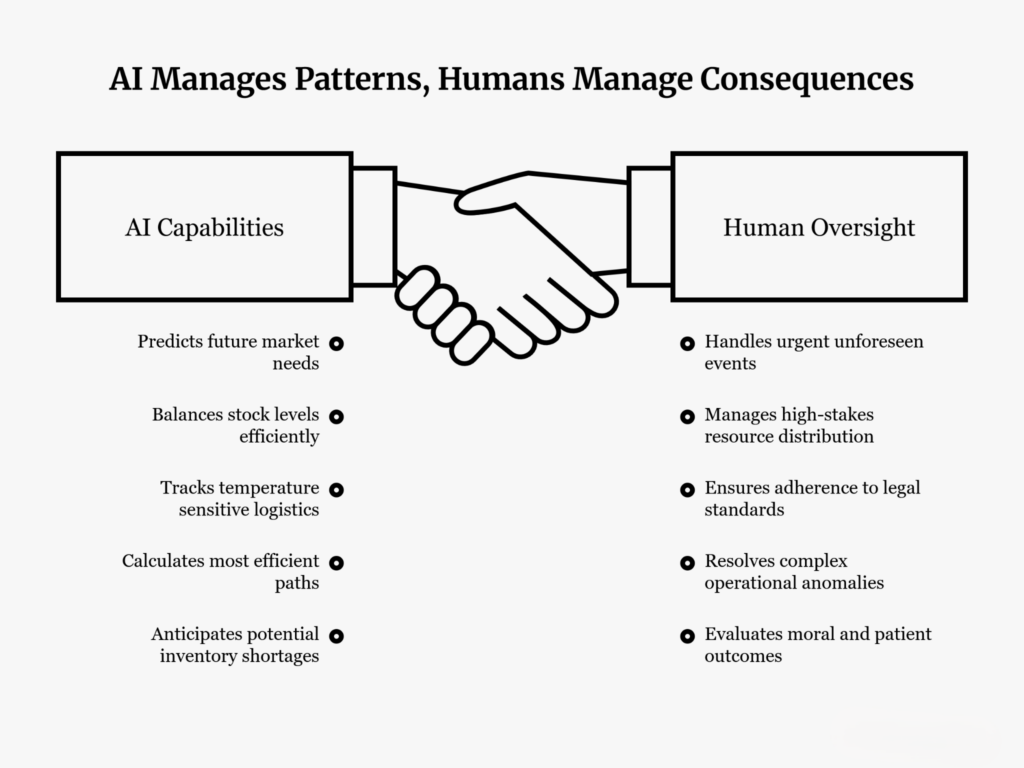
Taken together, the evidence points to a practical conclusion: AI is best at improving repetitive, data-rich, high-volume decisions in medical logistics. It is less convincing when the task depends on incomplete data, exceptional events, policy tradeoffs, or context that humans understand better than models.
Why can AI only manage medical logistics to a point?
The biggest reason is simple: real healthcare operations are messier than models. A 2026 review in BMC Health Services Research concluded that AI in healthcare supply-chain management remains largely in a theoretical stage, with much of the literature dominated by simulations rather than real-world operating evidence. That does not mean AI is useless. It means the market narrative is ahead of deployment reality.
The second limitation is data quality and infrastructure. The vaccine-logistics literature repeatedly flags incomplete or low-granularity data, infrastructure constraints, and technical-skills gaps as barriers to successful AI deployment. Implementation and scaling depend on shared understanding, sustainable infrastructure, and the ability to tailor tools to local contexts and regulatory environments.
The third limitation is interoperability. Healthcare data still sits across disconnected EHRs, ERP systems, eLMIS tools, supplier platforms, warehouse systems, and transportation feeds. Reviews of AI in healthcare warn that interoperability and data integration across diverse systems remain major concerns, which is a serious problem for logistics because prediction is only as good as the visibility feeding it.
The fourth limitation is governance and trust. WHO’s guidance on AI for health says ethics and human rights must sit at the center of AI design, deployment, and use. A 2026 scoping review of healthcare AI governance found 77 frameworks, but only 10 included all four major components studied, and oversight mechanisms were the least common element. In other words, many organizations still lack mature governance for deciding where AI should be used, who is accountable, and how errors are monitored after deployment.
The fifth limitation is regulation. In Europe, the AI Act uses a risk-based framework and applies progressively, with major enforcement milestones continuing through August 2026 and August 2027. For healthcare organizations operating in or selling into the EU, that means AI deployment is not just a technical project; it is also a compliance project.
So the honest answer is this: AI can manage parts of medical logistics very well, but it is not yet a reliable substitute for human operators, supply-chain planners, pharmacists, biomedical teams, compliance leads, and frontline managers. In healthcare, “autonomous” is still mostly a marketing word. “Augmented” is the more accurate one.
If you are evaluating AI for healthcare operations, start with one measurable logistics bottleneck and prove value there first. In medical logistics, the smartest AI strategy is rarely “automate everything.” It is “improve the decisions that matter most.”
How should healthcare leaders implement it safely?
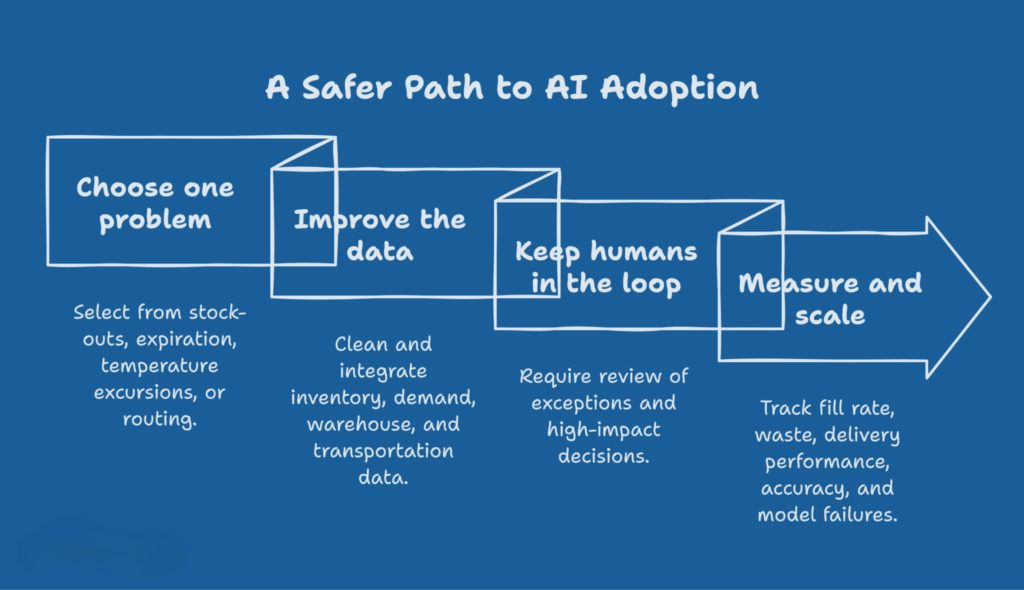
The best approach is to start narrow and operational. Choose one workflow with measurable pain: stock-out prediction, cold-chain alerts, batch-level expiry optimization, or route planning for temperature-sensitive deliveries. These are all use cases where the literature already shows plausible value and where success can be measured with clear KPIs like fill rate, expiry loss, on-time delivery, or alert response time.
Next, fix the data layer before scaling the model. If product master data, temperature data, demand history, or warehouse feeds are inconsistent, the model will reproduce those weaknesses at speed. Forecast effectiveness depends on the quality and granularity of available data.
Then, build human oversight into the workflow. WHO’s AI guidance and NIST’s AI Risk Management Framework both emphasize trustworthiness, governance, and risk management across the AI lifecycle. For medical logistics, that means humans should review exceptions, overrides, unusual recommendations, and high-risk allocation decisions, especially when shortages, vulnerable populations, or regulatory tradeoffs are involved.
Finally, treat governance as part of operations, not legal clean-up at the end. The strongest healthcare AI organizations are moving beyond abstract principles toward committees, assessment methods, lifecycle controls, and oversight mechanisms. That matters because a model that works in a pilot can drift, fail, or become unsafe as demand patterns, suppliers, product mix, or regulations change.
If you are evaluating AI for healthcare operations, start with one measurable logistics bottleneck and prove value there first. In medical logistics, the smartest AI strategy is rarely “automate everything.” It is “improve the decisions that matter most.”
Frequently Asked Questions (FAQ) – OLIMP Warehousing
Q: Can AI replace medical logistics managers?
No. Current evidence supports AI as a decision-support tool for forecasting, monitoring, and optimization, but not as a full replacement for human judgment, especially in high-risk or exception-heavy environments.
Q: What medical logistics tasks are most suitable for AI?
The strongest use cases are demand forecasting, inventory optimization for perishable products, cold-chain monitoring, and route optimization.
Q: Can AI reduce vaccine and drug waste?
Yes, especially by improving forecast accuracy, inventory replenishment, and temperature monitoring. Studies and technical briefs link AI use to lower wastage, fewer stock-outs, and better service levels when data quality is strong enough.
Q: So, can AI manage medical logistics to a point?
Yes, and that is the right framing. AI is already useful for improving specific logistics decisions, but healthcare organizations still need human oversight, governance, and robust infrastructure to make those gains safe and durable.
You may be interested in

What Are Companies Actually Getting From AI in Supply Chains in 2026? Hype vs Real-World ROI
Artificial intelligence in supply chain management represents the systematic deployment of predictive machine learning, generative intelligence, and autonomous agentic systems to optimize end-to-end planning, procurement, and logistics operations. As global networks face persistent economic volatility, enterprises are increasingly allocating digital transformation budgets to artificial intelligence in supply chain systems to mitigate operational disruptions, optimize working […]
What Is Just-in-Time Shipping and How Does It Work in Container Logistics?
Just-in-time shipping is a logistics model that moves materials, containers, and cargo as close as possible to the moment they are actually needed. In practice, it reduces inventory and storage costs by synchronizing suppliers, carriers, ports, and inland delivery around a tight delivery window. What Is Just-in-Time Shipping and Logistics? At its core, just-in-time shipping […]

What Is Putting Global Supply Chains Under Pressure in 2026?
Global supply chains are the cross-border networks that move raw materials, components, and finished goods from origin to customer. In 2026, those networks are under unusual pressure because slower trade growth, geopolitical fragmentation, shipping-route instability, resource concentration, and tougher compliance rules are all hitting at once. What makes 2026 different for global supply chains? The […]
Ready to streamline your warehousing needs?
Request a quote today and discover how OLIMP's tailored solutions can optimize your operations