Warehousing and Storage: How to Choose the Right Facility for Your Business
Warehousing and storage are critical links in the supply chain, the bridge between production and your customers. Choosing the right facility affects delivery speed, cost efficiency and customer satisfaction. This guide explains how to evaluate warehousing & storage options in the United States and match them to your business needs.
Why Warehousing and Storage Matter
Modern supply chains rely on strategically located warehouses to reduce total logistics costs by 10-30 % and improve delivery times by 15-40 %. The closer your warehouse is to customers and suppliers, the faster products move and the less you spend on freight. The warehousing decision therefore isn’t just about finding space, it’s about aligning storage capabilities with business goals.
TL;DR / Key Takeaways
- Match facility type to your product. Temperature‑controlled warehouses keep perishables safe with frozen, cold, chilled or ambient zones, while food‑grade facilities must meet FDA sanitation and humidity guidelines. Hazardous materials require specialized HAZMAT warehouses with spill containment and regulatory compliance.
- Location drives cost and service: Strategic placement near customers and transportation hubs cuts shipping time and cost.
- Evaluate building specifications: Look for adequate clear height (32–36 ft), number of loading docks and column spacing to maximize storage and material flow.
- Consider technology and labor: Modern warehouses use WMS systems that integrate transportation, labor, automation and analytics. Outsourcing labor can help overcome staffing shortages and scale during peak seasons.
- Understand the costs: Average 2025 storage rates are about $20.17 per pallet per month or $0.46 per cubic foot per month. Lease terms, triple‑net charges and variable fees can significantly affect your budget.
- Choose the right warehousing model: Dedicated warehouses offer customization but require long commitments and higher fixed costs. Shared warehouses provide flexibility and variable costs by sharing resources among multiple tenants.
Understanding Your Warehousing and Storage Needs
Assess Your Inventory and Handling Requirements
- Inventory volume and SKU variety: High SKU counts require more pick‑locations and may favor cubic‑foot or bin pricing models. If you store pallets of uniform products, pallet or square‑foot pricing may be more cost‑effective.
- Handling requirements: Heavy or oversized goods need reinforced floors and wide column spacing (50–60 ft). Fragile items may require padded racking or climate control.
- Temperature control: Temperature‑controlled warehousing protects sensitive goods. Facilities may offer frozen storage (0 °F to –13 °F), cold storage (32 °F–50 °F), chilled storage (35 °F–50 °F), ambient storage (59 °F–86 °F) or air‑conditioned rooms with humidity control. Pharmaceuticals often require 35 °F–46 °F or even ultra‑cold environments.
- Food‑grade requirements: Food‑grade warehouses must follow FDA and Food Safety Modernization Act (FSMA) rules, including temperature and humidity control, cleanliness, pest control and hazard analysis plans.
- Hazardous materials: Chemical warehouses specialize in storing flammable, corrosive or toxic substances. They feature segregation of incompatible chemicals, advanced ventilation, spill containment and compliance with OSHA, EPA and NFPA regulations.
- Seasonality and fluctuation: If your business experiences seasonal spikes, consider a flexible facility or shared warehouse where you can scale space and labor up or down. Shared warehousing spreads costs across multiple tenants and offers shorter contract terms.
Storage Duration: Short‑Term vs. Long‑Term
- Short‑term storage suits cross‑docking or transloading operations. Cross‑docking moves items directly from inbound trucks to outbound vehicles with little or no storage time, reducing carrying costs and speeding deliveries. Transloading transfers goods between different transportation modes (e.g., ship to rail) to consolidate shipments and reduce transit costs.
- Long‑term storage is ideal for inventory that stays for months or years. Look for stable lease terms, lower per‑square‑foot pricing and robust security. If storing inventory for long periods, ensure the facility has integrated WMS and inventory dashboards to avoid shrinkage and obsolescence.
Key Factors When Selecting Warehousing & Storage Facilities
1. Location and Network Strategy
Location is often the single most influential factor. A well‑placed warehouse near customers and supply routes can reduce logistics costs by up to 30 % and improve delivery times by 15-40 %. When evaluating location:
- Customer & supplier proximity: Choose sites near major customer clusters and suppliers to reduce transit time and freight costs. Use drive‑time analyses or heat‑maps to identify optimal locations.
- Transportation infrastructure: Access to highways, interstates, ports, airports and rail is vital. Being within a mile of an interstate on‑ramp reduces truck idle time and avoids local traffic. Businesses importing or exporting goods should prioritize proximity to ports and rail terminals.
- Cost vs. value: Cheap real estate in remote areas may increase transportation costs, while an urban facility may justify higher rent by enabling same‑day delivery.
- Market reach: A centrally located warehouse (e.g., Dallas or Indianapolis) can reach a large share of U.S. consumers within two days. Network studies show that two strategically placed warehouses can reach about 90 % of U.S. consumers within two days.
2. Building Specifications
- Clear height and racking: Modern warehouses typically offer 32-36 ft of clear height, allowing advanced racking systems that increase storage capacity by 25 % or more. Older facilities may have 24-28 ft heights and limited vertical storage.
- Loading docks and dock configuration: The number of loading docks should match your shipping volume. A 100,000‑sq‑ft warehouse may have 15+ docks, while facilities over one million sq ft often feature 200+ docks. Adequate dock depth (120 ft or more) ensures trucks can maneuver safely.
- Column spacing: Modern warehouses feature column spacing of 50–60 ft to support flexible layouts and automated material handling.
- Floor load and truck court: Ensure floors can handle 125–150 lbs per sq ft for standard operations; heavy manufacturing may need 250–500 lbs per sq ft. Truck courts should have adequate depth for tractor‑trailers.
- Power, climate and connectivity: Three‑phase electrical service with 2,000+ amps may be needed for automated warehouses or cold storage. Climate control (HVAC) and ventilation protect temperature‑sensitive goods and worker comfort. Fiber‑optic internet and redundant connections support cloud‑based WMS and real‑time inventory.
3. Technology and Visibility
Modern warehouses are no longer just storage boxes; they’re data‑driven hubs. Warehouse management systems (WMS) have evolved into control centers that link transportation, labor management, automation and analytics. A WMS provides real‑time inventory tracking, order processing and integration with robotics and AI. Key benefits include:
- Integration: A modern WMS connects to transportation management and labor systems, giving managers a unified view of supply chain activities.
- Automation: WMS acts as the orchestrator for robotics, conveyors and automated storage systems, reducing errors and increasing throughput.
- AI and analytics: AI‑enabled WMS monitors labor productivity and identifies bottlenecks, allowing managers to reallocate resources quickly.
In addition, cross‑docking and transloading operations rely on advanced WMS to coordinate inbound and outbound loads and update inventory in real time.
4. Labor Availability and Reliability
Labor is often the most unpredictable cost in warehousing. By 2025, high turnover, rising wages and competition from other industries have made it difficult to recruit and retain warehouse associates. Understaffing leads to overtime, safety risks and missed service‑level agreements. Strategies for addressing labor challenges include:
- Managed labor partnerships: Outsourcing part of your workforce to a third‑party provider allows you to scale headcount quickly for peak seasons or unexpected surges. Flexible labor strategies can reduce overtime costs by up to 18 % while improving on‑time fulfillment.
- Automation synergy: Robotics and AI reduce repetitive tasks but require skilled operators. Managed labor partners experienced in automation‑integrated facilities can deploy trained associates.
- Data transparency: Advanced labor partners offer real‑time dashboards and AI‑driven forecasting to optimize staffing.
When evaluating warehouses, consider local labor availability, wage rates and the provider’s ability to scale the workforce.
Cost Considerations for Warehousing Storage
Warehouse pricing depends on the amount of space you use, service levels, contract length and location. According to a 2025 survey of over 600 North American warehouses, the average monthly storage costs are:
| Pricing Method | Average Monthly Cost | Typical Range |
| Per pallet | $20.17 per pallet | $18–$25 per pallet |
| Per cubic foot | $0.46 per cubic foot | $0.35–$0.60 per cubic foot |
| Per bin | $3.08 per bin | $2.50–$4.00 per bin |
| Per square foot | $1.73 per sq ft | $1.25–$2.25 per sq ft |
Other fees and factors include:
- Pallet in/out fees: Many warehouses charge $4-$8 per pallet for inbound and outbound handling.
- Special conditions: Climate‑controlled storage, hazmat handling, bonded storage or trade show pallets increase per‑unit costs.
- Insurance and security: High‑value or fragile goods require additional insurance and security, raising the base rate.
- Cross‑docking and transloading: Eliminating long‑term storage reduces recurring fees but adds labor for fast turnarounds.
- Lease terms: Industrial leases often run three to five years, sometimes longer. Triple‑net leases require tenants to pay property taxes, insurance and maintenance in addition to base rent. Ask about common area maintenance (CAM) charges, which cover shared expenses like parking and lighting.
- Variable vs. fixed costs: Dedicated warehouses often charge a fixed monthly fee regardless of volume, whereas shared warehouses allocate variable costs based on usage.
To manage costs effectively, conduct a thorough cost‑benefit analysis, compare pricing models and negotiate flexible terms. Consider co‑warehousing (shared space), just‑in‑time inventory strategies and automation to optimize space utilization.
Storage & Warehousing Options
Choosing the right type of facility can improve service levels and control costs. Here are common options:
Short‑Term Storage: Cross‑Docking & Transloading
- Cross‑docking: Products are unloaded from inbound transport and loaded directly onto outbound vehicles with little or no storage time. This lean strategy reduces warehouse space needs, accelerates delivery and minimizes handling errors. Cross‑docking facilities need efficient sorting and loading areas rather than expansive storage and often use WMS for rapid tracking.
- Transloading: Goods are transferred between different transportation modes, such as from ocean containers to rail cars or trucks. Transloading consolidates multiple shipments, reduces storage time and lowers total shipping cost. It’s particularly beneficial for international shipments that cross multiple modes and need customs management.
Long‑Term Storage
- Dedicated warehouse space: A dedicated warehouse (also known as contract warehousing) is occupied by a single tenant. The tenant bears all fixed costs (rent, labor, capital equipment and WMS) and usually commits to a multi‑year contract (typically 3–7 years). This model offers full control over operations, customization and security.
- Shared warehouse space: Also called multi‑client or public warehousing, this model allows multiple companies to share space, equipment and labor. Contracts are shorter (1–3 years) and costs are variable based on actual usage. Shared warehousing suits businesses with seasonal demand or those testing new markets.
- Hybrid models: Some businesses use a combination of dedicated space for core inventory and shared or flex space for overflow or seasonal peaks. This approach balances cost control and scalability.
Specialized Storage
- Cold chain warehouses: For food, pharmaceuticals and sensitive chemicals, cold chain facilities offer frozen, chilled or refrigerated zones as described earlier. They require backup power, IoT sensors and strict monitoring to maintain product integrity.
- Food‑grade warehouses: Must comply with FDA regulations, FSMA and current Good Manufacturing Practices (cGMPs). Requirements include sanitation, pest control, humidity control, hazard analysis and labeling.
- Hazardous materials (HAZMAT) warehouses: These facilities separate incompatible chemicals, use spill containment, advanced ventilation, fire suppression and adhere to OSHA, EPA and NFPA standards. Facilities may be dedicated to one hazard class or multipurpose with zoned layouts.
Final Thoughts
Selecting the right warehousing and storage facility is a strategic decision that impacts cost, service levels and long‑term growth. Start by assessing your inventory characteristics, handling needs and regulatory requirements. Then evaluate location, building specifications, technology integration, labor availability and cost structures.
A well‑chosen facility can provide competitive advantages – faster delivery, lower logistics costs and higher customer satisfaction. Whether you choose dedicated, shared or hybrid solutions, ensure your warehouse strategy aligns with your business goals and can adapt to future growth.
Frequently Asked Questions (FAQ) – OLIMP Warehousing
Q: When should I choose dedicated vs. shared warehousing?
Choose a dedicated warehouse if you need full operational control, customized processes and stable long‑term storage; however, expect higher fixed costs and longer contracts. Shared warehousing is ideal for variable demand, smaller order volumes or businesses that need flexibility and shorter commitments.
Q: What regulations apply to food‑grade warehouses?
Food‑grade facilities must comply with FDA regulations and FSMA, which require temperature and humidity control, sanitation, pest control, hazard analysis and proper labeling to prevent contamination.
Q: Are hazardous materials stored differently from regular goods?
Yes. HAZMAT warehouses include features like spill containment, fire suppression, segregation of incompatible chemicals and compliance with OSHA, EPA and NFPA standards. They may be dedicated to specific hazard classes or zoned to handle multiple types safely.
You may be interested in
Chemical Warehousing & HAZMAT Storage: Safety, Standards, and Best Practices
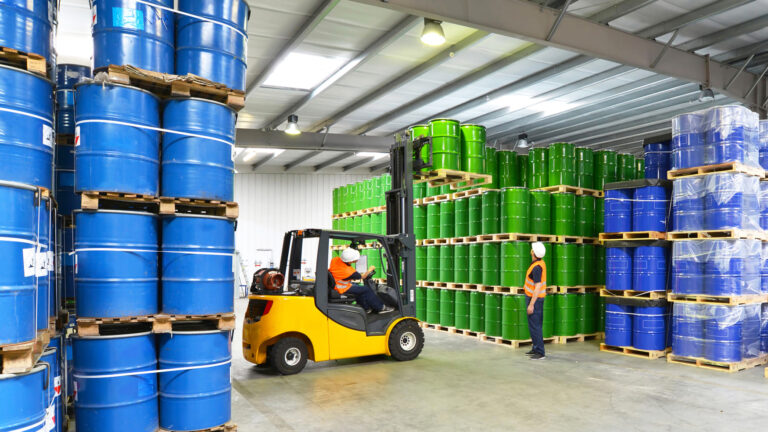
Chemical warehouse storing drums of hazardous substances under safety controls. Chemical warehousing (also called hazardous materials or HAZMAT warehousing) refers to specialized storage of chemicals and other dangerous goods under strict safety and regulatory controls. These facilities are designed to prevent accidents by segregating incompatible substances and complying with rigorous safety standards. In North America, […]

Complete Guide to Dry Warehouse Storage and Dry Goods Shipping (2025 Update)
In today’s fast‑moving supply chains, ambient storage plays an essential role in keeping non‑perishable products safe, organized and ready for distribution. Dry warehouse storage refers to facilities that keep goods at room temperature and protect them from moisture, pests and contamination. Unlike cold storage, which relies on refrigeration or freezing, dry warehouses provide clean, climate‑stable […]
Common Warehousing Myths Debunked: Myths vs. Reality
Warehouses are integral to today’s supply chains, yet many still see them as simple storage space. In reality, efficient warehouses manage inventory, fulfill orders, coordinate cross-docking, and even perform value-added tasks like packaging or assembly. This has become even more critical as global commerce grows – for example, about 6.6 million Americans worked in transportation […]
Ready to streamline your warehousing needs?
Request a quote today and discover how OLIMP's tailored solutions can optimize your operations