Smart Warehousing: How Intelligent Technologies Are Transforming Warehouse Operations
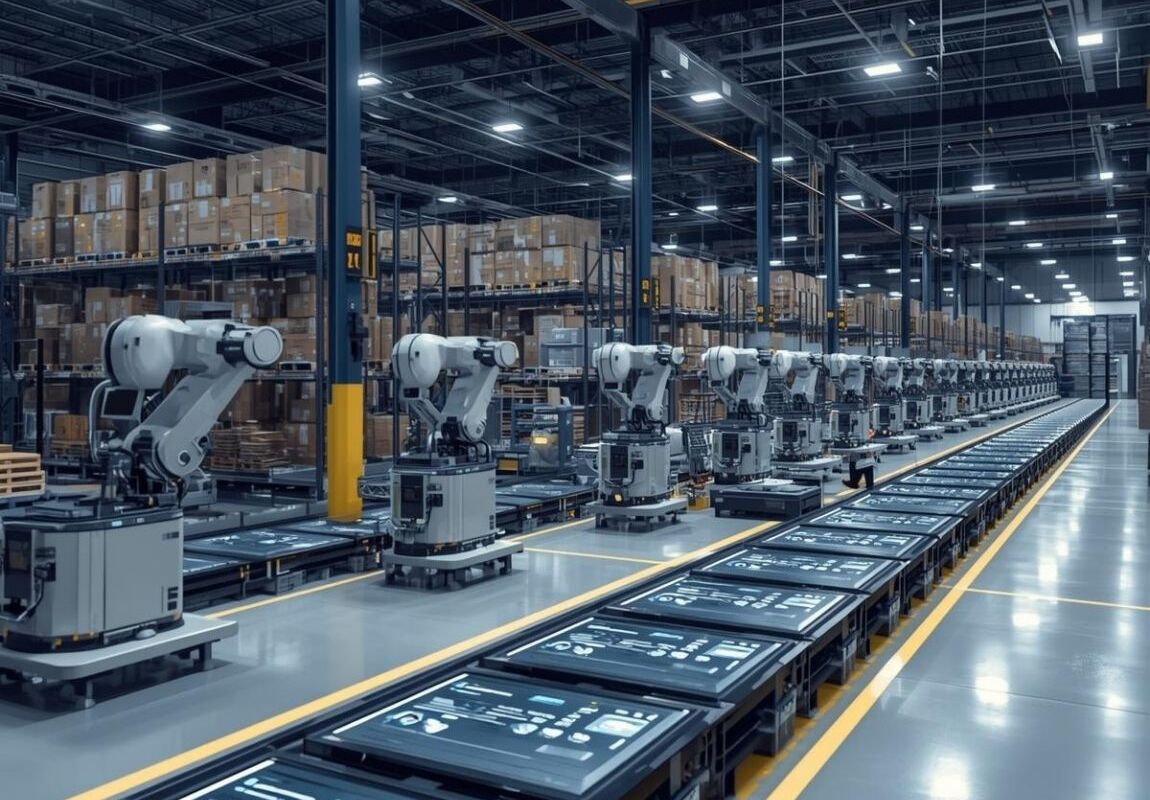
Smart warehousing isn’t “robots everywhere”-it’s an end-to-end operating model that connects data, systems, and material flow so the warehouse can see, decide, and act in near real time.
The biggest drivers in the U.S. are rising e-commerce volume/complexity and persistent workforce constraints, both of which increase the cost of errors and slow fulfillment.
Core smart warehousing technologies include IoT/auto-ID (RFID), WMS/WES software, robotics (AMRs, AS/RS), and analytics/AI.
High-impact outcomes typically show up in inventory accuracy, pick productivity, order cycle time, space utilization, and service levels.
Adoption barriers are usually budget, unclear business case, and insufficient understanding of the technology, so successful programs start with KPIs and phased pilots.
Smart warehousing is the shift from manual, siloed warehouse work to connected, data-driven operations-using software, sensors, and automation to run faster, more accurately, and with greater resilience.
Why smart warehousing matters in the United States today
Warehouse operations in the United States are being pushed by two compounding forces: higher expectations for fast, accurate fulfillment and sustained demand volatility driven by online shopping. In the third quarter of 2025, e-commerce accounted for 16.4% of total U.S. retail sales (seasonally adjusted), underscoring how much fulfillment performance now shapes customer experience.
At the same time, workforce constraints remain a top operational risk. In the 2025 MHI Annual Industry Report key findings, “hiring and retaining workers” is one of the top company challenges, indicating that labor availability isn’t just an HR issue-it’s a throughput issue.
The practical implication is simple: warehouses need tighter execution, fewer touches, and better real-time decisions. That combination is exactly what smart warehousing management aims to deliver-through connected systems, automation, and analytics rather than ad hoc heroics.
What is smart warehousing?
Smart warehousing is the integration of advanced technologies and modern warehouse/inventory management systems to digitize and automate warehouse processes in order to improve efficiency, accuracy, and responsiveness.
A useful way to think about a smart warehouse is as a “human + technology” environment where the goal is to optimize flow-of inventory, people, and information-rather than simply store product.
What typically distinguishes smart warehousing from traditional operations is:
- Real-time visibility: knowing “what, where, and status” continuously – not just at scan points or cycle counts.
- System-driven execution: work is assigned, sequenced, and balanced by software rather than tribal knowledge.
- Automation where it matters: repetitive travel and handling are reduced using warehouse automation technologies (e.g., AMRs, conveyors, AS/RS) tied into orchestration logic.
Core smart warehousing technologies powering modern operations
Smart warehousing technologies generally fall into five “stack” layers-data capture, systems of record, systems of execution, automation, and intelligence.
IoT, sensors, and automatic identification
The National Institute of Standards and Technology glossary describes IoT as industrial/user devices connected to the internet, including sensors and controllers-exactly the kind of hardware deployed in modern warehouses for tracking and monitoring.
In practice, this layer includes RFID, environmental sensors, and machine telemetry. GS1 US highlights RFID’s role in real-time inventory visibility and reports item-level inventory accuracy can exceed 95% in RFID-enabled environments, a major lever for reducing mis-picks and stockouts.
WMS and WES
A Warehouse Management System (WMS) is the operational backbone: SAP defines WMS as software that manages and controls daily warehouse operations from inbound to outbound, with real-time inventory visibility.
A Warehouse Execution System (WES) sits closer to the “shop floor,” coordinating manual and automated tasks in real time to keep work flowing efficiently-especially in mixed environments where people and machines both execute tasks.
Robotics, AMRs/AGVs, and AS/RS
Robots in warehousing are increasingly used to reduce non-value-added travel and stabilize throughput. Autonomous mobile robots (AMRs) can reduce picker walking distance and increase throughput, one reason AMR deployments are often attractive as retrofits, not just greenfield builds.
For storage density and consistent retrieval, AS/RS solutions are commonly cited for using vertical space and reducing manual handling time.
Analytics and AI
Industry surveys show why analytics is central: the MHI report’s technology adoption outlook places high predicted adoption on AI, predictive analytics, sensors/auto-ID, and inventory/network optimization tools-signaling that “intelligence” is expected to become standard equipment, not an add-on.
Connectivity: cloud, edge, and private cellular
Connectivity matters because smart systems depend on fast, reliable data exchange. The 5G-ACIA notes that industrial 5G edge computing enables reliable, low-latency communication and on-premises processing for industrial use cases-relevant for robotics fleets, computer vision, and real-time orchestration on large sites.
Smart warehousing benefits and the KPIs that prove impact
The business case for a smart warehouse is easiest to defend when it’s tied to measurable operational KPIs (and when the baseline is established before technology is installed).
Common smart warehousing benefits include:
- Higher accuracy and fewer exceptions: RFID and better system control reduce inventory record errors and mis-picks, supporting higher service levels.
- Faster order cycle times: orchestration (WES) plus goods-to-person automation can compress lead times dramatically when designed around flow.
- Improved labor productivity: AMRs and optimized slotting reduce walking and travel, helping stabilize throughput in tight labor markets.
- Better space utilization: high-density storage approaches like AS/RS can increase capacity without expanding footprint by leveraging vertical space and reducing aisle needs.
A concrete example from the MHI report describes a North American apparel retailer implementing goods-to-person picking plus a WES, improving accuracy while walking-and reporting reduced fulfillment lead times (from 8 days down to 2) and a 25% increase in outbound load density tied to right-sized packaging automation.
Building a smart warehouse strategy
Smart warehousing succeeds when technology deployment follows an operating strategy-not the other way around. The same MHI findings that show aggressive adoption forecasts also highlight primary barriers: lack of budget, lack of a clear business case, and lack of understanding of the technology.
A practical, low-regret roadmap usually looks like this:
Map workflows and define “proof” KPIs
Start by mapping receiving, putaway, replenishment, picking, packing, and shipping-and define target KPIs (accuracy, cycle time, dock-to-stock, labor hours per order, cube utilization). This makes pilots measurable and prevents “tech theater.”
Build the digital foundation first
For most U.S. operators, foundation means data integrity + WMS discipline, then layering execution/orchestration (WES) and automation. A WMS provides the inventory truth; a WES helps synchronize people and machines when automation increases complexity.
Pilot, integrate, then scale
Integration friction is a real limiter, especially when legacy systems and multiple automation vendors are involved. The MHI report includes examples where integration and deployment time dropped significantly once organizations used a more standardized approach to connecting systems and robotics.
Treat workforce enablement as part of the system
Smart warehousing management changes job design (exception handling, robot tending, analytics, maintenance). Many organizations are responding with upskilling initiatives (e.g., 63% upskilling current employees), highlighting that training is not optional if you want adoption and safe operations.
Engineer cybersecurity into the design
Connected warehouses increasingly blend IT and operational technology (OT). Cybersecurity and Infrastructure Security Agency emphasizes ongoing risk affecting industrial control systems, and NIST SP 800-82 provides guidance for securing ICS while accounting for performance and safety requirements, both relevant when warehouses deploy conveyors, sorters, PLCs, and edge-connected robotics.
Use-case fit and future trends to watch
Not every warehouse needs the same automation mix. Smart warehousing use cases that tend to benefit early include:
- E-commerce and omnichannel: high SKU counts and volatility make real-time visibility and dynamic execution valuable.
- Cold storage: temperature control and monitoring are critical for safety and compliance; U.S. food safety guidance highlights risk in unsafe temperature ranges, making sensor-based monitoring and alerting a high-value application.
- Distributed fulfillment and micro-fulfillment: strategy increasingly includes locating inventory closer to demand; Microfulfillment centers are one tactic used to improve delivery speed and customer experience.
Conclusion
Smart warehousing is best understood as a connected operating system for warehouse performance-combining visibility (IoT/auto-ID), control (WMS/WES), and acceleration (automation + analytics) to improve speed, accuracy, and resilience.
If you’re planning a smart warehouse strategy, start by making data and process measurable, then layer in the right technology stack in phases-so each step funds and de-risks the next.
Frequently Asked Questions (FAQ) – OLIMP Warehousing
Q: How much does implementing smart warehousing cost on average?
Costs vary widely by size and automation level. Small upgrades (WMS + sensors) may start around $20,000–$80,000, while fully automated smart warehouses with robotics can range from $500,000 to several million dollars. Most companies implement in phases to spread investment and achieve faster ROI.
Q: Which technologies provide the biggest ROI in smart warehouses?
The fastest ROI usually comes from:
1.Warehouse Management Systems (WMS)
2.Pick optimization software
3.Autonomous mobile robots (AMRs)
4.Inventory tracking sensors
These reduce labor time, errors, and travel distance immediately.
Q: How do you plan a phased smart warehouse implementation roadmap?
Start with visibility before automation:
1.Implement WMS and data tracking
2.Add sensors and analytics
3.Optimize workflows
4.Introduce robots and automation
5.Scale gradually after pilot testing
Q: What are best practices for integrating WMS with IoT and robotics?
Use API-based integrations, standard data formats, and centralized dashboards. The WMS should remain the main decision system while IoT and robots execute tasks automatically in real time.
Q: How do you measure KPIs and efficiency after smart warehousing upgrades?
•Track measurable operational metrics:
•Order accuracy rate
•Pick time per order
•Labor cost per unit
•Inventory turnover
•Dock-to-stock cycle time
Improvement in these metrics indicates successful implementation.
Q: What is smart warehousing and why does it matter?
Smart warehousing is using connected tech (WMS/WES, IoT, automation, analytics) to digitize and optimize warehouse work, improving speed and accuracy under higher e-commerce and labor pressure.
Q: What are the most important smart warehousing technologies?
The most common are IoT/auto-ID (RFID), WMS and WES software, robotics/AMRs, AS/RS, and AI/predictive analytics.
Q: What’s the difference between a smart warehouse and warehouse automation?
Warehouse automation technologies (robots, AS/RS, conveyors) automate tasks; a smart warehouse connects automation with software and real-time data so the whole system can plan, execute, and adapt.
Q: What KPIs improve most with smart warehousing?
Inventory accuracy, pick accuracy, order cycle time, labor productivity, space utilization, and on-time shipping are the most commonly targeted.
Q: What are the biggest risks of smart warehousing?
Common risks are unclear ROI, integration complexity, inadequate training, and cybersecurity exposure in connected IT/OT systems.
Q: Is smart warehousing only for large enterprises?
No. Many technologies (WMS modernization, targeted sensors, AMRs) can be adopted incrementally, making smart warehousing achievable for mid-sized operators when scoped to specific bottlenecks.
You may be interested in
Food Warehousing and Food Grade Warehousing: Challenges and Solutions
Operating a warehouse that stores food requires specialized handling beyond standard warehousing. Food-grade facilities must meet strict sanitation, temperature control, and traceability standards to prevent contamination and spoilage. In fact, “food-grade warehousing is crucial for maintaining product quality, ensuring consumer safety, and complying with industry regulations.”. By upholding these standards, food warehouses become the critical […]
Common Misconceptions in Warehousing: Myths vs. Reality
Warehouses are integral to today’s supply chains, yet many still see them as simple storage space. In reality, efficient warehouses manage inventory, fulfill orders, coordinate cross-docking, and even perform value-added tasks like packaging or assembly. This has become even more critical as global commerce grows – for example, about 6.6 million Americans worked in transportation […]
Essential Guide to Industrial Warehousing: Key Features, Technologies & Challenges
Industrial warehousing plays a pivotal role in the global supply chain, ensuring the efficient storage, management, and distribution of goods. In the broader transportation and warehousing industry, millions of people are employed to keep products moving (about 6.6 million in the U.S. as of mid-2024). North America (including the USA, Canada, and Mexico) similarly relies […]
Ready to streamline your warehousing needs?
Request a quote today and discover how OLIMP's tailored solutions can optimize your operations
