Rail, Road, or Air Freight: Which Mode Should You Choose in 2026?
08/14/2026
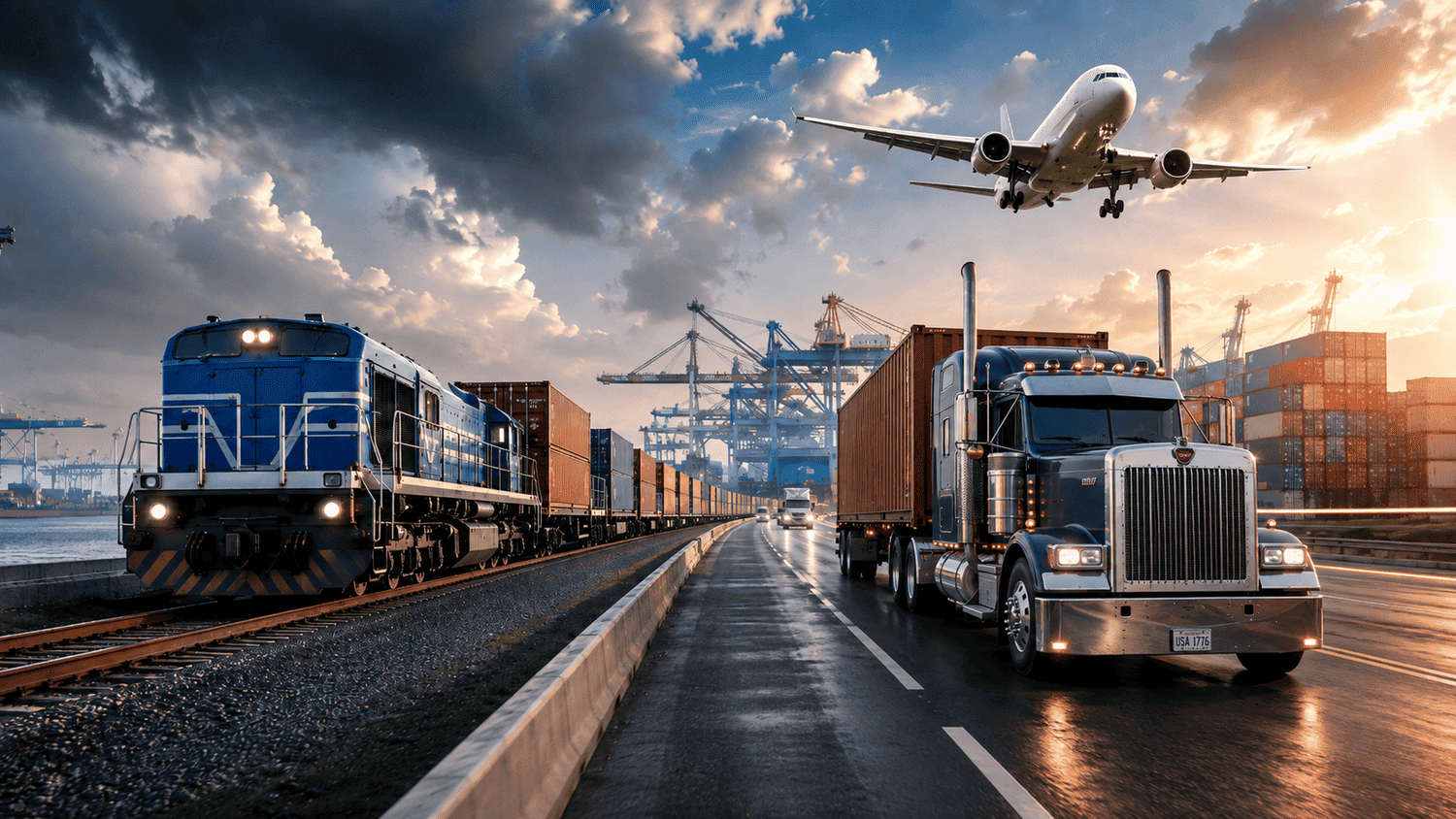
- Road freight is usually the best option for flexible, door-to-door transportation, especially for regional shipments, smaller loads, and freight that cannot tolerate multiple transfers.
- Rail freight is strongest for predictable, high-volume, long-distance moves where lower unit costs and fuel efficiency matter more than maximum speed.
- Air freight is best reserved for urgent, high-value, lightweight, or business-critical cargo because its speed comes at a significant cost premium.
- The lowest freight quote is not always the lowest-cost decision. Shippers should include inventory carrying costs, handling, drayage, delay risk, damage, and potential stockouts.
- A multimodal shipping strategy is often the most resilient approach in 2026, allowing companies to use rail for economical line-haul transportation, trucks for pickup and final delivery, and air for exceptions.
Choosing between rail, road, and air freight means balancing transportation cost against delivery speed, reliability, capacity, inventory risk, and customer expectations. In 2026’s volatile logistics market, the right answer is often not one mode, but a flexible transportation strategy that can change by shipment, lane, and urgency.
Why Is Freight Mode Selection More Difficult in 2026?
Freight demand in 2026 has been uneven rather than uniformly strong or weak. The U.S. Freight Transportation Services Index rose 1.5% between January and February 2026, but then fell 1.3% between April and May and was 0.3% lower than in May 2025. These swings indicate that capacity conditions and pricing pressure can change quickly by month and market.
Individual transportation modes are also moving in different directions. U.S. rail intermodal volume reached 14.06 million containers and trailers in 2025, its second-highest annual total, and average weekly intermodal volume set another monthly record in June 2026. Meanwhile, global air cargo demand reached a record level in 2025, increasing 3.4% from the previous year, with December demand up 4.3% year over year.
This mixed environment makes annual, one-mode transportation plans risky. A mode that is economical during a period of excess capacity can become expensive or difficult to secure after a disruption, seasonal surge, fuel-price change, weather event, or trade-lane shift. The better approach is to evaluate rail vs. road vs. air freight using the total business impact of each shipment.
Which Freight Transportation Mode Is Best for Your Shipment?
| Decision factor | Road freight | Rail freight | Air freight |
| Relative cost | Moderate | Low at sufficient scale | High |
| Transit speed | Fast for regional and domestic freight | Moderate to slow | Fastest over long distances |
| Door-to-door flexibility | Excellent | Limited without truck drayage | Limited without ground transportation |
| Best shipment profile | Small to full truckloads | Dense, heavy, or high-volume freight | Lightweight, urgent, high-value freight |
| Schedule flexibility | High | Best on planned, repeat lanes | High when capacity is available |
| Handling points | Usually few | Terminals and transfers may add handling | Airports, screening, and ground transfers |
| Environmental performance | Moderate | Usually best over land | Generally the most carbon-intensive |
| Best use case | Regional distribution | Long-haul planned replenishment | Emergencies and critical inventory |
These are general characteristics rather than fixed rules. Actual performance depends on the lane, shipment size, terminal access, carrier capacity, service level, and the consequences of late delivery.
When Should You Choose Road Freight?
Road freight should usually be the starting point when the shipment requires direct pickup and delivery, flexible routing, or precise appointment control. The Federal Highway Administration notes that trucks are particularly effective for time-sensitive, high-value goods moving over short and medium distances.
Road transportation is typically a strong choice for:
- Regional and domestic replenishment
- Less-than-truckload and full-truckload shipments
- Retail, manufacturing, and distribution-center deliveries
- Freight moving between locations without rail access
- Loads requiring minimal transfers or specialized trailers
The primary advantage is control. A truck can move from the origin to the destination without terminal transfers, reducing handling and simplifying shipment visibility. Trucks also transported more high-value, time-sensitive commodities in the United States than any other mode in 2024, reflecting the importance of road freight in domestic supply chains.
However, road freight is exposed to highway congestion, weather, fuel changes, driver availability, and sharp spot-market fluctuations. It can also become less economical as distance, shipment weight, and frequency increase.
Example: A manufacturer shipping eight pallets from Ohio to a customer in Pennsylvania will usually gain little from adding a rail terminal transfer. Direct trucking is likely to provide the simplest door-to-door solution.
When Should You Choose Rail Freight?
Rail freight is often the better choice for heavy, dense, or high-volume cargo moving over long distances on predictable lanes. Federal transportation guidance describes rail as an efficient option for heavy long-haul freight and containerized intermodal transportation, while trucks remain useful for pickup and final delivery.
Rail is particularly suitable for:
- Regular long-distance container movements
- Building materials, metals, chemicals, agricultural products, and industrial inputs
- High-volume replenishment with flexible lead times
- Shipments that can be consolidated into repeat lanes
- Companies seeking to reduce transportation emissions
The U.S. freight rail network covers almost 140,000 route miles, giving rail an extensive role in long-distance domestic and cross-border freight transportation.
Rail’s biggest economic advantage is scale. Once drayage, terminal, and minimum-volume requirements are justified, rail can produce a lower cost per unit than long-haul trucking. Its environmental advantage is also significant: freight trains can move one ton of cargo nearly 500 miles per gallon of fuel on average and are approximately three to four times more fuel-efficient than trucks.
The trade-off is reduced flexibility. Rail shipments generally require access to terminals or sidings, scheduled departures, and truck drayage at one or both ends. Additional handoffs can also increase the importance of packaging, inventory visibility, and lead-time planning.
Example: A company moving several containers of packaged goods every week from Southern California to a Midwest distribution center may reduce line-haul costs by using intermodal rail and reserving trucks for origin and destination drayage.
When Should You Choose Air Freight?
Air freight is the right option when the cost of delay is greater than the transportation premium. ICAO identifies rapid delivery of high-value and time-sensitive products as a central role of air cargo, particularly for global supply chains and just-in-time operations.
Common air freight use cases include:
- Production-line emergency parts
- Pharmaceuticals and medical supplies
- Electronics and precision components
- Product-launch inventory
- Perishable or highly time-sensitive goods
- Small shipments with a high value-to-weight ratio
Air cargo offers the fastest long-distance transit, but shippers must account for airport cutoffs, security screening, customs clearance, ground transportation, dimensional-weight pricing, and limited space on certain routes. Global air cargo demand grew faster than capacity in several periods during 2025, demonstrating how lane-specific capacity can tighten even when the broader market appears balanced.
Air transportation should therefore be used selectively. Sending low-value, bulky goods by air rarely makes financial sense unless a delay would stop production, trigger contractual penalties, or cause a costly stockout.
Example: Paying an air freight premium for a replacement component may be justified if the alternative is leaving an entire production line idle for several days.
How Should You Compare Rail, Road, and Air Freight?
Do not compare modes using the line-haul quote alone. Calculate the total landed logistics cost:
Transportation cost + fuel and accessorial charges + drayage + terminal handling + inventory carrying cost + delay risk + damage risk + stockout cost
Then evaluate each shipment using the following questions:
- How urgent is the delivery? Separate true emergencies from shipments that are merely labeled urgent because planning began late.
- What is the cargo’s value-to-weight ratio? High-value, lightweight freight can absorb air costs more easily than bulky, low-margin products.
- How much volume moves on the lane? Rail becomes more attractive when shipments are regular, consolidated, and large enough to offset terminal and drayage costs.
- How expensive would a late delivery be? Include lost production, canceled orders, expedited replacement freight, and customer penalties.
- How many handling points can the cargo tolerate? Fragile, sensitive, or poorly packaged freight may benefit from a more direct road move.
- What backup options are available? A resilient routing plan identifies an alternative mode, transfer point, and storage location before disruption occurs.
- What are the company’s emissions goals? Rail can materially reduce fuel consumption on suitable long-haul lanes, while air should generally be reserved for shipments whose urgency justifies its environmental impact. U.S. EPA data show that medium- and heavy-duty trucks account for a much larger share of transportation emissions than rail.
A practical 2026 strategy is to divide freight into service tiers: planned economy freight, standard replenishment, expedited freight, and business-critical emergencies. Assign a preferred and backup mode to each tier instead of making every shipping decision from scratch.
How Can Flexible Warehousing Reduce Transportation Risk?
Warehousing can serve as a buffer between transportation modes, helping shippers consolidate rail freight, stage road deliveries, cross-dock urgent loads, or position inventory closer to customers. OLIMP provides on-demand warehousing and storage services across North America through a network of more than 5,000 warehouse locations. Its flexible model supports short-term and longer-term storage, pallet-based space, cross-docking, fulfillment, and freight recovery without requiring every customer to make a fixed long-term facility commitment. This kind of distributed warehousing can help businesses respond to missed appointments, rejected freight, seasonal overflow, mode changes, and unexpected capacity constraints.
What Is the Best Freight Mode for 2026?
There is no single winner in the rail vs. road vs. air freight comparison. Choose road for flexibility, rail for long-haul scale and efficiency, and air for time-critical value. For many companies, the strongest strategy combines all three with flexible warehousing, clear service tiers, and predetermined backup routes.
Review your highest-cost and most disruption-sensitive lanes first. Even one well-designed shift-from routine air freight to road, from long-haul trucking to intermodal rail, or from emergency shipping to strategically positioned inventory-can improve both cost control and supply chain resilience.
Frequently Asked Questions (FAQ) – OLIMP Warehousing
Q: What is the cheapest freight transportation mode?
Rail is generally the lowest-cost land option for heavy, high-volume freight moving long distances. Road may be cheaper for shorter or smaller direct shipments because it avoids rail terminals and drayage. Air is usually the most expensive option.
Q: What is the fastest freight mode?
Air is normally fastest for long-distance and international shipments. For regional freight, direct road transportation may be faster door to door because it avoids airport processing and transfers.
Q: Is rail freight more sustainable than road freight?
Usually, yes. Rail is approximately three to four times more fuel-efficient than trucking on average, although the final emissions result depends on train utilization, drayage distance, routing, equipment, and the number of transfers.
Q: Can road and rail be used for the same shipment?
Yes. Intermodal freight uses rail for the long-distance portion and trucks for pickup and final delivery. This can combine rail’s long-haul efficiency with the flexibility of door-to-door trucking.
Q: How can shippers manage logistics volatility in 2026?
Use multiple routing options, segment freight by urgency, monitor total landed cost, prequalify backup capacity, and position inventory near major customers or transportation hubs. Review high-volume lanes regularly rather than relying on a mode decision made during different market conditions.
You may be interested in
Can One Mega Carrier Handle LTL, LCL and Air Cargo Freight?
Many shippers want one simple answer: can one mega carrier handle LTL, LCL, and air cargo freight from start to finish? The short answer is: one logistics provider can coordinate all three, but one carrier usually does not own and operate every truck, ocean container service, aircraft, warehouse, and final-mile network involved. That is why […]

What Is Transloading? Definition, Services & Facilities Guide
Transloading moves cargo between trucks, trains and ships to cut costs and speed delivery. It means unloading freight from one mode (like a ship’s container) and reloading it onto another (such as a freight train or trailer). This process lets importers and shippers mix modes – using rail or ocean for long hauls and trucks […]
How to Choose a Transloading Provider Near Major Ports
International trade flows through U.S. container ports have exploded in recent years. According to the U.S. Department of Transportation’s Port Performance Freight Statistics Report, the ports of New York/New Jersey, Los Angeles and Long Beach each handled more than 6 million loaded twenty‑foot equivalent units (TEUs) in 2022, while Savannah processed 4.33 million TEUs. The […]
Ready to streamline your warehousing needs?
Request a quote today and discover how OLIMP's tailored solutions can optimize your operations