What Are Companies Actually Getting From AI in Supply Chains in 2026? Hype vs Real-World ROI
08/28/2026

- Budget Allocation vs. Financial Gain: Despite 67% of digital supply chain budgets being directed toward artificial intelligence, approximately 70% of implementing organizations report zero measurable increase in Earnings Before Interest and Taxes (EBIT).
- The 3:1 Organizational Investment Ratio: Achieving sustained financial returns requires spending at least $3 on change management, process redesign, and workforce enablement for every $1 spent on software licensing or compute infrastructure.
- The Scaling Bottleneck: While 88% of supply chain organizations regularly experiment with artificial intelligence across operations, only 33% of enterprise pilots successfully scale into production.
- The High-Performer Margin: An elite 6% of deployers, designated as AI high performers, capture greater than 5% enterprise EBIT contributions by fundamentally redesigning operational workflows and establishing strict governance frameworks prior to technology selection.
- Evolution of System Architecture: Enterprise operations are shifting from predictive machine learning and document-based generative models toward multi-agent systems capable of executing complex operational exceptions autonomously.
Artificial intelligence in supply chain management represents the systematic deployment of predictive machine learning, generative intelligence, and autonomous agentic systems to optimize end-to-end planning, procurement, and logistics operations. As global networks face persistent economic volatility, enterprises are increasingly allocating digital transformation budgets to artificial intelligence in supply chain systems to mitigate operational disruptions, optimize working capital, and enhance forecasting precision.
While digital investments allocated to artificial intelligence have reached 67% of total supply chain digital budgets in 2026, more than half of Chief Supply Chain Officers (CSCOs) express uncertainty regarding the direct return on investment (ROI). Market forecasts project that the enterprise valuation of artificial intelligence across transportation, logistics, and inventory management will expand from $9.94 billion to $236 billion over the next decade. However, operational benchmarks indicate that translating software adoption into measurable balance-sheet improvements requires structural workflow redesign rather than simple technology integration.
| Supply Chain AI Benchmark Metric | 2026 Enterprise Benchmark | Source / Industry Indicator |
| Digital Budget Allocated to AI | 67% | Gartner CSCO Survey |
| Companies Reporting Zero EBIT Contribution | ~70% | McKinsey Global AI Study |
| Median Realized Enterprise ROI | 10% (vs. 20% Target) | BCG Center for CFO Excellence |
| Enterprise Pilots Scaling to Production | 33% | McKinsey State of AI |
| Change Management Investment Ratio | 3 : 1 (Change : Tech Spend) | Industry Transformation Benchmarks |
| Profitability Advantage of AI-Mature Firms | +23% | Accenture Global Supply Chain Analysis |
What Is the Difference Between Machine Learning, Generative AI, and Agentic AI in Supply Chains?
Evaluating modern enterprise capabilities requires analyzing artificial intelligence across three distinct technological paradigms: predictive machine learning (ML), generative AI, and agentic AI systems. Each phase represents an advancement in operational autonomy, moving the enterprise from passive data analysis to proactive decision execution.
The historical evolution of artificial intelligence in supply chain operations began with predictive machine learning. These mathematical models process structured quantitative inputs-such as historical sales transactions, ocean freight tariffs, and warehouse throughput metrics-to identify pattern variations and output probabilistic forecasts. While highly effective for inventory slotting and demand planning, machine learning operates passively, requiring human planners to manually translate predictions into transactional ERP actions.
The introduction of generative ai in supply chain networks expanded software capabilities to unstructured data handling. Large language models (LLMs) parse complex bill-of-lading documents, summarize cross-border trade compliance regulations, translate vendor contracts into standardized fields, and automate supplier communications. Although generative tools eliminate administrative friction across procurement and customer support, they remain fundamentally advisory, generating content or recommendations that require human initiation and approval.
The current operational frontier is defined by agentic ai in supply chain architecture. Unlike passive systems that merely generate summaries or forecast curves, agentic systems possess goal-directed autonomy. These multi-agent networks perceive changing operational conditions through real-time API feeds, evaluate alternative resolution paths against business logic, call external software tools, and execute transactions across enterprise systems. For instance, when a maritime port closure is detected, an agentic system can independently query alternative regional motor carriers, verify spot-rate allowances, adjust warehouse arrival slots, and update retail ERP inventory availability without requiring human manual intervention.
| Capability Dimension | Machine Learning (ML) | Generative AI in Supply Chain | Agentic AI in Supply Chain |
| Primary Operational Role | Predictive analytics & anomaly detection | Unstructured data processing & document synthesis | Multi-step task execution & autonomous exception handling |
| Primary Data Input | Structured historical operational data | Unstructured text, contracts, invoices, and images | Real-time multi-system APIs, sensor feeds, and LLM reasoning |
| Human Decision Requirement | High (Planners evaluate outputs and manually execute) | Moderate (Humans review and approve generated draft content) | Low to Moderate (Autonomous execution within defined spending and policy limits) |
| 2026 Enterprise Maturity | Standardized Baseline Infrastructure | Scaled Across Back-Office Operations | Targeted Deployments in High-Value Workflows |
| Primary Failure Risk | Data latency and statistical model drift | Hallucinations in regulatory or contractual parameters | System cascades and unauthorized third-party API actions |
Pro Tip: When evaluating vendor platforms claiming to offer “agentic capabilities,” verify whether the system can execute multi-step workflows across legacy ERP and WMS databases without continuous user prompt intervention. True agentic architecture requires tool-calling, state memory, and configurable organizational governance controls.
What Are the Real Financial Results of AI in Supply Chain Management in 2026?
The financial reality of deploying artificial intelligence in supply chain management is defined by a significant contrast between macroeconomic potential and actual balance-sheet realizations. While analytical models project that generative technology could create between $2.6 trillion and $4.4 trillion in global economic value annually, enterprise surveys show that most individual deployers struggle to achieve target returns.
Data compiled by the BCG Center for CFO Excellence reveals that the median reported ROI across enterprise operations utilizing artificial intelligence sits at 10% – exactly half of the 20% internal hurdle rate typically mandated by executive boards. Furthermore, comprehensive implementation research indicates that approximately 70% of companies deploying artificial intelligence capture no measurable increase in EBIT. Among the 30% of organizations that do achieve financial gains, the majority report that AI contributes less than 5% to total net earnings.
A major cause of underperforming ROI is the structural misallocation of digital transformation capital. Industry benchmarks show that organizations capturing sustained financial gains adhere to a strict capital ratio: for every $1 invested in software licensing, model training, or API tokens, at least $3 must be allocated to operational change management, field process redesign, and workforce enablement.
This change management investment must address three key operational areas:
- Workflow Transformation: Reconfiguring end-to-end operational handoffs so automated decisions directly substitute for manual entry rather than creating dual-review oversight loops.
- Process Alignment: Reconciling official corporate manuals with actual field workarounds used by warehouse managers and freight dispatchers.
- Role Redesign: Creating formal governance structures and human-in-the-loop oversight positions to monitor autonomous software execution.
When change management is underfunded, software adoption stalls, leading departments to limit token usage or restrict platform access to manage costs without securing productivity gains.
| Operational Domain | Documented Performance Gains | Primary Cost & Friction Drivers | Realized Business Impact |
| Demand & Inventory Planning | 15% – 25% reduction in safety stock holdings | Legacy ERP data fragmentation; algorithmic parameter tuning | Working capital reduction |
| Warehouse Operations | 20% – 35% improvement in picking/slotting efficiency | Physical WMS integration costs; hardware maintenance overhead | Direct labor productivity gains |
| Procurement & Sourcing | 40% – 60% reduction in contract review timelines | Platform licensing fees; contractual accuracy validation | Sourcing cycle time acceleration |
| Customer & Logistics Service | $150K – $500K annual savings per enterprise deployment | API integration with carrier networks; exception escalation protocols | Reduced service costs and higher customer retention |
Did You Know?: Logistics operations achieved a 72% worker adoption rate for digital tools, the highest across all industrial sectors, yet enterprise financial performance remains constrained by isolated software deployments that fail to connect supplier systems with last-mile execution.
How Is AI Transforming Food Supply Chains and Cold Chain Logistics?
Deploying ai in food supply chains introduces unique technical demands due to product perishability, strict regulatory standards, and narrow profit margins. Unlike durable goods manufacturing, food distribution requires continuous real-time monitoring to mitigate spoilage and maintain food safety compliance.
Machine learning models have transformed demand forecasting across grocery retail and food service by evaluating complex environmental variables. Algorithms process hyper-local weather predictions, local event schedules, price elasticity, and remaining shelf-life metrics to generate precise purchasing orders at the individual SKU level. Aligning store-level procurement with real-time consumption patterns significantly reduces store-level waste while maximizing on-shelf product availability.
In cold chain logistics, temperature deviations during transit represent a major source of financial loss. Modern monitoring systems integrate artificial intelligence with Internet of Things (IoT) sensors embedded in refrigerated transport containers. Rather than generating basic threshold alerts after a refrigeration failure occurs, predictive models continuously calculate the remaining shelf life of fresh cargo based on cumulative thermal exposure. If a cooling unit degrades, an agentic system can automatically re-route freight to a closer regional distribution center or adjust unloading schedules to salvage inventory before spoilage occurs.
Automated traceability represents another critical advancement in food logistics. When contamination incidents occur, traditional paper-based trace-back procedures can take days to identify affected farms or processing plants. Generative models digitize and index unstructured bills of lading, supplier certificates, and health inspections into centralized databases. During a food safety recall, machine learning algorithms trace affected lot numbers across multi-tier distribution networks in seconds, enabling targeted product isolation without requiring broad, brand-damaging market recalls.
| Food Supply Chain Application | Core Operational Function | Quantified Industry Result |
| Dynamic Shelf-Life Pricing | Algorithmic store-level price markdowns based on real-time expiration tracking | 10% – 20% reduction in grocery store fresh produce shrink |
| Cold Chain Thermal Monitoring | Predictive temperature deviation modeling via IoT sensor telemetry | 15% – 30% reduction in transit spoilage losses |
| Automated Traceability | Instantaneous back-tracing of contaminated lot numbers across multi-tier suppliers | Recall containment times reduced from days to under 5 minutes |
| Predictive Fresh Replenishment | Demand forecasting aligned with localized weather and perishable shelf life | 2% – 5% increase in fresh produce on-shelf availability |
Why Are Most Supply Chain AI Pilots Failing to Scale?
Although 88% of supply chain organizations report actively experimenting with artificial intelligence, only 33% of enterprise pilots successfully scale into full production operations. Understanding the primary structural failure modes is essential for operations executives seeking to transition software investments from experimental concepts into scalable enterprise capabilities.
The primary barrier to scaling software lies in the disconnect between documented operational procedures and actual field practices. Enterprise software implementations are frequently designed around official corporate process manuals. However, warehouse personnel, port dispatchers, and procurement buyers routinely utilize unwritten, practical workarounds to manage everyday disruptions. When an automated model is deployed based strictly on formal documentation, it frequently conflicts with field realities, leading staff to bypass the tool entirely.
Data fragmentation and system latency represent a second critical point of failure. Artificial intelligence models require clean, real-time data inputs to generate reliable operational recommendations. In practice, many enterprises suffer from inconsistent inventory counts across regional warehouses, outdated supplier lead times stored in legacy ERPs, and unstandardized part numbering formats across international business units. Feeding low-quality or delayed data into machine learning models produces inaccurate outputs, quickly eroding operational trust among field personnel.
Finally, many organizations suffer from pilot proliferation without establishing clear measurement frameworks. Dispersing resources across dozens of isolated, low-impact pilots prevents engineering teams from focusing on high-value end-to-end workflows. High-performing organizations focus capital on scaling a limited sequence of high-impact use cases, establishing precise financial baseline metrics before committing capital.
Pro Tip: Before issuing software RFPs, conduct detailed workflow audits with frontline warehouse supervisors, dispatchers, and buyers to document real-world operational workarounds. Ensure software vendors design deployment plans around actual field operations rather than standardized corporate documentation.
What Does an AI-Native Supply Chain Look Like in 2026?
A distinct cohort of industry leaders, representing the top 6% of enterprise deployers, captures substantial profitability gains by operating fully integrated, AI-native supply chains. Rather than applying digital tools to legacy manual tasks, these high-performing organizations redesign their operating models around human-machine collaboration.
High-performing enterprise supply chains are characterized by four key operational practices:
- Dedicated Transformation Leadership: Steering digital initiatives through dedicated cross-functional transformation units rather than isolating projects within corporate IT.
- Pre-Defined Measurement Governance: Establishing explicit financial baseline metrics, such as unit freight cost reductions, order-to-cash cycle acceleration, and working capital improvement, prior to pilot approval.
- Focus on Enterprise Growth: Deploying artificial intelligence not only for cost reduction, but to enable new business models, expand market responsiveness, and build resilient network capacity.
- Workflow Architecture Redesign: Fundamental re-engineering of operational workflows to allow autonomous agents to handle standard decisions, while human experts focus exclusively on managing complex, high-value exceptions.
In an AI-native operating model, human workers transition from executing repetitive transactions to serving as system orchestrators. Demonstrating this structural shift, 22% of leading supply chain organizations have established formal enterprise roles dedicated specifically to managing and supervising autonomous business operations. These personnel monitor multi-agent networks, adjust algorithmic decision boundaries, review high-value exceptions, and align software logic with overall corporate strategy.
An AI-native operating model functions as a continuous feedback system. Real-time operational data feeds directly into autonomous agentic layers, which execute standard freight routing, purchase order releases, and inventory rebalancing within pre-set parameters. When complex exceptions exceed defined policy boundaries, the system routes the issue to human supervisors for resolution. The human decision is then logged by the system, refining future automated reasoning and creating a continuously optimizing operational loop.
Moving From Hype to Results in 2026
Capturing measurable results from artificial intelligence in supply chain management requires moving beyond vendor hype to focus on disciplined operational execution. While advanced technologies offer transformational potential, real-world returns depend on maintaining clean data infrastructure, aligning software logic with field operations, and committing sufficient capital to organizational change management.
Rather than dispersing resources across isolated experiments, enterprise leaders must focus on re-engineering core end-to-end workflows, establishing explicit financial baseline metrics, and building human-machine operating models. Organizations seeking to evaluate their operational readiness should begin by auditing field-level workflows and establishing data governance frameworks before committing to large-scale software acquisitions.
Frequently Asked Questions (FAQ) – OLIMP Warehousing
Q: What is AI in supply chain management?
Artificial intelligence in supply chain management involves applying machine learning, generative models, and autonomous agentic systems to automate and optimize demand forecasting, procurement, warehouse operations, and transportation logistics. It integrates real-time and historical operational data to predict market shifts, streamline administrative tasks, and execute logistics decisions autonomously.
Q: What is the actual ROI of AI in supply chain operations in 2026?
Industry benchmarks indicate that the median realized ROI for enterprise deployments is 10%, falling below standard 20% internal corporate targets. Approximately 70% of companies report zero direct EBIT increases, primarily due to unmanaged field processes, poor data quality, and underfunded change management. However, top-quartile high performers achieve positive financial returns exceeding 5% of overall enterprise EBIT.
Q: What is the difference between generative AI and agentic AI in logistics?
Generative AI focuses on processing unstructured text, generating documentation, summarizing compliance records, and powering conversational search interfaces. Agentic AI extends these capabilities by introducing multi-step task execution, tool integration via APIs, and goal-directed autonomy, allowing systems to re-route delayed shipments, release purchase orders, or adjust warehouse schedules within approved policy boundaries without manual prompting.
Q: How is AI used in food supply chains?
Artificial intelligence in food logistics optimizes hyper-local demand forecasting, monitors real-time cold-chain IoT temperature sensors, automates dynamic shelf-life retail pricing, reduces store-level waste, and accelerates product recall tracing during food safety incidents from days to minutes.
Q: Why do most AI pilots fail to scale in supply chain organizations?
Pilots fail primarily because enterprise software is modeled on official manuals rather than actual field workarounds, underlying enterprise data suffers from high latency and formatting inconsistencies, and projects lack dedicated change management. Furthermore, organizations frequently launch scattered pilots without establishing ROI evaluation frameworks prior to capital commitment.
Q: How much should companies budget for change management relative to software costs?
Transformation data indicates that for every $1 invested in software licenses, compute infrastructure, or platform integration, enterprises must allocate at least $3 toward organizational change management, workflow redesign, and workforce reskilling to capture sustained balance-sheet returns.
You may be interested in
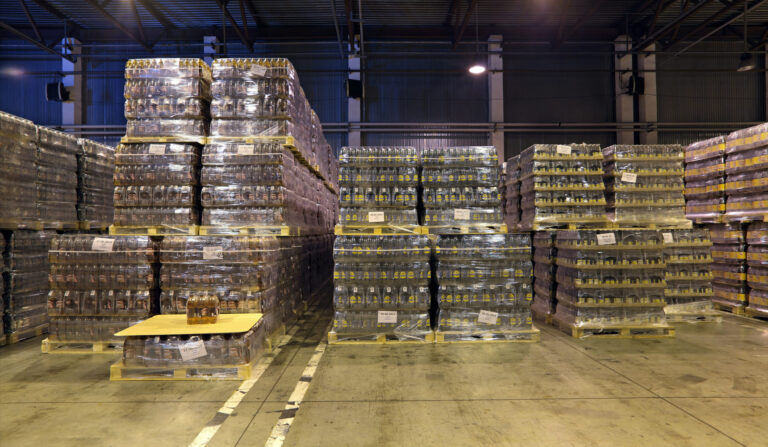
Guide to Top Alcohol 3PL Companies in Los Angeles
Third-party logistics (3PL) providers handle warehousing and distribution on behalf of brands, including specialized cases like alcoholic beverages. In the Los Angeles area, a major U.S. trade hub, partnering with a local 3PL can cut delivery times and costs. A Los Angeles 3PL warehouse stores, picks, and ships products (wine, beer, spirits) under strict compliance. […]
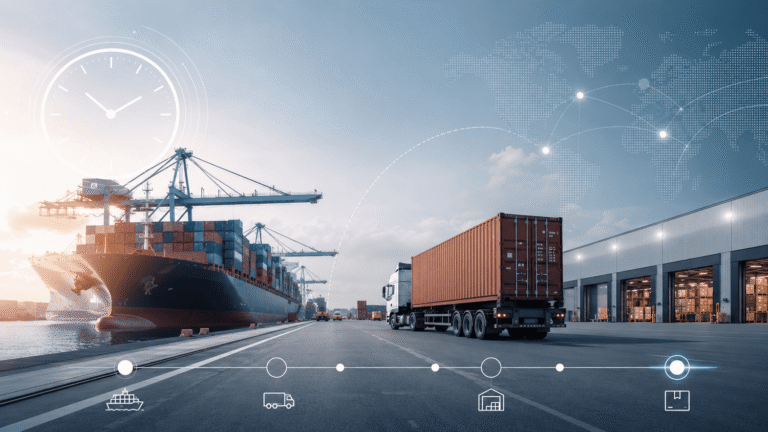
What Is Just-in-Time Shipping and How Does It Work in Container Logistics?
Just-in-time shipping is a logistics model that moves materials, containers, and cargo as close as possible to the moment they are actually needed. In practice, it reduces inventory and storage costs by synchronizing suppliers, carriers, ports, and inland delivery around a tight delivery window. What Is Just-in-Time Shipping and Logistics? At its core, just-in-time shipping […]

What Is Putting Global Supply Chains Under Pressure in 2026?
Global supply chains are the cross-border networks that move raw materials, components, and finished goods from origin to customer. In 2026, those networks are under unusual pressure because slower trade growth, geopolitical fragmentation, shipping-route instability, resource concentration, and tougher compliance rules are all hitting at once. What makes 2026 different for global supply chains? The […]
Ready to streamline your warehousing needs?
Request a quote today and discover how OLIMP's tailored solutions can optimize your operations