What Is Dropshipping? A Comprehensive Guide to E-Commerce Fulfillment, Market Trends, and Operational Strategy
08/31/2026
Dropshipping is an e-commerce retail fulfillment model where an online storefront sells products to consumers without purchasing, warehousing, or physically handling inventory. When a customer places an order, the merchant transfers the transaction details to a third-party supplier, who picks, packs, and ships the product directly to the end buyer.
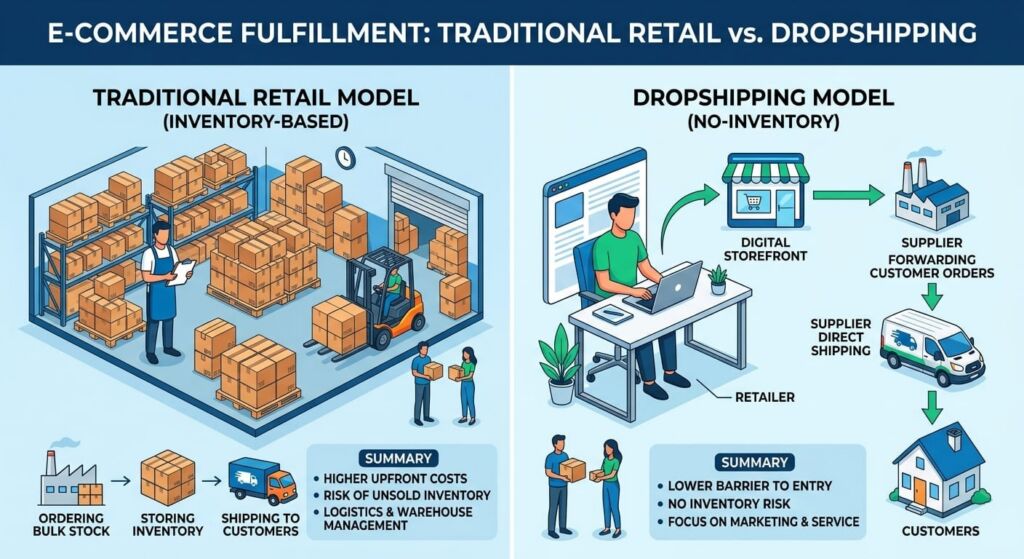
How Does the Dropshipping Fulfillment Model Work?
The dropshipping business model relies on a synchronized supply chain connecting the customer, the retail merchant, and the third-party supplier.
[ Customer ] —> Places Order & Pays Retail Price —> [ Retail Storefront ]
|
[ Customer ] <— Ships Product in White-Label Packaging <— [ Supplier ]
(Keeps Wholesale Difference)
The standard operational workflow functions through a structured multi-step sequence:
- Customer Order Placement: A buyer navigates to the merchant’s digital storefront and purchases a item at the listed retail price.
- Automated Order Routing: The order details, including product specifications and delivery addresses, flow from the e-commerce platform directly to the designated supplier.
- Wholesale Settlement: The merchant pays the supplier the agreed-upon wholesale rate plus fulfillment fees, retaining the remaining price difference as gross profit.
- Supplier Fulfillment: The third-party supplier picks, packages, and dispatches the item directly to the customer using white-label branding to preserve the merchant’s customer-facing business identity.
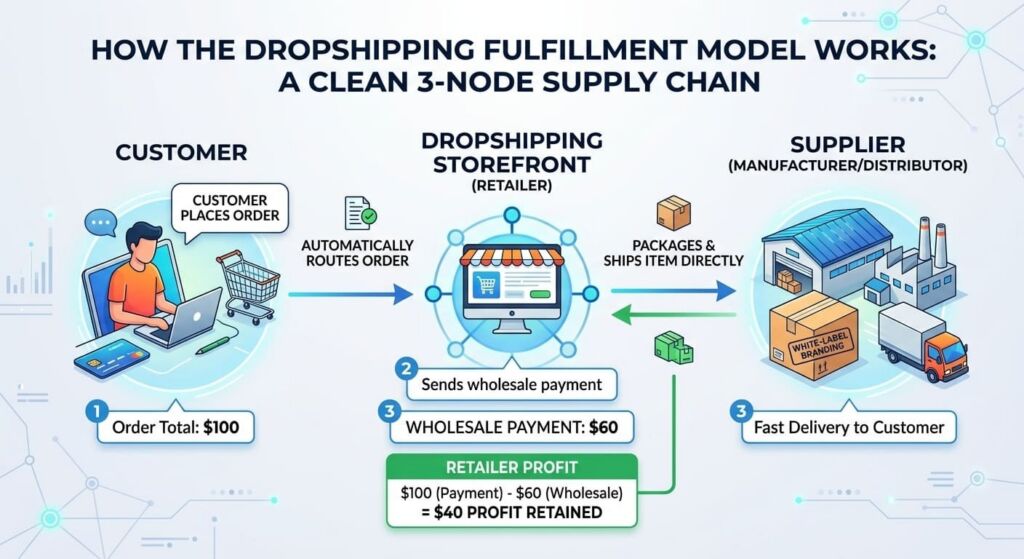
Within digital retail, merchants deploy three distinct fulfillment strategies:
- Product Reselling: Curating specialized products from multiple third-party vendors into a cohesive, niche-specific catalog, such as eco-friendly home goods.
- Business Extensions: Partnering directly with regional brick-and-mortar boutiques or specialty manufacturers to expand their distribution through online channels.
- Product Bundling: Assembling complementary goods from a single supplier into unique consumer kits or DIY sets to optimize order values and logistics.
Pro Tip: AI and Supply Chain Automation
Modern dropshipping operations heavily leverage automated software integrations and artificial intelligence to sync live inventory levels, dynamically adjust pricing, route customer orders, and generate SEO-optimized product copy. Adopting automated workflows eliminates manual order processing errors and protects storefronts from overselling out-of-stock items.
What Is a Simple Dropshipping Example?
Imagine an online store lists a desk organizer for $50.
After a customer buys it, the store pays its supplier:
- $25 for the product
- $7 for shipping
- $3 in payment and platform fees
The store has $15 remaining before deducting advertising, software, refunds, taxes, and other business expenses.
The seller never physically handles the organizer, but the customer still expects the seller to resolve any late delivery, damage, or return.
Did you know? The supplier may be invisible to the customer, but the store remains the face of the transaction. If fulfillment goes wrong, the customer contacts the store-not the factory or wholesaler.
Who Is Responsible for Dropshipping?
| Responsibility | Online seller | Dropshipping supplier |
| Creating and managing the storefront | Yes | No |
| Marketing products | Yes | No |
| Setting retail prices | Yes | Usually no |
| Holding inventory | No | Yes |
| Picking and packing orders | No | Yes |
| Shipping orders | No | Yes |
| Providing tracking information | Communicates it | Generates it |
| Customer service | Yes | May provide support to seller |
| Returns and refunds | Responsible to customer | Depends on agreement |
| Product quality and compliance | Must verify | Must supply compliant goods |
Responsibilities can vary by contract. Before listing a product, the seller and supplier should agree on delivery times, packaging, tracking, stock updates, damaged items, returns, and refund costs.
What Is the Global Market Size and Growth Outlook for Dropshipping?
Driven by expanding internet accessibility, rising smartphone adoption, and the widespread adoption of digital payment infrastructure, the global dropshipping market exhibits robust growth projections across leading industry research organizations.
| Research Firm | 2025 Base Valuation | 2026 Estimated Valuation | Forecasted Market Valuation | Forecast Period | Projected CAGR |
| Straits Research | $471.03 Billion | $604.94 Billion | $4,477.62 Billion | 2026–2034 | 28.43% |
| Precedence Research | $434.98 Billion | $537.81 Billion | $2,898.41 Billion | 2026–2035 | 20.88% |
| Global Market Insights | $290.70 Billion | $343.00 Billion | $1,840.00 Billion | 2026–2035 | 20.60% |
| Research Nester | $418.20 Billion | $514.30 Billion | $3,314.60 Billion | 2026–2035 | 23.00% |
| Grand View Research | $464.40 Billion | $583.50 Billion | $2,180.80 Billion | 2026–2033 | 20.70% |
Regional Market Share Distribution
The Asia-Pacific region dominated the global dropshipping ecosystem with a 36.0% to 38.5% market share in 2025. The region’s market position is bolstered by high manufacturing density, growing disposable incomes, and mobile-first e-commerce expansion across China, India, and Southeast Asia. Alibaba maintains an industry-leading position in this space, capturing over 12.8% of global market share in 2025.
North America stands as the second-largest market, accounting for approximately 32.4% of global revenue in 2025. It is projected to expand at a 22.6% CAGR through 2035, driven by developed digital infrastructure, high consumer spending, and social commerce integration on platforms like TikTok, Instagram, and Facebook.
Emerging regional markets are also showing elevated growth. For example, Brazil’s dropshipping sector is projected to expand at a 20.1% CAGR, propelled by digital payment innovations like the government-backed PIX instant payment system and installment purchasing options (‘parcelamento’).
Leading Product Categories
Product category performance reflects changing consumer purchasing behaviors online:
- Fashion and Apparel: Represents the single largest segment, capturing 26.2% to 37.4% of total market revenue. Low inventory risk enables dropshippers to adapt rapidly to fast-changing seasonal fashion trends.
- Consumer Electronics and Media: Represents the second-largest category, driven by frequent product upgrades and global manufacturing standards. While generating higher gross value per order, electronics require clear customer service workflows due to higher return rates.
- Food, Personal Care, and Niche Goods: Projected to experience steady growth (up to 23.6% CAGR), sustained by recurring consumer demand and wellness trends.
Did You Know? Dropshipping in Established Enterprise Retail
Market analysis indicates that over 27% of active online retailers utilize dropshipping as an operational fulfillment channel. Rather than being limited to startups, established brands deploy dropshipping to test product demand before committing capital to bulk inventory, protect against holiday surge stockouts, and ship heavy, fragile, or high-value goods directly from specialized supplier facilities.
How Do Dropshipping Businesses Make Money?
Dropshipping businesses make money by selling products at a higher price than the total cost of sourcing and delivering them.
A basic calculation is:
Net profit = selling price − product cost − shipping − transaction fees − advertising − returns − operating expenses
A high markup does not automatically mean a product is profitable. Sellers should calculate the complete landed cost and consider:
- Supplier product price
- Domestic or international shipping
- Customs duties and import charges
- Marketplace commissions
- Payment processing fees
- Advertising cost per sale
- Ecommerce software subscriptions
- Refunds, chargebacks, and replacements
- Customer support expenses
- Taxes and regulatory costs
Products with frequent returns, expensive shipping, or intense price competition may generate sales without generating meaningful profit.
What Are the Key Advantages and Operational Challenges of Dropshipping?
While dropshipping lowers entry barriers for new retailers, operational success requires navigating specific trade-offs between capital efficiency and supply chain control.
Strategic Advantages
- Capital Efficiency: Eliminates the need for upfront capital investment in bulk wholesale stock, physical warehouse leases, or fulfillment labor.
- Agile Market Testing: Merchants can introduce, test, and pivot new product lines-such as pet accessories or fitness gadgets-without taking on inventory write-off risks.
- Location and Operational Flexibility: Storefronts can be managed remotely from anywhere, scaling sales volume without facing immediate fulfillment bottleneck constraints.
- Inventory Buffer Protection: Established stores can integrate dropshipping suppliers to fulfill orders during unexpected demand surges or supplier disruptions, preserving revenue and customer satisfaction.
- Specialized Inventory Management: Products that are bulky, fragile, expensive, or require specialized storage conditions (e.g., light-sensitive or temperature-controlled items) can be fulfilled directly by equipped manufacturers.
Operational Challenges
- Compressed Net Margins: Because third-party wholesale pricing includes supplier processing and handling markups, retailers face lower profit margins compared to direct bulk purchasing.
- Supply Chain and Fulfillment Dependence: Storefronts remain accountable to customers for supplier errors, package tracking delays, stock discrepancies, or product defects.
- Return and Logistics Costs: In categories like high-tech electronics, product returns can eat 5% to 10% of gross margin due to unrecoverable digital ad spend and double shipping costs.
Which E-Commerce Platforms Are Best for Dropshipping Operations?
Selecting an e-commerce platform impacts software integration options, order automation capabilities, platform transaction fees, and operational scalability.
| Platform | Recommended Store Scale | Core Advantages | Ecosystem & Sourcing Integrations | Strategic Considerations |
| Shopify | Startups to Mid-Market | User-friendly store creation, automated tax calculations, rich app marketplace | Integrated with Shopify Collective, Print-on-Demand, and supplier market apps | Platform subscription fees and cumulative monthly third-party app expenses |
| BigCommerce | Growing Brands to Enterprise | Strong built-in B2B functionality, multi-channel syncing, low reliance on add-ons | Direct sync with dropship apps, Grepsr review extraction integration | Steeper initial configuration setup for non-technical users |
| WooCommerce | Custom & Open-Source | Complete site ownership, zero software licensing platform fees, flexible customization | Open-source WordPress ecosystem, custom API integrations | Requires self-managed web hosting, security maintenance, and site optimization |
| Amazon | Marketplace Sellers | Immediate access to high buying traffic, robust infrastructure | Integrated seller ecosystem, automated distribution options | Strict policy enforcement, seller competition, marketplace fee structures |
How Can You Start a Dropshipping Business?
1. Choose a Specific Market
Focus on a customer group or problem rather than selecting random trending products. A focused niche makes it easier to create relevant content, advertising, and product recommendations.
2. Research Product Demand
Use keyword data, competitor research, marketplace trends, customer reviews, and social conversations to evaluate demand. Look for products with a clear purpose, manageable shipping costs, and room for differentiation.
Avoid relying only on viral product lists. By the time a product appears on every “winning product” page, competition may already be high.
3. Find Reliable Dropshipping Suppliers
Evaluate potential suppliers based on:
- Product quality
- Processing and delivery times
- Warehouse locations
- Real-time inventory updates
- Tracking capabilities
- Packaging options
- Return and replacement procedures
- Per-order and membership fees
- Customer support responsiveness
- Product safety documentation
- Marketplace authorization
Ask for a written agreement explaining responsibilities, charges, service expectations, and how customer information will be used.
4. Calculate Unit Economics
Estimate profit after every direct and indirect cost. Test different scenarios for increased advertising costs, refunds, supplier price changes, and shipping surcharges.
A product should still make financial sense when conditions are less than perfect.
5. Build the Online Store
Create accurate product pages with original descriptions, realistic images, clear delivery estimates, and transparent policies. Avoid copying the supplier’s generic descriptions if competitors use the same content.
A trustworthy store should clearly display:
- Contact information
- Shipping timeframes
- Return and refund policies
- Privacy information
- Accepted payment methods
- Product specifications
- Customer support options
6. Connect Orders and Inventory
Dropshipping software can automatically route orders, update tracking information, and synchronize stock levels. Automation reduces manual work, but sellers should still monitor canceled orders, inventory discrepancies, and late shipments.
7. Market and Improve the Business
Potential marketing channels include SEO, paid search, social media, email, influencer partnerships, and educational content. Track profit by product-not just traffic, orders, or revenue.
What Is the Difference Between Dropshipping and 3PL Fulfillment?
Dropshipping and third-party logistics both outsource order fulfillment, but inventory ownership is different.
| Factor | Dropshipping | Ecommerce with a 3PL |
| Inventory purchase | Usually after receiving an order | Purchased in advance |
| Inventory owner | Usually the supplier | The ecommerce business |
| Storage location | Supplier’s facility | 3PL warehouse |
| Upfront inventory cost | Low | Higher |
| Product and packaging control | Limited | Greater |
| Unsold inventory risk | Low | Higher |
| Potential for branded packaging | Depends on supplier | Usually greater |
| Suitability | Testing and low-volume sales | Proven products and growing volume |
Traditional ecommerce with a 3PL requires more working capital, but it can provide better control over inventory, branding, delivery, and returns. Our guide to ecommerce vs. dropshipping explains these differences in more detail.
Pro tip: Consider a hybrid fulfillment strategy. Dropship new or uncertain products, then purchase successful products in bulk and move them to a warehouse or 3PL once demand becomes predictable.
How Do Retailers Build a Sustainable Dropshipping Strategy?
Scaling a dropshipping business from initial product research to a profitable e-commerce enterprise requires disciplined niche selection, supplier evaluation, and regulatory compliance.
1. Niche Selection and Competitor Auditing
Entering overly broad markets forces merchants into direct price competition with major retailers. Target micro-niches yield higher conversion rates and lower customer acquisition costs. Retailers validate demand by analyzing search volume trends using tools like Google Trends and Facebook Audience Insights.
For example, eBike Generation generated over $3 million in sales by focusing specifically on an underserved niche: electric bikes tailored for hunters. Similarly, focusing on specialized niches like vegan dark chocolates allows merchants to target selective audiences with less market saturation.
2. Supplier Vetting and Quality Assurance
A retailer’s brand reputation depends on supplier reliability. When auditing potential third-party supplier partners, merchants should evaluate operational standards:
- Red Flags: Suppliers charging ongoing monthly membership fees to access inventory catalogs, vendors selling directly to the public at retail prices, or those with opaque return policies.
- Quality Markers: Vendors operating centralized fulfillment centers with fast processing times, dedicated B2B support teams, transparent tracking data, and clear sample ordering options.
3. Financial Unit Economics and Pricing Models
To maintain profitability, storefronts must calculate comprehensive net margin economics. The net margin calculation must account for supplier wholesale fees, platform processing rates, digital advertising acquisition costs (CAC), and return reserves:
Net Margin=Retail Price-Wholesale Cost-CAC-Shipping Fees-Platform FeesRetail Price
While average dropshipping profit margins range between 10% and 30%, high-ticket items like consumer electronics yield higher dollar profits per order ($114 on average) but carry higher return rates that must be factored into financial models.
4. Cross-Border Tax and Regulatory Compliance
Operating an international dropshipping business requires adhering to cross-border trade regulations. Merchants shipping goods to international customers must manage import tariffs and accurately assign Harmonized System (HS) customs codes to prevent delivery delays. For sales into the European Union, retailers must comply with specific Value Added Tax (VAT) rules, often registering under the Import One-Stop Shop (IOSS) scheme to handle cross-border tax collection cleanly at checkout.
Pro Tip: Mitigating Split Shipments
When a customer orders multiple items that originate from different suppliers, the items ship in separate packages. This doubles shipping fees for the store and creates a fragmented delivery experience for the customer. Designing curated product bundles sourced exclusively from a single supplier ensures orders ship in a single package, lowering fulfillment costs.
Operational Roadmap for Modern E-Commerce Merchants
Dropshipping continues to serve as an accessible business model for new entrepreneurs and an efficient expansion mechanism for established online retailers. Long-term business viability depends on selecting focused product niches, establishing transparent supplier partnerships, leveraging AI-driven store automation, and maintaining strict compliance with cross-border trade standards. Store owners should begin by conducting keyword research to validate product demand, ordering product samples to audit supplier fulfillment speeds, and modeling net unit profit economics before scaling ad spend.
Frequently Asked Questions (FAQ) – OLIMP Warehousing
Q: What is dropshipping and how does it work?
Dropshipping is an e-commerce fulfillment model where an online store sells items without keeping them in stock. When an order is placed, the store purchases the item from a third-party supplier who ships it directly to the customer.
Q: Is dropshipping still profitable in 2026?
Yes, dropshipping remains profitable, with the global market projected to maintain double-digit annual growth rates. However, profitability requires moving away from generic product catalogs toward curated micro-niches, automated store workflows, and strong customer retention strategies.
Q: What is the average profit margin for a dropshipping business?
Average net profit margins for dropshipping storefronts typically range between 10% and 30%. Final profit margins depend on digital ad costs, supplier contract terms, shipping fees, and return management.
Q: How much capital is required to start dropshipping?
Capital requirements are lower than traditional retail because inventory is purchased only after a customer pays. Initial costs generally consist of e-commerce platform subscriptions, custom domain registration, sample ordering, and initial advertising budget.
Q: What are the main supplier red flags to avoid?
Key supplier red flags include ongoing monthly membership fees to browse catalogs, suppliers that sell directly to the public at retail prices, long unverified shipping lead times, and an absence of clear return or error-handling policies.
Q: How do Shopify and BigCommerce compare for dropshipping?
Shopify offers an accessible setup with an extensive app ecosystem, making it ideal for solopreneurs and rapidly growing businesses. BigCommerce features strong built-in multi-channel integrations, native B2B capabilities, and lower reliance on paid third-party applications.
Q: What cross-border tax obligations affect dropshipping?
Cross-border dropshipping requires compliance with international tariff laws, accurate HS customs coding, and regional tax obligations. Merchants selling to European Union consumers often utilize the Import One-Stop Shop (IOSS) registration framework to simplify VAT collection and customs clearance.
You may be interested in

Freight Shipping Guide for Growing Brands: Reduce Costs & Deliver Faster
Shipping becomes more complex as your ecommerce or retail brand grows. Once your products exceed parcel‑carrier limits, packages heavier than 150 pounds are considered freight, you must navigate new modes, pricing models and logistics partners. Choosing the wrong mode or failing to optimize packaging and contracts can erode margins, while a strategic freight program shortens delivery […]

Best Practices for Warehouse Receiving Processes
Warehouse receiving is the essential first step of warehouse operations – it encompasses everything from unloading inbound deliveries to updating inventory records. In practice, an effective warehouse receiving process means checking in, inspecting, and storing all incoming goods promptly and accurately. How inventory is received at a warehouse sets the tone for the rest of […]

What Are The Main Benefits Of Urban Distribution Centers?
What are distribution centers? A distribution center is a logistics facility designed to store, manage, and efficiently distribute goods to various destinations, such as retail stores, wholesalers, or directly to customers. These centers are essential in the supply chain, acting as hubs for receiving, organizing, and dispatching products to ensure timely delivery. Their strategic locations […]
Ready to streamline your warehousing needs?
Request a quote today and discover how OLIMP's tailored solutions can optimize your operations