What Is Just-in-Time Shipping and How Does It Work in Container Logistics?
07/30/2026
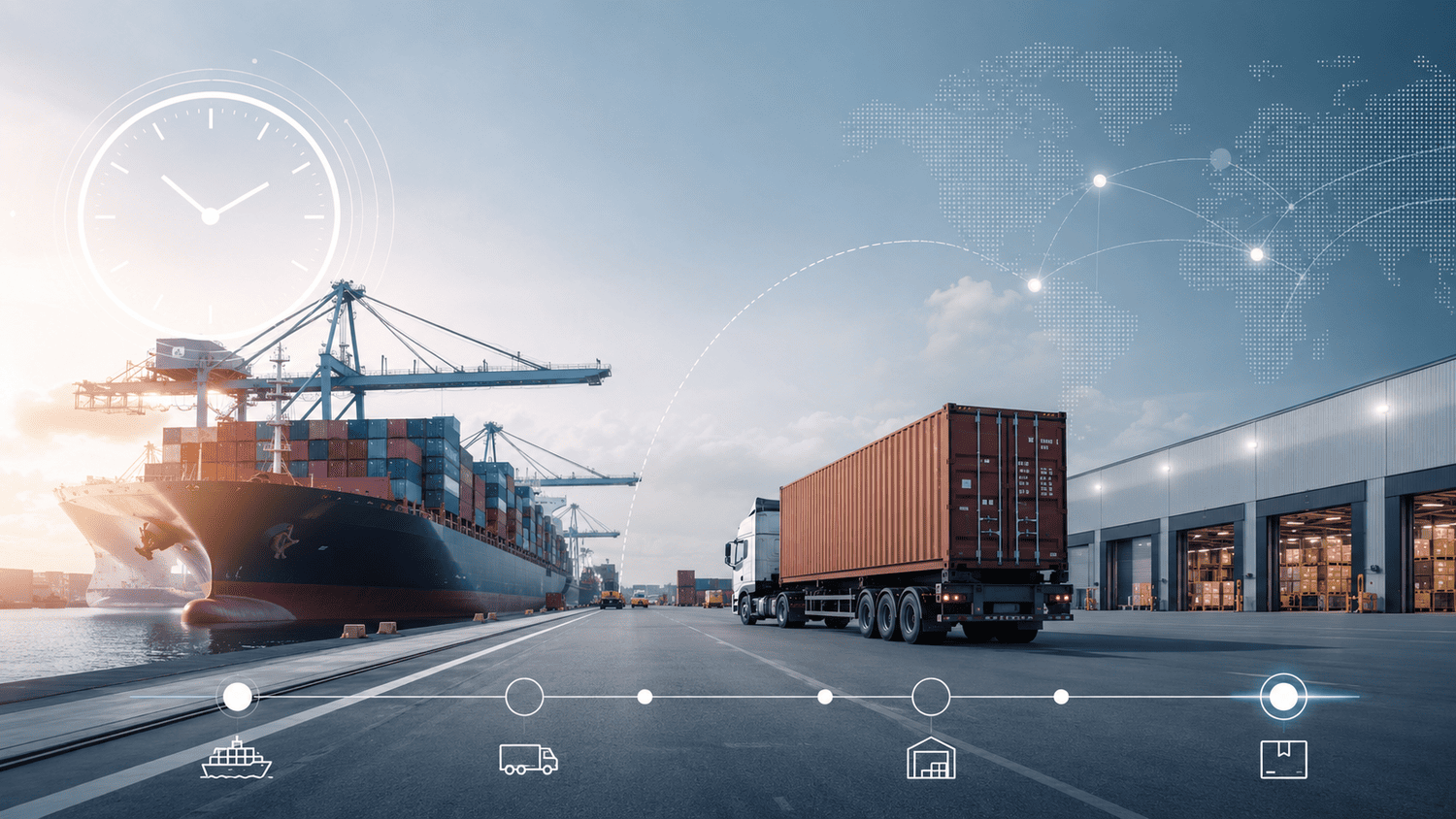
- Just-in-time shipping means receiving goods only when they are needed, rather than carrying large buffer inventories.
- Just in time container shipping applies that principle to ocean freight by aligning factory dispatch, vessel schedules, port handling, customs, drayage, and warehouse receiving.
- In maritime operations, just-in-time arrival also means a ship adjusts speed to reach port when berth, fairway, and nautical services are available instead of arriving early and waiting at anchor.
- The biggest benefits are lower inventory carrying costs, less waste, and better cash flow. The biggest risks are forecast errors, supplier delays, port disruption, cyber outages, and chokepoint volatility.
Just-in-time shipping is a logistics model that moves materials, containers, and cargo as close as possible to the moment they are actually needed. In practice, it reduces inventory and storage costs by synchronizing suppliers, carriers, ports, and inland delivery around a tight delivery window.
What Is Just-in-Time Shipping and Logistics?
At its core, just-in-time shipping is a transportation and inventory strategy built around precise timing. Goods, materials, or components are delivered when they are needed for production, fulfillment, or another stage of the supply chain, rather than arriving too early and sitting in storage.
That same principle expands into just in time logistics, which covers more than transportation alone. It coordinates purchasing, order planning, inventory management, shipping, warehouse operations, and production schedules so that goods move through the supply chain at the right time and in the right quantity.
The related terms have slightly different meanings:
- Just-in-time shipping: Scheduling freight deliveries based on actual operational or production needs.
- Just in time logistics: The broader strategy of coordinating procurement, transportation, inventory, warehousing, and fulfillment around demand.
- Just in time container shipping: Applying JIT principles to ocean containers, including vessel schedules, port handling, customs clearance, drayage, and final delivery.
- Just in time cargo logistics: Using the same timing-focused approach across different cargo modes, including ocean, truck, rail, and air freight.
A simple way to understand JIT is that instead of relying on large amounts of inventory as a safety buffer, businesses rely on accurate planning, real-time visibility, reliable transportation, and close coordination between supply chain partners. This can make operations more efficient and reduce unnecessary storage, but it also requires strong execution because delays can have a greater impact when little backup inventory is available.
How Does Just in Time Container Shipping Work?
In containerized freight, just in time container shipping is not a single event. It is a chain of tightly coordinated handoffs. A delay at one stage can quickly affect the rest of the supply chain, so accurate timing and communication are essential.
A typical just in time container shipping process looks like this:
- A customer order or production schedule triggers a purchase order.
- The supplier prepares only the required quantity and ships it according to a defined schedule.
- Ocean booking, customs documentation, terminal planning, drayage, and warehouse appointments are coordinated around the same receiving window.
- During the ocean journey, the vessel may adjust its arrival time so it reaches the port when the berth and required services are available, rather than arriving too early and waiting outside the port.
- Once the container is discharged, it moves inland by drayage or rail and is delivered directly to a production facility, cross-dock, or scheduled warehouse receiving appointment.
For example, a manufacturer importing components from overseas may schedule a container to arrive on Monday morning, clear customs the same day, move by drayage that afternoon, and support Tuesday’s production run. If the vessel or berth schedule changes, the drayage appointment, warehouse slot, and production plan may also need to be adjusted.
This is why just in time container shipping depends on more than fast transportation. It requires accurate shipment visibility, coordinated schedules, reliable partners, and the ability to respond quickly when delays occur.
What Are the Biggest Benefits of Just in Time Cargo Logistics?
The main reason companies adopt just in time cargo logistics is efficiency. By reducing the amount of inventory sitting idle, businesses can lower warehousing costs, free up working capital, and keep goods moving more closely in line with actual demand.
The biggest benefits usually include:
- Lower inventory carrying costs. Keeping less stock on hand can reduce expenses related to storage, handling, insurance, and the risk of products becoming obsolete.
- Better cash flow. Companies can purchase and move goods closer to the point when they are actually needed instead of tying up money in large inventories months in advance.
- Less waste. JIT helps reduce overstocking, unnecessary handling, long waiting times, and excess inventory.
- Faster identification of problems. With less buffer inventory, quality issues, supplier delays, and process inefficiencies become visible sooner, allowing teams to respond more quickly.
- More efficient transportation planning. When shipments are closely aligned with production and receiving schedules, companies can improve coordination between suppliers, carriers, warehouses, and customers.
- Potential sustainability benefits. In maritime logistics, better arrival planning and reduced waiting times can help lower unnecessary fuel consumption and emissions. Containerships can reduce fuel consumption and CO2 emissions by about 14% per voyage on average when JIT arrival is applied across the full voyage. Even applying JIT only over the last 12 hours of a voyage showed savings of 4.23%.
In other words, JIT is not only a cost model. In the right lanes, it can also become a service and sustainability model.
What Are the Risks of Just-in-Time Logistics?
The biggest weakness of just-in-time logistics is simple: it removes much of the extra inventory and time buffer from the supply chain. When everything runs smoothly, this creates efficiency. But when one critical supplier, transportation route, or operational process fails, there is less room to absorb the disruption.
The major risks include:
- Demand forecasting errors. If demand rises unexpectedly, lean inventory levels may not be enough to meet customer or production needs before replenishment arrives.
- Supplier concentration and limited visibility. Relying heavily on a small number of suppliers can increase risk, especially when businesses have limited visibility into problems deeper within the supply chain.
- Port and trade-lane disruptions. Geopolitical tensions, extreme weather, congestion, and pressure at major shipping chokepoints can extend transit times and increase costs.
- Cyber and systems risk. JIT operations depend heavily on connected systems, shipment data, forecasting tools, and real-time communication. A cyberattack, software outage, or data failure can quickly disrupt tightly scheduled cargo flows.
- Operational delays with little cushion. Labor shortages, customs delays, terminal congestion, weather events, equipment problems, or missed drayage appointments can interrupt production or fulfillment faster when there is little backup inventory available.
For this reason, many companies no longer treat pure JIT as the right strategy for every product or shipment. Instead, they combine just-in-time logistics with selective safety stock, alternative suppliers, backup transportation options, and stronger supply chain visibility.
The goal is not to abandon JIT, but to balance efficiency with resilience so that one unexpected delay does not disrupt the entire operation.
How Can You Implement JIT Without Making Your Supply Chain Fragile?
The most effective just-in-time logistics strategy is usually selective rather than absolute. The goal is to use JIT where demand is predictable and transportation is reliable, while protecting high-risk or critical items with additional resilience measures.
A strong JIT implementation usually includes five key steps:
- Segment your inventory. Use tighter JIT rules for stable, predictable products and maintain limited safety stock for high-risk, critical, or highly variable items.
- Map supplier risk beyond direct suppliers. Identify potential single points of failure and understand where disruptions could occur deeper in the supply chain.
- Invest in shared visibility. Connect order, inventory, transportation, capacity, and shipment data so teams can identify delays before they turn into production stoppages or stockouts.
- Coordinate the full port-to-door journey. For container freight, JIT works best when booking, ETA updates, customs clearance, terminal handling, drayage, and receiving appointments are managed as one connected process.
- Create exception playbooks. Define backup carriers, alternative routes, emergency inventory options, and rebooking procedures before a disruption occurs.
For companies adopting just in time logistics for the first time, it is often better to start small. Test the strategy with one shipping lane, supplier group, or product category. Once the data, transportation timing, and response process are proven reliable, the model can be expanded gradually.
The goal is not to eliminate every buffer. It is to use inventory, transportation capacity, and backup options strategically while keeping the supply chain as lean and efficient as possible.
If you want leaner inventory without turning every delay into a crisis, start by tightening one inbound flow, measuring it closely, and scaling JIT only where your suppliers, carriers, and container lanes are consistently reliable.
Frequently Asked Questions (FAQ) – OLIMP Warehousing
Q: What is just-in-time shipping?
Just-in-time shipping is the practice of moving materials or finished goods so they arrive as close as possible to the moment they are needed, instead of sitting in inventory for long periods.
Q: What is the difference between just-in-time shipping and just-in-time logistics?
Just-in-time shipping focuses on transport timing, while just-in-time logistics covers the wider system: purchasing, inventory, warehousing, transport, and production coordination.
Q: How does just in time container shipping reduce costs?
It lowers inventory carrying costs, reduces storage needs, and can improve capital efficiency by shrinking the amount of stock held between origin and point of use.
Q: What are the main risks of just in time cargo logistics?
The biggest risks are forecast errors, supplier or port delays, cyber outages, and global trade disruptions that leave you with too little buffer inventory.
Q: Is just-in-time logistics still relevant today?
Yes, but most companies now use it more selectively. The trend is toward balancing JIT efficiency with resilience, visibility, and limited buffers for critical items.
Q: Does JIT help sustainability?
It can. Leaner inventory reduces waste, and in maritime transport, just-in-time vessel arrivals can cut fuel burn and emissions by reducing unnecessary waiting and speed inefficiency.
Q: What technology supports just in time logistics?
Accurate forecasting, shipment visibility, shared supply chain data, ETA management, and port-call coordination tools all support JIT execution and help teams respond to delays earlier.
You may be interested in
How AI Is Driving New Warehouse Demand in Data-Center Logistics
Data-center logistics refers to the specialized supply chains for deploying servers, racks, cooling units and other critical hardware under tight timing and security requirements. As generative AI and cloud services expand, companies are building more and larger data centers, which in turn drives unprecedented demand for warehousing that can handle these high-value assets. Below we break […]

Planning for Chinese New Year 2026: How U.S. Importers Can Navigate Major Logistics Disruptions
Chinese New Year (Lunar New Year or Spring Festival) 2026 begins on February 17 (the Year of the Horse). This holiday is Asia’s biggest annual manufacturing shutdown, with official holidays likely Feb 17–23. In practice, factories begin closing weeks early and resume slowly, so the supply chain impact often stretches roughly mid-January through early March. […]
What Are the 5 Types of Logistics? A Complete Guide for Businesses
Logistics is how products, information, and materials actually move through a supply chain—from suppliers, to warehouses, to customers, and even back again. For freight brokers, carriers, shippers, retailers, and manufacturers, understanding the five main types of logistics is essential to controlling costs, improving delivery performance, and keeping customers happy. In this guide, we break down […]
Ready to streamline your warehousing needs?
Request a quote today and discover how OLIMP's tailored solutions can optimize your operations