What Is Putting Global Supply Chains Under Pressure in 2026?
07/17/2026
- 2026 is a complexity shock, not just a cost shock. The world is dealing with slower trade growth, renewed policy uncertainty, energy risk, route changes, and stricter trade rules at the same time.
- Trade is still global, but it is being rewired. OECD says global value chains still account for about 70% of international trade, while UNCTAD says firms and governments are actively reconfiguring those chains around geopolitics and resilience.
- Shipping is more fragile than it looks. Red Sea disruptions added days to transit times, Panama has adjusted drafts again in 2026, and Drewry’s container index has climbed to its highest level since September 2024.
- The next bottlenecks are strategic inputs. Critical minerals remain heavily concentrated, new export controls are spreading, and the AI build-out is making trade more import-intensive and more sensitive to hardware availability.
Global supply chains are the cross-border networks that move raw materials, components, and finished goods from origin to customer. In 2026, those networks are under unusual pressure because slower trade growth, geopolitical fragmentation, shipping-route instability, resource concentration, and tougher compliance rules are all hitting at once.
What makes 2026 different for global supply chains?
The short answer is overlap. Supply chains have handled pandemics, inflation spikes, and isolated shipping disruptions before. What makes 2026 stand out is that several types of risk are arriving together: slower global growth, more tariffs, more regulatory friction, vulnerable shipping chokepoints, and tighter competition for strategic materials. That combination is why 2026 feels less like a temporary disruption and more like a structural test of supply chain resilience. This is an inference from the pattern across current trade, logistics, and policy data.
WTO’s March 2026 outlook put baseline world merchandise trade volume growth at 1.9% in 2026, down from 4.6% in 2025. Under its higher-energy-price scenario, trade growth would slow further to 1.4%. UNCTAD also expects global growth to remain subdued at about 2.6% in 2026. That matters because weaker growth leaves less room for error: delays, rerouting, or new tariffs hit harder when demand is already softer.
At the same time, this is not a story of deglobalization in the simple sense. OECD says global value chains still account for roughly 70% of international trade, and that trade linked to value chains remained at record levels in 2024. In other words, supply chains are not disappearing. They are becoming more selective, more regional in some places, and more politically shaped than they were a few years ago.
How are geopolitics and trade policy reshaping supply chains?
Trade policy is now a supply chain variable, not just a government variable. UNCTAD says tariffs rose in 2025, especially in manufacturing, and governments are expected to keep using them in 2026 for industrial and strategic goals. The same UNCTAD update says around 18,000 new discriminatory trade measures have been introduced since 2020, while technical regulations now affect roughly two thirds of global trade. For importers and exporters, that means more landed-cost uncertainty, more documentation, and more country-by-country compliance work.
There is also a direct investment effect. WTO notes that FDI in tariff-exposed and global-value-chain-intensive sectors was projected to fall by 25% for 2025, with textiles, electronics, and machinery among the affected sectors. That is a major warning sign because supply chains do not become more resilient when investment in core production networks slows. They become more fragile, more concentrated, or simply more expensive to duplicate.
Still, the answer is not blanket reshoring. OECD’s modeling shows that efforts to relocalize supply chains could cut global trade by more than 18% and lower global real GDP by more than 5%, without consistently improving stability. That is an important reality check for executives: resilience usually comes from diversification, visibility, and speed of response, not from trying to make every supply chain local.
Why are shipping routes and freight rates still so fragile?
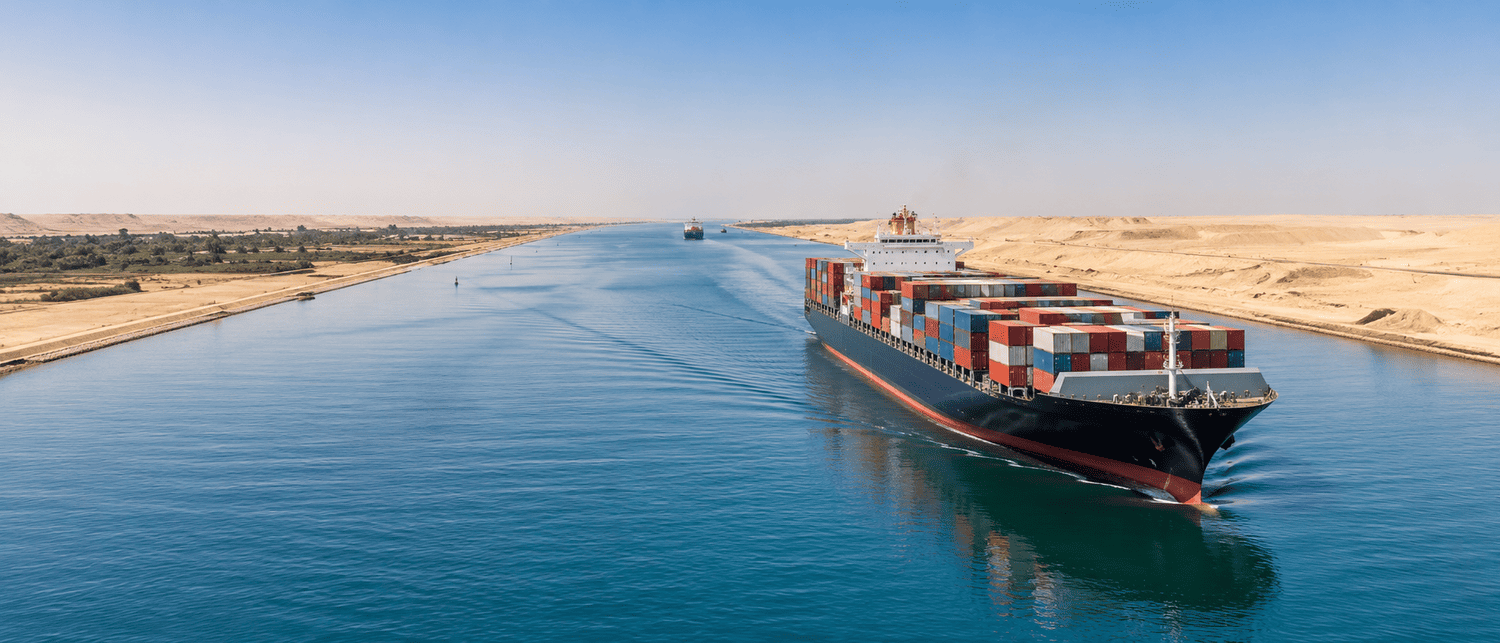
Two maritime chokepoints explain a lot of today’s stress. Suez Canal normally carries about 15% of global maritime trade volume, and that Red Sea attacks pushed many vessels to reroute around the Cape of Good Hope, adding 10 days or more to delivery times on average. In early 2024, PortWatch data showed trade through the Suez Canal down 50% year over year, while Panama Canal trade fell by nearly 32%. Those earlier shocks still matter because they changed routing habits, buffer strategies, and carrier decisions that continue to shape 2026.
The Red Sea story also shows why 2026 is a year of operational uncertainty rather than full normalization. Reuters reported in July 2026 that Maersk was resuming some Suez Canal services, with expected transit-time improvements of about seven days westbound and up to 14 days eastbound. That is good news, but it also confirms that carriers are still actively redesigning routes in response to security conditions.
Panama remains a climate-linked supply chain risk. In a June 2026 advisory, the Panama Canal Authority said it would reduce the maximum authorized draft for Neopanamax vessels to 15.09 meters effective July 3, 2026, citing hydrological conditions and the potential development of El Niño. Even when the canal avoids broader transit cuts, draft changes can alter how much cargo ships can carry and how operators plan voyages.
The Strait of Hormuz has added another layer of cost risk in 2026. War-risk insurance premiums for ships transiting the strait rose sharply during the crisis, increasing from about 0.125% of a vessel’s insured value to roughly 0.2%–0.4% per transit. For a very large oil tanker, that could add around $250,000 in insurance costs for a single voyage. These costs can quickly feed into tanker rates, fuel prices, and broader transportation expenses across global supply chains.
Freight pricing reflects that fragility. Drewry’s World Container Index rose to $4,639 per 40-foot container on July 9, 2026, its highest level since September 2024. Drewry also described the East-West market as volatile, with Middle East tensions and security concerns around the Strait of Hormuz adding uncertainty. For shippers, that means routing decisions and freight budgets still need active weekly management, not passive annual planning.
Why are critical minerals, AI demand, and traceability becoming the next bottlenecks?
The next big supply chain pressure point is not just where goods move. It is what the world depends on to make them. UNCTAD says critical mineral supply chains remain highly concentrated: in 2025, the Democratic Republic of the Congo accounted for 74% of global cobalt mine production, China produced 78% of the world’s natural graphite, and Australia, Chile, and China together supplied more than 70% of global lithium. That level of concentration makes price, policy, and geopolitical risk much harder to absorb.
The policy response is already intensifying. Nearly 100 export-related measures on critical minerals have been introduced since 2020, including licenses, taxes, and export bans. Traceability is becoming more important, but companies still face barriers such as high implementation costs, limited interoperability, and the difficulty of transmitting information across complex and geographically concentrated supply chains. That means the supply chain challenge is now twofold: secure the material, then prove where it came from and how it moved.
AI is adding a newer layer of pressure. Investment is the most import-intensive part of GDP, and recent AI-related investment appears to have an import intensity of 70% to 90%. As firms and governments keep investing in AI systems, servers, electronics, networking gear, and related infrastructure, global trade becomes more exposed to the availability of specialized hardware and upstream inputs. In simple terms, the AI boom is not replacing supply chain pressure. It is adding to it.
What should companies do now to strengthen supply chain resilience?
The most practical response is to stop treating resilience as a generic slogan and start treating it as a deliberate supply chain design choice.
- Map beyond tier-one suppliers. Companies need visibility deeper into their supplier networks. If you do not know which parts of your supply chain depend on Suez-sensitive routes, Panama-sensitive shipping lanes, or critical materials concentrated in a single country, you may not fully understand your exposure.
- Build tariff and route scenarios into procurement planning. In 2026, changes in trade policy, tariffs, and shipping routes can affect landed costs almost as quickly as changes in commodity prices. Procurement teams should regularly model alternative sourcing and transportation scenarios.
- Diversify intelligently, not symbolically. Resilience does not necessarily mean moving every supplier closer to home. A more effective strategy is to reduce excessive dependence on a single supplier, country, transportation route, or critical input while maintaining flexibility across the network.
- Invest in traceability and compliance systems early. This is becoming especially important for electronics, batteries, energy technologies, and products exposed to critical mineral, sustainability, or supply chain due-diligence requirements.
- Carry targeted buffers, not blanket inventory. When delays and transit-time volatility affect specific lanes or materials, selective safety stock can protect service levels without creating unnecessary inventory costs across the entire network.
The companies best positioned to succeed in 2026 will not be those waiting for global supply chains to “go back to normal.” They will be the ones building supply chains designed for a world where volatility, disruption, and rapid change are part of normal operations.
Frequently Asked Questions (FAQ) – OLIMP Warehousing
Q: Is 2026 worse than the pandemic for supply chains?
Not in the same way. The pandemic created a broad, sudden shutdown shock. In 2026, the bigger issue is simultaneous pressure from trade policy, chokepoints, energy risk, compliance, and strategic-input concentration.
Q: Are global supply chains deglobalizing?
Not exactly. OECD says supply chains still account for about 70% of international trade. The better description is that they are being rewired around resilience, geopolitics, and regional priorities.
Q: Why does the Red Sea still matter in 2026?
Because it is still a core Asia-Europe route. Suez normally handles about 15% of global maritime trade volume, and carriers are only gradually restoring some services through the corridor.
Q: What industries are most exposed right now?
Electronics, machinery, batteries, clean-energy technologies, and any sector that relies on critical minerals or complex cross-border component flows are especially exposed. WTO and UNCTAD both highlight electronics, machinery, and critical mineral-linked supply chains as key pressure points.
Q: What is the smartest supply chain strategy for 2026?
For most firms, it is diversification plus visibility: map deeper suppliers, qualify alternatives, watch tariffs and freight weekly, and improve traceability instead of relying on a single reshoring bet.
You may be interested in
How E‑commerce Is Reshaping U.S. Logistics Real Estate in 2026
The e‑commerce boom continues to transform how goods move through the U.S. supply chain. As online penetration climbs toward 20 % of global retail sales by 2026, digital retailers and their logistics partners are racing to secure warehouse space. Research by Prologis shows that e‑commerce companies will account for nearly a quarter of all new […]
Third‑Party Fulfillment: Save Money & Scale Faster
Outsourcing order fulfillment isn’t just a logistics decision; it’s a strategic move that can lower costs, save time and help you expand into new markets. According to the U.S. Chamber of Commerce, working with a third‑party fulfillment provider reduces costs by leveraging the provider’s infrastructure and negotiated carrier rates. At the same time, logistics costs […]
What is Drayage? Definition, Meaning & Types in Shipping
As global trade continues to expand, the demand for efficient drayage services is growing rapidly. With the drayage services market projected to increase by over $2.4 billion between 2024 and 2029, this critical component of the supply chain is becoming even more essential. In logistics terms, a drayage service means handling the transport of a […]
Ready to streamline your warehousing needs?
Request a quote today and discover how OLIMP's tailored solutions can optimize your operations