AI in Logistics & Supply Chain: A Practical Guide for Shippers, 3PLs and Warehouse Operators
02/11/2026
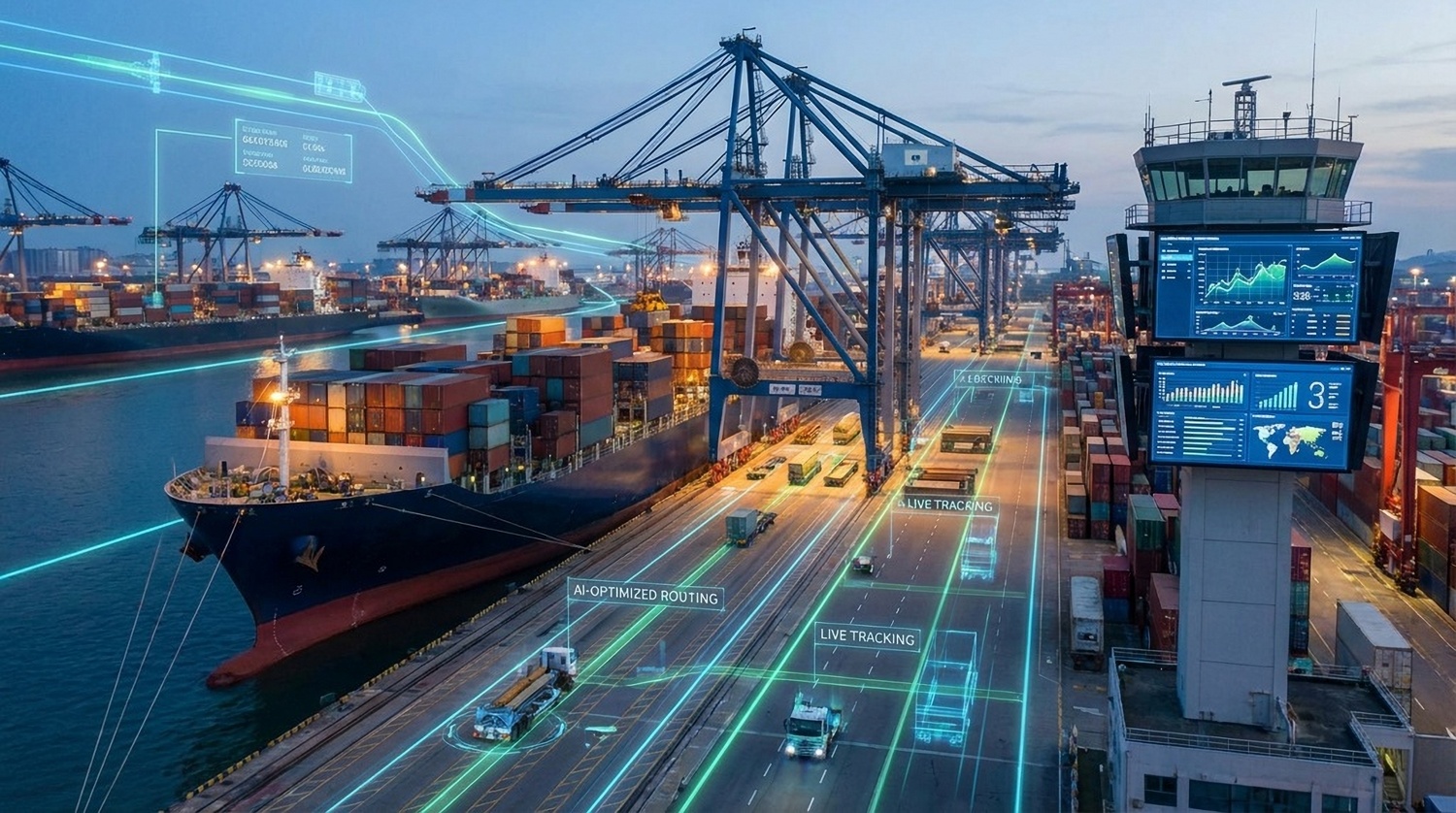
- AI adoption is accelerating: Research by Strategic Market Research shows the global AI in supply‑chain market was worth about US$7.3 billion in 2024 and is expected to grow to US$63.8 billion by 2030, an annual growth rate of ~42 %. More recent market reports estimate that the AI in logistics market reached US$21.70 billion in 2025 and will soar to US$435.61 billion by 2033. The broader AI in supply‑chain market is projected to rise from US$13.81 billion in 2026 to about US$236.42 billion by 2035. Logistics companies cannot afford to ignore a technology with this level of market momentum.
- Intelligent forecasting, routing and automation deliver measurable value: Studies report 15–25 % cost reductions and 10–20 % fuel savings for fleets using AI‑powered route optimisation. Warehouse automation continues to scale – the global market was.
- Generative AI and digital twins are going mainstream: AI models trained on large volumes of shipping data now outperform classical algorithms and generalise across route sizes and service levels. Digital twins simulate thousands of “what‑if” scenarios, allowing logistics operators to stress‑test networks and identify the most sustainable, cost‑effective designs.
- AI reduces environmental impact: A World Economic Forum/McKinsey report finds that optimised routing, capacity utilisation and modal shifts can cut freight‑sector emissions by 10‑15 % without massive infrastructure changes. Route optimisation alone often yields.
- Challenges remain: High costs, data quality issues, workforce adaptation and ethical considerations hinder adoption. Only 23 % of logistics AI systems currently provide explainability of their decisions. Yet the shift to subscription‑based platforms and plug‑and‑play AI tools is lowering barriers to entry.
Most conversations about artificial intelligence (AI) in logistics still focus on futuristic concepts. Yet AI is no longer confined to research labs; it’s a practical tool delivering real business results today. Market analysts forecast that the global AI in supply‑chain market will grow from US$7.3 billion in 2024 to US$63.8 billion by 2030. DataM Intelligence reports that the AI in logistics market already reached US$21.7 billion in 2025 and is projected to reach US$435.6 billion by 2033, while Precedence Research predicts the broader AI in supply‑chain market will increase from US$13.8 billion in 2026 to roughly US$236.4 billion by 2035. Meanwhile, more than half of U.S. freight operators already use AI routing.
This guide is written for shippers, third‑party logistics (3PL) providers, warehouse operators and supply‑chain managers who want to understand what AI can do, how to implement it and where it pays off. It distills proven use cases, quantifies benefits and discusses the pitfalls to avoid. Whether you run a 3PL network, manage a distribution centre or oversee procurement, the following sections will help you move from curiosity to action.
What Is AI in Logistics?
Artificial intelligence in logistics refers to machine‑learning, predictive analytics, operations research and generative AI techniques used to automate decision‑making and improve the efficiency of moving goods. AI models analyse historical and real‑time data – including sales, weather and social‑media sentiment – to forecast demand, optimize routes, control robots and generate dynamic pricing. Strategic Market Research notes that AI technologies such as machine learning, natural language processing, computer vision and predictive analytics are being embedded into every link of the supply chain. Compared with traditional optimisation, AI can learn better policies over time and adapt when conditions change.
Key components:
- Data ingestion: IoT sensors, transportation management systems (TMS), warehouse management systems (WMS) and enterprise resource planning (ERP) platforms provide the raw data for AI models.
- Algorithmic engines: Machine‑learning models forecast demand, recommend inventory levels, optimize transport routes and detect anomalies. Generative AI and large language models summarise data, answer queries and generate documents.
- Decision execution: Outputs feed into TMS, WMS or back‑office systems to automate order fulfilment, dispatch sequencing, pricing and customer communication.
How Is AI Used in Supply Chain Management?
AI touches almost every layer of the modern supply chain:
- Demand forecasting and supply planning: By analysing point‑of‑sale data, historical shipments, weather patterns and even social‑media sentiment, AI predicts demand with greater accuracy. These forecasts feed dynamic supply‑chain planning systems that adjust reorder points and production schedules in near real time, reducing stock‑outs and excess inventory.
- Routing and freight optimisation: Routing and freight optimisation: Route optimisation algorithms consider traffic, weather, vehicle capacity and delivery windows to minimise distance travelled and maximise utilisation. Companies deploying AI‑powered routing typically realise 15–25 % cost reductions and 10–20 % fuel savings. A report by the World Economic Forum and McKinsey suggests that smarter routing, capacity utilisation and modal shifts together can cut freight emissions by roughly 10–15 %.
- Supply‑chain visibility and simulation: AI‑enabled control towers aggregate data from procurement, manufacturing and logistics to provide end‑to‑end visibility. Digital twins create virtual replicas of warehouses, fleets or entire networks, allowing planners to run thousands of “what‑if” scenarios without disrupting operations. These models identify bottlenecks, test network redesigns and recommend low‑carbon routes.
- Warehouse automation and back‑office management: Robotics, autonomous mobile robots (AMRs), automated storage and retrieval systems (AS/RS) and computer‑vision inspection are transforming warehousing. The global warehouse automation market was US$31.21 billion in 2025 and is projected to reach US$119.86 billion by 2034. Hardware systems account for ~80 % of revenue and many AMR deployments achieve payback in under 24 months. Amazon’s Sequoia robotic system accelerates inventory identification by up to 75 % and reduces order processing time by 25 %.
- Customer service and sales: AI chatbots now handle real‑time delivery updates, answer FAQs, reschedule shipments and manage overflow during peak periods. A case study from NW People reported that after deploying a chatbot, 60 % of inquiries were automatically resolved in the first month, freeing staff to focus on high‑value tasks. Modern bots integrate with TMS and CRM systems to provide live ETAs, inventory availability and pricing.
- Pricing and revenue management: AI models analyse demand patterns, capacity constraints and competitor rates to generate instant spot quotes and dynamic pricing. Early adopters in freight brokerage report fewer empty miles and improved margins through algorithmic carrier pricing – Uber Freight reduced empty miles from about 30 % to 10‑15 % by matching loads using machine‑learning.
AI Use Cases in Warehousing and Transportation
Demand Forecasting & Supply Planning
- Segmentation and promotion planning: AI can segment customers by behaviour and recommend targeted promotions. The most reliable AI win in 2025 came from improving demand forecasts by integrating a wider mix of external signals, including weather fluctuations, sports schedules, holiday timing and social sentiment. Retailers and consumer‑goods manufacturers reported measurable accuracy improvements when combining these signals with store‑level inventory data. Forecasting models then adjust purchase orders dynamically.
- Inventory optimisation: AI‑driven supply planning ensures the right stock at the right place. Better predictions reduce safety stock and free capital tied up in inventory.
Route Optimisation & Freight Management
- Dynamic route planning: Algorithms update routes in real time based on traffic, weather and delivery windows. 15–25 % cost reductions and 10–20 % fuel savings. AI‑assisted routing proved especially effective during disruptions – routing engines generated alternate scenarios faster than planners could manually rebuild plans when faced with port congestion, regional capacity shortages or weather‑related road closures.
- Load matching and backhaul reduction: Machine‑learning models match multiple shipments to reduce empty backhauls. Uber Freight cut empty miles from 30 % to 10–15 % by algorithmically matching loads. AI‑based load‑matching platforms improved asset utilisation for private fleets and dedicated networks by generating optimal pairing scenarios that humans could quickly approve.
- Sustainability: Optimised routing and better fleet utilisation support sustainability initiatives. The World Economic Forum/McKinsey report indicates AI‑driven routing and modal decisions can reduce freight emissions by 10–15 %.
Supply‑Chain Visibility & Simulation
- Control towers: AI aggregates data from procurement, manufacturing, logistics and customer interactions to provide real‑time dashboards. Better visibility reduces lead times and enables proactive exception management. In 2025, visibility platforms using predictive ETA models and anomaly‑detection algorithms reduced noise by filtering false alarms, clustering related delays and highlighting late‑stage risks.
- Digital twins and simulation: Virtual replicas of warehouses and networks allow planners to test layout changes, capacity expansions and safety‑stock policies without physical disruption. Digital twins help identify fuel‑efficient routes and reduce carbon emissions. Multi‑agent pilots in 2025 successfully recommended targeted inventory moves across distribution centres by monitoring forecast deltas, inbound variability, capacity constraints and safety‑stock thresholds.
Warehouse Automation & Back‑Office Management
- Autonomous mobile robots (AMRs): Robots handle picking, sorting and transport within the warehouse. Research shows that over 75 % of companies expect to implement cyber‑physical systems by 2027, yet nearly 80 % of warehouses remain non‑automated, highlighting a large opportunity.
- Automated storage and retrieval systems (AS/RS): AS/RS improves space utilisation and inventory accuracy through vertical storage and RFID/barcode tracking.
- Computer vision & quality control: AI‑powered cameras inspect goods and packaging for defects, reducing returns and improving safety.
- Back‑office automation: Intelligent document processing automates invoice validation, customs paperwork and proof‑of‑delivery, speeding up billing cycles. Retrieval‑augmented generation and document‑intelligence tools classify customs forms, validate commercial invoices, cross‑check certificates of origin and assign harmonised system (HS) codes, reducing manual review time and improving compliance accuracy.
Customer Service & Sales
- AI chatbots: Bots handle routine inquiries, provide real‑time tracking updates and reschedule deliveries.
- Hybrid support models: Chatbots handle high‑volume, low‑emotion queries (“Where is my parcel?”) while humans manage complex, high‑emotion issues such as damaged goods or customs delays.
- Dynamic pricing & quoting: Machine‑learning models generate instant spot rates and adjust prices based on capacity and demand. Algorithmic pricing eliminates friction and ensures market‑aligned rates.
Benefits of AI for Logistics Companies
- Operational efficiency: AI‑powered forecasting and routing reduce fuel and inventory costs. Combined use cases deliver 10–25 % cost reductions across selling, general and administrative expenses, warehouse management and last‑mile delivery.
- Carbon footprint reduction: AI route optimisation can cut fuel usage by 10–20 % and reduce freight emissions by 10–15 %. Government agencies and industry studies suggest that AI‑powered logistics solutions have the potential to reduce energy consumption in freight transportation by up to 15 %.
- Improved customer experience: Predictive analytics and digital control towers minimise delays and stock‑outs. AI chatbots provide real‑time shipment updates, while generative AI anticipates questions and offers proactive solutions.
- Faster decision‑making: AI models generalise across problem sizes, learning better policies autonomously. Digital twins enable planners to test new network designs rapidly.
- Better utilization of assets: Load‑matching and dynamic pricing improve asset utilisation and reduce empty miles.
- Workforce augmentation: Automating repetitive tasks allows staff to focus on exception management and customer relationships.
- E‑commerce readiness: Rapid growth of e‑commerce is fuelling AI adoption in logistics. As online shopping surges, businesses must handle larger order volumes, deliver on tighter service windows and offer real‑time tracking. E‑commerce expansion is a primary driver for AI adoption because it requires sophisticated routing, inventory management and customer‑experience tools.
Challenges & Limitations of AI Adoption
High costs and ROI concerns: Enterprise‑grade AI logistics platforms require significant investment. Market reports note that high implementation costs and integration challenges remain key barriers, particularly for small and medium‑sized enterprises. While subscription‑based models lower entry barriers, the total cost of ownership can still be high. Careful business‑case analysis and phased pilots are essential.
Data quality & integration issues: AI’s effectiveness depends on the quality and accessibility of data. Many organisations still use only a fraction of their available data and struggle with duplicates and inconsistent formats. Investing in data governance and integration middleware will unlock more value.
Workforce adaptation: AI adoption demands change management. Resistance often stems from fear of job displacement. Upskilling staff to work alongside AI and clarifying how roles will evolve is critical. Hybrid roles such as “customer experience specialists” and “conversational AI analysts” are emerging.
Ethical and privacy concerns: AI models need to be transparent and explainable, especially when decisions affect suppliers and customers. Regulations such as Europe’s AI Act and privacy laws require responsible data use. Security is another concern; AI‑enabled supply chains have experienced more cyber‑attack attempts than traditional systems.
Future Trends & Emerging Opportunities
Generative AI & digital twins: Next‑generation generative models simulate entire logistics networks, enabling real‑time scenario testing and network redesign. Digital twins will become standard tools for capacity planning, sustainability scoring and risk management.
AI‑native workflows within TMS and WMS: Analysts forecast that by 2026, AI will be embedded directly into transportation and warehouse management systems rather than bolted on. Routing engines, slotting modules, replenishment planners and labour forecasting tools will natively surface AI‑driven recommendations, accelerating adoption.
Knowledge‑assisted reasoning: Retrieval‑augmented generation (RAG) and graph RAG will expand beyond document retrieval to full knowledge‑assisted reasoning. They will help logistics planners evaluate multi‑tier supplier networks, facility interdependencies and multimodal routing combinations.
Context retention & persistent AI assistants: Modern context protocols will enable AI systems to remember shipment history, recall supplier performance patterns and maintain continuity across sessions, transforming AI from a one‑off tool into a persistent planning partner.
Autonomous negotiations & network synchronization: AI will begin handling the early stages of procurement and carrier negotiation, issuing RFQs and evaluating bids based on cost, service and emissions. Continuous network synchronization will shift organisations from static weekly plans to event‑aware planning with dynamic safety stock adjustments and daily transportation rebalancing.
AI democratization: Subscription‑based platforms and plug‑and‑play AI modules are lowering the barriers to entry. Solutions that required multi‑million‑dollar investments can now be adopted for US$50 000–150 000 in initial costs, making them accessible to mid‑sized providers.
Sustainability & green logistics: AI will play a central role in sustainability, from route optimisation and dynamic load planning to predictive maintenance and low‑carbon route selection. Environmental scorecards integrated into routing platforms will help carriers earn carbon credits.
Human‑AI collaboration: The future of logistics is not AI‑only. Experts emphasise human‑in‑the‑loop systems, where AI handles the bulk of routine tasks and people focus on exceptions, strategic oversight and relationship management. This shift will create new roles and require cross‑functional collaboration.
Real‑World Examples of AI in Logistics Operations
- Uber Freight – algorithmic routing and pricing: The company uses machine learning to match loads and optimise routes, reducing empty miles from ~30 % to 10–15 %. Its marketplace uses algorithmic carrier pricing to deliver upfront, accurate quotes, removing friction in rate negotiations.
- Amazon – Sequoia robotic system: Amazon’s Sequoia robotics accelerates inventory identification and storage by up to 75 % and reduces order processing time by 25 %.
- DHL & Locus Robotics – autonomous mobile robots: DHL Supply Chain, in partnership with Locus Robotics, surpassed 500 million picks using AMRs across 35 sites by June 2024. The adoption rate is accelerating – the first 10 million picks took 2.5 years, while the most recent 100 million took just 154 days.
- Walmart – automated fulfilment centres: Walmart plans for 65 % of its stores to be serviced by automation and 55 % of fulfilment volume to flow through automated facilities by FY2026, expecting 20 % unit cost improvements.
- Amazon & Locus – picker productivity: Decathlon’s warehouse using Exotec’s Skypod system reduced staff walking distance from 10 km to 1 km per day, compressing order preparation space from 17 000 m² to 5 000 m² and doubling daily order preparation volume.
- AI chatbots – NW People case study: After launching a chatbot to handle logistics customer service, one client saw 60 % of inquiries resolved automatically in the first month, freeing staff to handle high‑value exceptions.
Conclusion – Turning AI Hype into Action
AI has moved from experimental to essential for logistics and supply‑chain management. The technology is reshaping how goods are forecast, stored, shipped and delivered, unlocking cost savings, sustainability gains and customer‑experience improvements. Yet success is not guaranteed. Companies must invest in data quality, start with targeted use cases and build a workforce capable of collaborating with machines.
The commercial opportunity is clear. With the global AI in supply‑chain market expected to grow more than eightfold by 2030 and warehouse automation set to triple within a decade, logistics providers that embrace AI now will secure a lasting competitive advantage.
Frequently Asked Questions (FAQ) – OLIMP Warehousing
Q: How is AI used in logistics?
AI in logistics and supply chain encompasses machine‑learning models for demand forecasting, generative AI for scenario simulation, and operations research for route optimization. It powers chatbots, warehouse robotics and predictive maintenance, helping companies deliver faster and more efficiently.
Q: How does AI improve demand forecasting?
Machine‑learning algorithms combine historical sales, market trends and external signals to predict demand more accurately than traditional forecasting. Better forecasts reduce stock‑outs and excess inventory and feed downstream decisions like routing and production schedules.
Q: What are the costs of implementing AI in logistics?
Enterprise‑grade AI logistics platforms typically cost USD 500 000 to USD 2.5 million to implement, with maintenance adding 15 % – 20 % annually. Cloud‑based SaaS solutions can start from USD 50 000.
Q: How does AI reduce carbon emissions in transportation?
AI‑driven route optimization reduces empty miles and fuel waste. Studies show 20 % – 30 % fuel savings and 28 % emissions reduction through AI routing. Case studies of European fleets report 27 % emissions cuts after adopting AI routing.
Q: What challenges limit AI adoption in logistics?
Key challenges include high implementation costs, poor data quality (organizations use only 23 % of available data), integration issues, workforce resistance and ethical concerns around transparency and bias.
Q: What is the future of AI in logistics?
The next wave will feature generative AI and digital twins for network simulation, democratized AI solutions with consumption‑based pricing, sustainability‑focused routing and human‑AI collaboration.
Q: Are there examples of AI logistics companies?
Yes. Uber Freight uses AI to match loads and optimize routes, cutting empty miles to 10 % -15 %. Many third‑party logistics providers are integrating AI into transportation management, warehouse automation and customer service platforms.
You may be interested in

Blockchain in Supply Chain Management: Transparency and Procurement
Blockchain in supply chain management uses a shared digital ledger to record transactions, product movements, and document history across businesses. It can help authorized partners trace goods, compare records, and investigate discrepancies between purchasing, shipping, and receiving. The technology works best when several organizations need a dependable history of their interactions. Its usefulness still depends […]

Warehouse Automation Trends 2026: AI, Robotics, Orchestration & Sustainability
Warehouse automation has evolved rapidly over the past few years. In 2025 many facilities adopted advanced robotics, AI‑driven analytics and automated storage systems to keep pace with labour shortages and rising e‑commerce volumes. By 2026 the conversation has shifted from why to automate to how to orchestrate multiple technologies across distributed networks. This guide examines […]

Staples Modernizes Fulfillment with Cloud-Based Warehouse Management System (WMS) Upgrade
Facing growing e-commerce and B2B demand, Staples embarked on a major warehouse management system (WMS) overhaul. The goal was to replace its legacy, on-premises WMS – which had become hard to update or integrate – with a modern cloud-based warehouse management system to maintain its 98% next-day delivery promise. The new cloud WMS would modernize […]
Ready to streamline your warehousing needs?
Request a quote today and discover how OLIMP's tailored solutions can optimize your operations